An Exegetical, Historical, and Theological Study of Genesis 14:17–20, Psalm 110, and Hebrews 5–7
Theological Abstract
Melchizedek is among the most enigmatic figures in Scripture. Although appearing in only two Old Testament passages, his person and priesthood become foundational to the Christological argument developed in the Epistle to the Hebrews. His sudden appearance in Genesis, the absence of a recorded genealogy, and the description of his priesthood in Hebrews 7:3 have generated considerable speculation concerning his identity, including interpretations identifying him as an angelic being or a preincarnate manifestation of Jesus Christ. However, a historical-grammatical and biblical-theological examination of the relevant passages, together with archaeological and extrabiblical evidence concerning ancient Jerusalem, provides compelling reasons to understand Melchizedek as a historical king-priest of Salem, most likely the pre-Israelite Canaanite city of Jerusalem subsequently associated with the Jebusites. His significance rests not upon an inherently supernatural identity but upon the historical precedent established by his simultaneous occupation of the royal and priestly offices apart from the Aaronic priesthood. This article examines the historical development of ancient Jerusalem, the significance of Melchizedek's priesthood in Genesis 14, the prophetic union of kingship and priesthood in Psalm 110, the interpretive traditions of Second Temple Judaism, and the theological argument presented in Hebrews. It concludes that Melchizedek is most appropriately understood as a historical person whose priesthood providentially foreshadowed the superior, eternal, and non-Aaronic priesthood of Jesus Christ.
Keywords: Melchizedek, Christology, priesthood, biblical typology, Genesis 14, Psalm 110, Hebrews 7, Aaronic priesthood, Jebusites, Canaanites, ancient Jerusalem, Christophany, messianic prophecy.
Unless otherwise indicated, Scripture quotations are from the New King James Version (NKJV).
Introduction
Few biblical figures have generated as much theological speculation from so little biographical information as Melchizedek. He appears suddenly in Genesis 14 following Abram's military victory over a coalition of kings, blesses the patriarch, receives a tithe from him, and then disappears from the historical narrative.
Centuries later, his name reappears in Psalm 110 in connection with the promise of an everlasting priesthood. It is not until the New Testament, however, that the full theological significance of this otherwise obscure Old Testament figure becomes apparent.
The author of Hebrews devotes considerable attention to Melchizedek in explaining how Jesus Christ could legitimately occupy the office of High Priest despite belonging to the tribe of Judah rather than Levi and having no genealogical connection to Aaron.
Among Christian laypersons, Melchizedek is sometimes understood to be a supernatural figure. Some believe he was an angelic being, while others identify him as a Christophany—a preincarnate appearance of Jesus Christ. These interpretations arise primarily from the unusual language employed in Hebrews 7:3:
“Without father, without mother, without genealogy, having neither beginning of days nor end of life, but made like the Son of God, remains a priest continually.”
At first glance, such a description appears to suggest that Melchizedek possessed an eternal existence. Yet the historical context of Genesis, the ancient history of Jerusalem, the prophetic significance of Psalm 110, and the literary argument of Hebrews provide substantial reasons for an alternative interpretation.
A significant body of biblical scholarship understands Melchizedek as a historical king-priest whose importance lies in the manner in which his priesthood anticipates that of Jesus Christ.
The tendency to emphasize the mysterious aspects of Melchizedek's identity may inadvertently obscure the very reason he becomes so important in the New Testament.
The author of Hebrews is addressing a significant theological question. Under the Mosaic covenant, kingship and priesthood were associated with different tribal and familial lines. The promised Messiah was to descend from David through the tribe of Judah, yet He was also to serve as an everlasting High Priest.
How could Jesus legitimately occupy both offices?
The answer is found in a priesthood that existed long before the establishment of the Mosaic covenant—a priesthood represented by an ancient king of Jerusalem.
The central question, therefore, may not be whether Melchizedek was a supernatural being, but why God providentially preserved the historical account of his priesthood and subsequently employed it to reveal the nature of Christ's eternal ministry.
1. Melchizedek in the Genesis Narrative
The encounter with Abram
The first appearance of Melchizedek occurs in Genesis 14:18–20:
“Then Melchizedek king of Salem brought out bread and wine; he was the priest of God Most High. And he blessed him and said:
‘Blessed be Abram of God Most High,
Possessor of heaven and earth;
And blessed be God Most High,
Who has delivered your enemies into your hand.’
And he gave him a tithe of all.”
The historical context concerns a military conflict involving several ancient Near Eastern kings. Following the capture of Lot, Abram assembled his trained servants, defeated the invading forces, and recovered the captives and their possessions.
Upon his return, Abram encountered two kings: the king of Sodom and Melchizedek, king of Salem.
The contrast between these two rulers is significant. Whereas the king of Sodom negotiated concerning the recovered people and possessions, Melchizedek brought provisions, blessed Abram, and attributed his victory to God Most High.
The narrative presents Melchizedek as a ruler within the historical and geographical setting of the other kings mentioned in Genesis 14. Nothing in the immediate context explicitly identifies him as an angel, a divine manifestation, or a supernatural visitor.
Instead, Scripture identifies him by two offices:
King of Salem.
Priest of God Most High.
Melchizedek is, in fact, the first person explicitly identified as a priest in Scripture.
D. G. Peterson, writing in the New Dictionary of Biblical Theology, understands Melchizedek as a historical figure whose priesthood provides a precedent for the priesthood of Jesus Christ. His simultaneous occupation of the royal and priestly offices was consistent with established patterns of kingship in the ancient Near East.¹
To appreciate the significance of this identification, it is helpful to examine the history of the city over which Melchizedek ruled.
2. The Historical Background of Melchizedek: Jerusalem Before David
Although contemporary readers generally associate Jerusalem with David, Solomon, the temple, and the nation of Israel, the city's history extends considerably further into antiquity.
Jerusalem was an established Canaanite city-state long before the emergence of the Israelite monarchy. Its association with Melchizedek in Genesis 14 is consistent with what is known concerning the political, cultural, and religious characteristics of ancient Near Eastern cities.
Archaeological evidence of pre-Israelite Jerusalem
Archaeological investigations indicate that the site of Jerusalem has been occupied for approximately five thousand years.
Evidence of Early Bronze Age settlement includes domestic structures and pottery, while more substantial remains from the Middle Bronze Age include buildings and defensive fortifications along the southeastern ridge of the ancient city.²
The earliest settlement developed near the Gihon Spring, which provided a dependable source of water. Its elevated position and natural defensive advantages made it suitable for the establishment of a fortified city-state.
This archaeological evidence is particularly relevant to the account of Melchizedek because it demonstrates that Jerusalem possessed an established urban history long before its incorporation into the kingdom of Israel.
The description of Melchizedek as the king of Salem is therefore consistent with the historical and cultural environment of the patriarchal period.
Although archaeology has not independently identified Melchizedek himself, it provides a credible historical setting for the biblical account.
Jerusalem in ancient extrabiblical literature
The antiquity of Jerusalem is further supported by references in ancient Near Eastern literature.
Egyptian texts from the second millennium BC refer to a location commonly identified with Jerusalem under the name Rushalimum.
More securely, the Amarna Letters of the fourteenth century BC identify the city as Urusalim and refer to its local ruler, Abdi-Hepa.³
The Amarna correspondence demonstrates that Jerusalem was an established political entity governed by a local ruler centuries before David's conquest.
Possible references to Jerusalem have also been identified in the Ebla archives and Egyptian Execration Texts, although these earlier identifications remain less certain.⁴
Such evidence does not directly establish the identity of Melchizedek, but it confirms that the biblical description of an ancient ruler governing Jerusalem is historically plausible.
Jerusalem did not suddenly emerge as a significant city during the reign of David. It possessed an established political history extending back centuries before the Israelite monarchy.
The identification of Salem with Jerusalem
Genesis 14:18 introduces Melchizedek as the king of Salem.
Although Genesis does not explicitly identify Salem as Jerusalem, this identification has considerable biblical and historical support.
Psalm 76:1–2 declares:
“In Judah God is known;
His name is great in Israel.
In Salem also is His tabernacle,
And His dwelling place in Zion.”
The parallelism between Salem and Zion provides substantial evidence that Salem was understood as a designation for Jerusalem.
This identification is also reflected in ancient Jewish literature, including the Genesis Apocryphon discovered among the Dead Sea Scrolls and the writings of the first-century Jewish historian Flavius Josephus.⁵
While alternative geographical identifications have occasionally been proposed, the identification of Salem with Jerusalem remains a historically and exegetically persuasive interpretation.
The name Jerusalem itself appears to have originated within the pre-Israelite cultural environment of Canaan. Some scholars associate its original form with Shalem, an ancient Near Eastern deity or divine concept.
This historical possibility should be distinguished from the theological interpretation of Salem presented in Hebrews 7:2, where Melchizedek is described as the “king of peace.”
The author of Hebrews employs the association between Salem and the Hebrew concept of peace to illuminate the typological relationship between Melchizedek and Jesus Christ. His theological argument does not depend upon establishing the original etymology of the city's name.
Melchizedek and Adoni-Zedek: The kings of ancient Jerusalem
An additional historical consideration is the striking similarity between the name Melchizedek in Genesis 14 and the name Adoni-Zedek in Joshua 10.
Joshua 10:1 introduces the latter as follows:
“Now it came to pass when Adoni-Zedek king of Jerusalem heard how Joshua had taken Ai and had utterly destroyed it…”
Adoni-Zedek subsequently organized a coalition of Amorite kings against Gibeon because its inhabitants had established a peace agreement with Israel.
Both Melchizedek and Adoni-Zedek are associated with the kingship of ancient Jerusalem, and both names contain the Hebrew element ṣedeq (צֶדֶק), traditionally associated with righteousness.

Some scholars have suggested that the shared element may reflect a traditional royal naming convention associated with ancient Jerusalem. Others have considered the possibility that the element originally referred to a Canaanite deity named Zedek.⁶
Although the linguistic and religious background of these names remains a matter of scholarly discussion, their similarity is historically noteworthy.
It is particularly significant that two rulers associated with the same ancient city, appearing in different periods of biblical history, possess names containing the same distinctive element.
Scripture does not establish that Adoni-Zedek descended from Melchizedek or that the two belonged to the same royal dynasty. Nevertheless, the similarity provides additional circumstantial support for understanding Melchizedek within the historical tradition of Canaanite kingship in Jerusalem.
Jerusalem and the Jebusites
The biblical record consistently associates pre-Davidic Jerusalem with the Jebusites.
The Jebusites are first identified among the descendants of Canaan in Genesis 10:15–16. They subsequently appear among the peoples occupying the land promised to Abraham (Gen. 15:18–21).
During Israel's conquest and settlement of Canaan, Jerusalem remained a significant Canaanite stronghold.
Joshua 15:63 records:
“As for the Jebusites, the inhabitants of Jerusalem, the children of Judah could not drive them out; but the Jebusites dwell with the children of Judah at Jerusalem to this day.”
Joshua 18:28 explicitly associates Jebus with Jerusalem:
“Jebus (which is Jerusalem), Gibeath, and Kirjath.”
Judges 1:21 similarly states:
“But the children of Benjamin did not drive out the Jebusites who inhabited Jerusalem; so the Jebusites dwell with the children of Benjamin in Jerusalem to this day.”
Although Judges 1:8 records a successful military action against Jerusalem by the tribe of Judah, the continuing presence of the Jebusites indicates that this victory did not result in permanent Israelite control of the city.
The city is again identified with Jebus in Judges 19:10–12, where it is distinguished from cities occupied by the Israelites.
Some scholars have questioned whether Jebus was the city's original name or whether the designation simply identified it as the city of the Jebusites. Regardless, the biblical writers clearly associate Jerusalem with its Jebusite inhabitants.⁷
This historical continuity is significant. Jerusalem remained substantially outside Israelite political control until the establishment of the Davidic monarchy.
Paul Rainbow, in his examination of the Melchizedek traditions preserved at Qumran, identifies the Melchizedek of Genesis 14 as a Jebusite priest-king.⁸ Such an identification is consistent with the broader biblical association of ancient Jerusalem with its pre-Israelite Canaanite inhabitants.
Nevertheless, historical precision requires acknowledging that Genesis 14 does not explicitly identify Melchizedek's ethnicity, nor does the available evidence establish precisely when Jebusite control of Jerusalem began.
The identification of Melchizedek as a Jebusite king is therefore a reasonable historical inference rather than an independently demonstrated fact.
David's conquest of Jerusalem
The decisive transformation of Jerusalem occurred when David captured the city and established it as the capital of his kingdom.
Second Samuel 5:6–7 records:
“And the king and his men went to Jerusalem against the Jebusites, the inhabitants of the land…
Nevertheless David took the stronghold of Zion (that is, the City of David).”
The Jebusites regarded their city as sufficiently secure to resist David's forces. Nevertheless, David captured the stronghold and established his residence there.
The biblical account refers to a water shaft or water system in connection with the conquest. Some interpreters have associated this reference with the Gihon Spring and Warren's Shaft, although the precise identification and dating of these archaeological structures remain debated.⁹
David's conquest brought an ancient Canaanite city under the authority of the Israelite monarchy.
The selection of Jerusalem as the capital was politically strategic. Its location between the territories associated with Judah and the northern tribes made it particularly suitable as the center of a united kingdom.
David subsequently brought the ark of the covenant into Jerusalem, establishing the city not merely as the political capital of Israel but also as the center of its national religious life.¹⁰
David did not found Jerusalem. Rather, he transformed an existing Canaanite city with a long history of local kingship into the political and theological center of Israel.
This historical development provides an important background for understanding Psalm 110.
The city once governed by Melchizedek, a ruler who simultaneously occupied the offices of king and priest, subsequently became the seat of the Davidic monarchy.
Although the Israelite covenant maintained a distinction between the royal and Aaronic priestly offices, the earlier history of Jerusalem provided a recognizable precedent for their union.
A historical chronology of ancient Jerusalem
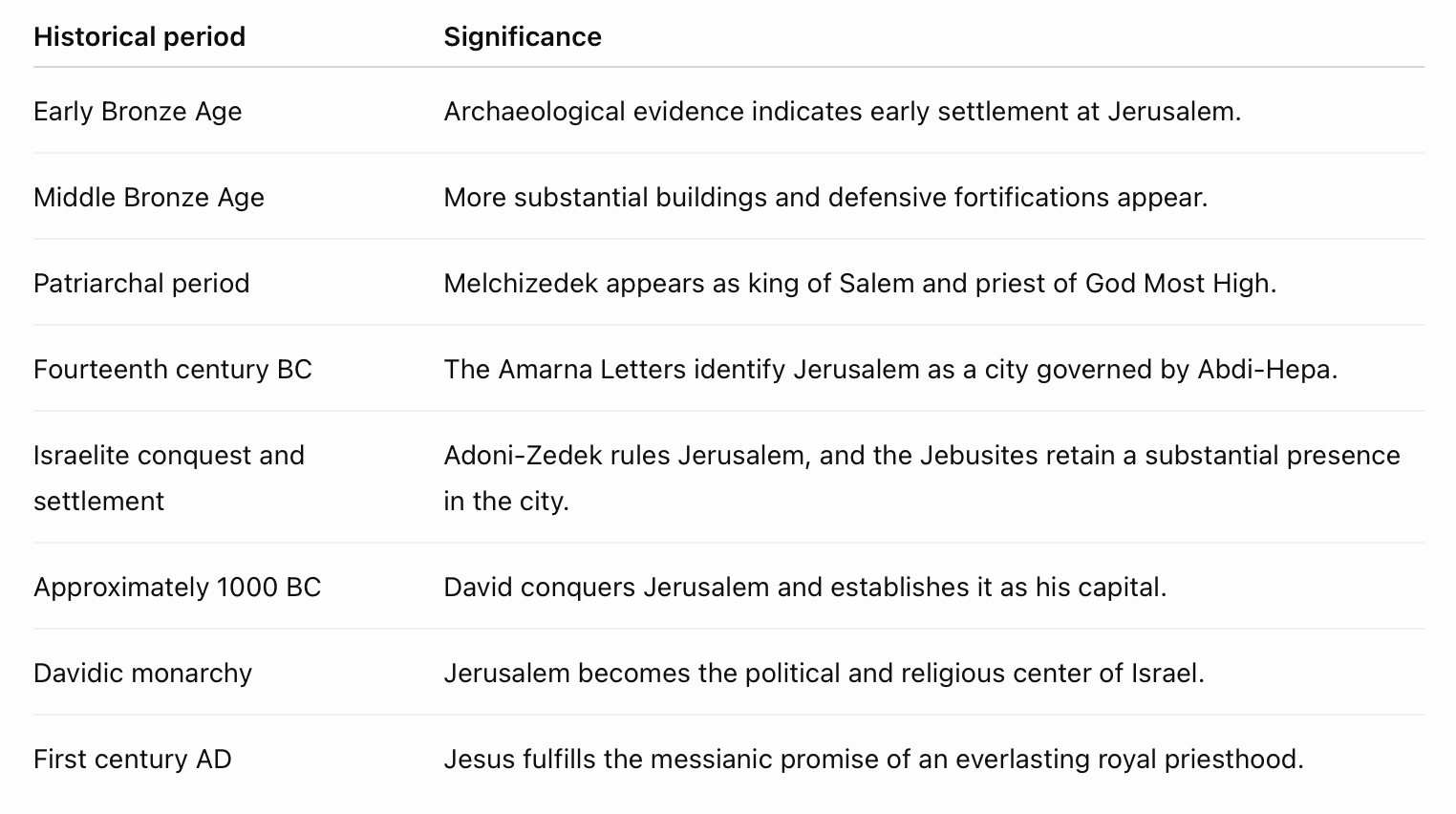
The precise dates of the patriarchal and conquest periods remain debated. Nevertheless, the broad historical progression establishes Jerusalem as an ancient city whose political existence preceded the nation of Israel.
The historical significance of the evidence
The cumulative biblical, archaeological, and historical evidence provides a coherent setting for understanding Melchizedek as a historical king-priest of ancient Jerusalem.
His appearance in Genesis is consistent with the established existence of Canaanite city-states governed by local rulers. His simultaneous occupation of royal and priestly offices is likewise consistent with ancient Near Eastern patterns of sacral kingship.
His association with Salem, the similarity between his name and that of Adoni-Zedek, and the subsequent identification of Jerusalem with the Jebusites collectively support the historical interpretation.
None of these considerations independently proves Melchizedek's personal identity or ethnicity. Taken together, however, they provide substantial reasons for interpreting him as a historical ruler rather than assuming that his appearance represents an angelic visitation or a preincarnate manifestation of Jesus Christ.
3. Melchizedek as a Priest of God Most High
Perhaps more remarkable than Melchizedek's kingship is his identification as a priest of God Most High.
The Hebrew expression translated “God Most High” is El Elyon (אֵל עֶלְיוֹן).
Melchizedek identifies God Most High as the possessor of heaven and earth, attributing Abram's military victory to His divine intervention.
Abram subsequently declares:
“I have raised my hand to the LORD, God Most High, the Possessor of heaven and earth.” — Genesis 14:22
Here Abram explicitly associates God Most High with Yahweh, the God who called him.
Whatever the broader use of such divine titles among ancient Near Eastern peoples, the Genesis narrative presents Melchizedek's blessing and Abram's confession as referring to the same sovereign God.
Abram's willingness to receive Melchizedek's blessing and give him a tenth of the recovered possessions further demonstrates his recognition of Melchizedek's priestly standing.
Robert Letham observes that Scripture provides no explanation of how Melchizedek acquired his priesthood. Nevertheless, Abram's actions demonstrate that his priesthood was recognized as legitimate.¹¹
This is particularly significant because Melchizedek's priesthood existed centuries before the establishment of the Mosaic covenant and the Aaronic priesthood.
Knowledge of God outside the Abrahamic line
Some readers may find it difficult to reconcile Melchizedek's probable Canaanite background with his identification as a priest of the true God.
However, such an objection may arise from projecting the religious conditions of later Canaanite societies backward into the patriarchal period.
The Bible does not teach that knowledge of the true God was confined exclusively to Abraham and his descendants.
Other individuals outside the eventual covenant nation, such as Job and Jethro, demonstrate that knowledge of God was not restricted to Israel.
Indeed, Israel did not yet exist as a nation when Melchizedek encountered Abram.
God's calling of Abraham represented a particular development in His redemptive purposes, but it did not mean that God had previously revealed Himself to no one else.
Melchizedek stands as an especially significant example because Scripture recognizes him not merely as a worshiper of God but as His priest.
The precise historical circumstances through which Melchizedek came to know God and occupy the priestly office remain unknown.
Nevertheless, the biblical narrative establishes the legitimacy of his priesthood without requiring him to belong to Abraham's family or the later nation of Israel.
This becomes foundational to the argument of Hebrews.
4. The Distinction Between Kingship and Priesthood in Israel
To appreciate the theological significance of Melchizedek, it is necessary to understand the distinction between kingship and priesthood under the Mosaic covenant.
In many ancient Near Eastern societies, kings performed religious functions and could occupy both political and priestly offices.
The union of kingship and priesthood was not inherently unusual within the surrounding cultures.
Israel, however, developed a more definite distinction between these offices.
The Aaronic priesthood
Under the Mosaic covenant, God established the priesthood through Aaron and his descendants.
“Now take Aaron your brother, and his sons with him, from among the children of Israel, that he may minister to Me as priest.” — Exodus 28:1
The tribe of Levi was set apart for sacred service, while the priestly office itself was entrusted specifically to Aaron and his descendants.
Numbers 3:10 states:
“So you shall appoint Aaron and his sons, and they shall attend to their priesthood; but the outsider who comes near shall be put to death.”
Priestly legitimacy under this covenant was therefore inseparably connected to divine appointment and genealogical descent.
The importance of genealogy is further illustrated in Ezra 2:61–63, where individuals claiming priestly ancestry were excluded from priestly service because they could not establish their genealogical qualifications.
The Davidic monarchy
The royal line, by contrast, was established through the tribe of Judah.
The prophetic blessing pronounced by Jacob declared:
“The scepter shall not depart from Judah,
Nor a lawgiver from between his feet,
Until Shiloh comes;
And to Him shall be the obedience of the people.” — Genesis 49:10
God subsequently established His covenant with David, promising the enduring establishment of his throne and kingdom (2 Sam. 7:12–16).
Thus, the royal and priestly offices became associated with different tribal and familial lines.

Although Israelite kings occasionally performed certain religious functions, such as blessing the people, sponsoring sacrifices, and overseeing religious reforms, these activities did not grant them unrestricted authority to exercise the Aaronic priesthood.
The example of King Uzziah
The distinction is particularly evident in the experience of King Uzziah.
According to 2 Chronicles 26:16–21, Uzziah entered the temple intending to burn incense upon the altar.
Azariah the priest confronted him, declaring:
“It is not for you, Uzziah, to burn incense to the LORD, but for the priests, the sons of Aaron, who are consecrated to burn incense.” — 2 Chronicles 26:18
Uzziah's royal authority did not authorize him to assume the responsibilities of the priesthood.
His subsequent judgment demonstrates that even a legitimate Davidic king could not simply appropriate the priestly office established through Aaron.
This distinction creates an important theological question concerning Jesus Christ.
If the promised Messiah was to descend from David and belong to the tribe of Judah, how could He also legitimately serve as High Priest?
The answer is found not in an exception to the Aaronic priesthood but in the existence of another order of priesthood altogether.
Melchizedek's historical priesthood demonstrates that the Aaronic system was not the only form of priesthood God had ever recognized.
5. Psalm 110: The Prophetic Union of Kingship and Priesthood
Following his appearance in Genesis, Melchizedek is not mentioned again in the Old Testament until Psalm 110.
This remarkable messianic psalm brings together the concepts of royal authority, divine enthronement, judgment, and everlasting priesthood.
The psalm begins:
“The LORD said to my Lord,
‘Sit at My right hand,
Till I make Your enemies Your footstool.’” — Psalm 110:1
It subsequently declares:
“The LORD has sworn
And will not relent,
‘You are a priest forever
According to the order of Melchizedek.’” — Psalm 110:4
The significance of this declaration cannot be overstated.
The individual addressed in the psalm possesses both royal authority and an everlasting priesthood. Yet this priesthood is not established according to the order of Aaron.
Instead, it is established according to the order of Melchizedek.
The historical relationship between Melchizedek and David
The history of Jerusalem provides a particularly meaningful background for understanding the imagery of Psalm 110.
David captured the ancient city associated with Melchizedek and established it as the political center of his kingdom.
The city that had previously been governed by a king-priest subsequently became the capital of the Davidic monarchy.
Some scholars suggest that Psalm 110 draws upon this earlier Jerusalem tradition of sacral kingship in describing the priestly role associated with the Davidic ruler.¹²
The historical connection is particularly noteworthy.
Melchizedek's kingship and priesthood were not associated with an unrelated geographical location. They were associated with the very city that would eventually become the center of Davidic kingship and Israelite worship.
However, David's conquest of Jerusalem did not itself authorize him to assume the Aaronic priesthood. Nor does Scripture establish that David formally inherited an unbroken succession of Melchizedekian priests.
Rather, the historical association between Jerusalem, kingship, and priesthood provides a meaningful background for the prophetic promise of a ruler in whom these offices would ultimately be united.
The authority for that union rests not upon David's conquest of Jerusalem but upon God's prophetic declaration and irrevocable oath.
The messianic interpretation of Psalm 110
The New Testament consistently identifies Psalm 110 as having messianic significance.
Jesus Himself appealed to the opening verse when questioning the Pharisees concerning the identity of the Messiah:
“If David then calls Him ‘Lord,’ how is He his Son?” — Matthew 22:45
Jesus was not denying His Davidic descent. Rather, He was demonstrating that the Messiah possessed an identity and authority greater than that of an ordinary descendant of David.
Peter similarly employed Psalm 110 in his Pentecost sermon to explain the resurrection and exaltation of Jesus Christ (Acts 2:34–36).
The author of Hebrews repeatedly draws upon the same psalm to establish both Christ's heavenly enthronement and His eternal priesthood.
The messianic King who sits at God's right hand is also the Priest whom God has appointed forever.
In Jesus Christ, the offices that remained institutionally distinct under the Mosaic covenant find their ultimate union.
What is meant by the order of Melchizedek?
The Hebrew expression translated “according to the order of Melchizedek” is ʿal-divrati malki-tsedeq.
The Septuagint renders the expression using the Greek word taxis (τάξις), which may convey the idea of an order, arrangement, or established pattern.
The expression does not necessarily imply the existence of an organized religious institution consisting of successive Melchizedekian priests.
Scripture provides no record of such an institution, no list of Melchizedek's successors, and no genealogical line through which his priesthood was transmitted.
Hebrews 7:15 further clarifies the nature of the relationship by referring to another priest arising “in the likeness of Melchizedek.”
The emphasis is therefore upon the character and pattern of the priesthood rather than an inherited succession of priestly officeholders.
Jesus possesses a priesthood corresponding to the pattern established by Melchizedek, but He does not receive His authority through biological descent from Melchizedek.
A priesthood established by divine oath
Another important feature of Psalm 110:4 is the manner in which the priesthood is established:
“The LORD has sworn
And will not relent.”
The Messiah's priesthood is not dependent upon hereditary succession, political appointment, or human recognition.
It rests upon an irrevocable divine oath.
The author of Hebrews develops this distinction in Hebrews 7:20–22, explaining that Christ's priesthood possesses a superiority corresponding to the divine oath by which it was established.
Melchizedek provides the historical precedent, Psalm 110 supplies the prophetic promise, and Jesus Christ constitutes its ultimate fulfillment.
6. Melchizedek in Second Temple Jewish Literature
The mysterious nature of Melchizedek was recognized long before the development of contemporary Christian interpretations.
During the Second Temple period, Jewish interpreters developed various traditions concerning his identity and theological significance.
These traditions are particularly important because they demonstrate the interpretive environment within which the Epistle to the Hebrews was written.
The Dead Sea Scrolls
Among the documents discovered at Qumran is a fragmentary manuscript commonly designated 11QMelchizedek, or 11Q13.
This document portrays Melchizedek in an eschatological role associated with liberation, judgment, atonement, and deliverance from the forces of evil.
Some scholars interpret the Melchizedek of this document as an exalted angelic figure, possibly the archangel Michael.
Others understand him as a messianic deliverer.
Paul Rainbow challenges the assumption that the Qumran document necessarily identifies Melchizedek as an angel. He argues that a messianic interpretation provides a coherent explanation of the manuscript's contents and its relationship to Genesis 14 and Psalm 110.¹³
The fragmentary condition of the manuscript, however, prevents absolute certainty.
Other Jewish traditions developed additional explanations concerning Melchizedek's origins and identity.
Later traditions sometimes identified him with Shem, the son of Noah, while other writings attributed extraordinary circumstances to his birth or preservation.
These traditions illustrate the extent to which interpreters attempted to supply information absent from the Genesis narrative.
Does Hebrews depend upon these traditions?
The existence of supernatural interpretations within ancient Judaism raises a legitimate question: Did the author of Hebrews adopt a similar understanding of Melchizedek?
Some scholars have argued that the language of Hebrews 7:3 may reflect Jewish traditions concerning a heavenly Melchizedek.
However, the existence of such traditions does not establish that Hebrews depends upon them or endorses their conclusions.
Peterson observes that, when compared with the speculative traditions surrounding Melchizedek, the author of Hebrews demonstrates considerable restraint in his treatment of the biblical material. His argument is grounded in the historical narrative of Genesis and interpreted through the prophetic declaration of Psalm 110.¹⁴
The author does not identify Melchizedek as Michael, attribute supernatural acts to him, describe his heavenly origin, or introduce an alternative account of his birth.
Instead, he concentrates upon the characteristics of Melchizedek's priesthood and their relationship to the priesthood of Christ.
The distinction between the canonical biblical texts and later interpretive traditions is therefore essential.
Extrabiblical literature can illuminate the historical environment of Scripture, but it should not determine the meaning of Scripture independently of the biblical text itself.
7. Melchizedek and the Priesthood of Jesus Christ
The theological importance of Melchizedek becomes most apparent in the Epistle to the Hebrews.
Hebrews was written to demonstrate the superiority of Jesus Christ and the covenant established through Him.
Among its principal arguments is that Christ possesses a superior priesthood, offers a superior sacrifice, ministers in a superior sanctuary, and mediates a better covenant.
Melchizedek becomes central to explaining the legitimacy and nature of this priesthood.
Jesus was not qualified under the Aaronic system
The author of Hebrews openly acknowledges that Jesus did not possess the genealogical qualifications necessary to serve as an Aaronic priest.
“For it is evident that our Lord arose from Judah, of which tribe Moses spoke nothing concerning priesthood.” — Hebrews 7:14
This statement presents an apparent difficulty only if one assumes that the Aaronic priesthood represents the exclusive and permanent form of priesthood recognized by God.
Robert Letham explains that Jesus could not qualify as a priest within Israel's established genealogical system. He belonged neither to the tribe of Levi nor to the family of Aaron. The author of Hebrews resolves this apparent impasse by appealing to the priesthood of Melchizedek.¹⁵
The Genesis narrative demonstrates that God recognized a legitimate priesthood before the establishment of the Mosaic covenant.
Psalm 110 subsequently reveals that the Messiah would occupy a priesthood corresponding to this earlier precedent.
Jesus, therefore, did not become an Aaronic priest through an exception to the Mosaic Law. His priesthood belongs to a different order established by divine appointment.
Christ did not appoint Himself
Hebrews 5:4–6 establishes that legitimate priesthood depends upon God's calling:
“And no man takes this honor to himself, but he who is called by God, just as Aaron was.
So also Christ did not glorify Himself to become High Priest.”
The author then appeals to Psalm 2:7 and Psalm 110:4, bringing together Christ's divine Sonship and His priestly appointment.
Christ's priesthood is therefore neither self-appointed nor dependent upon human ancestry.
It rests upon the authority of the Father.
Just as Melchizedek's priesthood is presented without reference to the Aaronic system, Christ's priesthood is established independently of that system.
Melchizedek's superiority to Abraham and Levi
Hebrews 7:4 invites readers to consider the greatness of Melchizedek:
“Now consider how great this man was, to whom even the patriarch Abraham gave a tenth of the spoils.”
Abraham occupied a foundational position in Israel's covenant history. He was the recipient of God's promises and the ancestor of the nation through whom those promises would unfold.
Yet Abraham acknowledged Melchizedek's priestly standing by giving him a tithe and receiving his blessing.
The author subsequently explains:
“Now beyond all contradiction the lesser is blessed by the better.” — Hebrews 7:7
The argument concerns priestly standing within the encounter rather than an assertion that Melchizedek was morally or spiritually superior to Abraham in every respect.
The author then extends this reasoning to Levi:
“Even Levi, who receives tithes, paid tithes through Abraham, so to speak, for he was still in the loins of his father when Melchizedek met him.” — Hebrews 7:9–10
Levi, the ancestor of Israel's priestly tribe, was represented in Abraham.
Consequently, the Levitical priesthood is portrayed as acknowledging the superiority of Melchizedek's priesthood through its patriarchal ancestor.
The argument prepares the reader to understand why Christ's priesthood, established according to the order of Melchizedek, possesses superiority over the Levitical system.
A necessary change in the priesthood
Hebrews 7:11–12 further develops the argument:
“Therefore, if perfection were through the Levitical priesthood (for under it the people received the law), what further need was there that another priest should rise according to the order of Melchizedek, and not be called according to the order of Aaron?
For the priesthood being changed, of necessity there is also a change of the law.”
The author reasons that if the Levitical priesthood had been capable of accomplishing the ultimate purpose of priesthood, there would have been no need for God to promise another priesthood in Psalm 110.
The prophetic declaration itself demonstrates that the Aaronic priesthood was not intended to constitute the final realization of God's redemptive purposes.
The emergence of another priesthood necessarily involves a change in the legal and covenantal arrangements governing priestly service.
Christ does not merely supplement the existing Aaronic priesthood. He fulfills what the former priesthood could not ultimately accomplish and mediates a better covenant.
8. What Does “Without Father, Without Mother, Without Genealogy” Mean?
Perhaps no passage has contributed more to supernatural interpretations of Melchizedek than Hebrews 7:3:
“Without father, without mother, without genealogy, having neither beginning of days nor end of life, but made like the Son of God, remains a priest continually.”
Taken in isolation, this description appears to suggest that Melchizedek was an eternal being without biological parents.
However, the literary and theological context provides substantial reasons for understanding the language differently.
The absence of a recorded genealogy
Genealogies occupy an important place throughout Genesis.
The book frequently records the ancestry, descendants, ages, and deaths of significant individuals.
Melchizedek, however, appears without any such introduction or conclusion.
Scripture provides no information concerning:
His father or mother.
His ancestral lineage.
The circumstances of his birth.
The duration of his life.
The circumstances of his death.
A priestly predecessor or successor.
This absence becomes particularly significant when contrasted with the genealogical requirements of the Aaronic priesthood.
The author of Hebrews draws theological significance from the manner in which Melchizedek is presented in the biblical narrative.
His priesthood is not introduced as something inherited from his father, nor is its termination or transfer to a successor recorded.
The Greek word agenealogētos (ἀγενεαλόγητος), translated “without genealogy,” is particularly important.
Within the context of Hebrews 7, the absence of genealogy distinguishes Melchizedek's priesthood from one whose legitimacy depended upon hereditary descent.
The issue is not necessarily whether Melchizedek possessed biological ancestry, but whether his priestly authority depended upon a recorded hereditary qualification.
Historical existence and literary presentation
A distinction must be maintained between what was true of Melchizedek as a historical person and how he is presented within the biblical record.
The historical Melchizedek, understood as a human ruler, would have been born, lived, and died like other human beings.
The Melchizedek presented in Genesis, however, enters and leaves the narrative without any recorded beginning or termination of his priesthood.
This literary presentation allows him to function typologically as a representation of an enduring priesthood.
Peterson explains that the absence of genealogical and biographical information in Genesis is especially remarkable in view of the importance of hereditary qualifications for priestly legitimacy. In the providence of God, Melchizedek is presented in a manner that anticipates the eternal priesthood of the Son of God.¹⁶
This interpretation does not require us to conclude that every biblical figure whose birth or death goes unrecorded is eternal.
Rather, the significance of the omission in Melchizedek's case is established by the subsequent prophetic declaration of Psalm 110 and its inspired interpretation in Hebrews.
The author of Hebrews is not merely constructing an argument from silence. He is interpreting the silence of Genesis in light of a subsequent divine revelation concerning the everlasting priesthood of the Messiah.
What does Hebrews 7:8 mean?
A related difficulty occurs in Hebrews 7:8:
“Here mortal men receive tithes, but there he receives them, of whom it is witnessed that he lives.”
Those who understand Melchizedek to be a supernatural being frequently appeal to this verse as additional evidence that he did not experience death.
However, the statement must be considered in conjunction with the author's earlier description of Melchizedek and the scriptural testimony upon which his argument rests.
The Levitical priests are known to have died and been replaced by their successors. Melchizedek, by contrast, is presented in Scripture without a recorded death or termination of his priesthood.
Within the historical-typological interpretation, the author continues to reason from the canonical presentation of Melchizedek rather than introducing an independent historical claim that the ancient king never died.
The contrast reaches its ultimate fulfillment in Christ, whose continuing life is not merely a feature of His literary presentation but a reality grounded in His resurrection and indestructible life.
“Made like the Son of God”
One of the strongest indications that Melchizedek and Jesus Christ are distinct persons appears in the latter portion of Hebrews 7:3:
“But made like the Son of God.”
The Greek expression aphōmoiōmenos (ἀφωμοιωμένος) conveys the idea of being made like or resembling another.
The direction of the comparison is significant.
Melchizedek is made like the Son of God.
The author does not say that Melchizedek was the Son of God, but that he was made to resemble Him.
This language is consistent with biblical typology, in which a historical person, institution, or event providentially anticipates a greater fulfillment.
Melchizedek's priesthood resembles that of Christ without being identical to it.
Hebrews 7:15 reinforces this distinction by speaking of “another priest” arising “in the likeness of Melchizedek.”
The natural force of these comparisons favors the understanding of Melchizedek as a distinct historical person whose priesthood anticipates Christ's.
Although these expressions do not render every alternative interpretation logically impossible, they provide substantial exegetical reasons for distinguishing the historical king-priest from the eternal Son of God.
9. Was Melchizedek a Christophany?
A Christophany is understood in Christian theology as a manifestation of the Son of God prior to His incarnation.
Many evangelical interpreters understand certain Old Testament appearances of the Angel of the LORD to represent such manifestations.
The question, therefore, is not whether preincarnate appearances of Christ are possible, but whether the biblical evidence warrants identifying Melchizedek as one.
The arguments supporting a Christophany
Those who identify Melchizedek as the preincarnate Christ generally appeal to several characteristics:
His description as having neither beginning of days nor end of life.
His apparently perpetual priesthood.
His superiority to Abraham.
His identification as king of righteousness and king of peace.
His presentation of bread and wine.
These characteristics are certainly compatible with important aspects of Christ's identity and ministry.
However, compatibility with Christological imagery does not establish personal identity with Christ.
Indeed, such correspondences are precisely what one would expect of a biblical type.
The difficulties with identifying Melchizedek as Christ
Several considerations weigh against the Christophany interpretation.
First, Genesis presents Melchizedek as the king of a recognizable geographical location within an otherwise historical narrative.
Second, the history of ancient Jerusalem provides a credible cultural and political setting for his kingship.
Third, his priesthood is described without any explicit identification of him as a divine being.
Fourth, Hebrews distinguishes Melchizedek from the Son of God by describing him as resembling the Son.
Fifth, Hebrews 7:15 speaks of another priest arising in Melchizedek's likeness.
Finally, the historical-typological interpretation provides a coherent explanation of the entire biblical argument without requiring the introduction of an otherwise unmentioned divine manifestation.
If Melchizedek were Christ Himself, the language of resemblance and the introduction of another priest would become considerably less straightforward.
Under the historical interpretation, however, the progression is natural: an earlier priesthood anticipates the greater priesthood that would subsequently be established through Jesus Christ.
The historical interpretation also takes seriously the fact that Melchizedek's kingship is associated with an actual ancient city.
While a supernatural manifestation could theoretically occur within a historical setting, Genesis does not provide an explicit indication that the king of Salem was anything other than the historical ruler it describes.
The significance of the bread and wine
Melchizedek's presentation of bread and wine has frequently been interpreted as anticipating the Lord's Supper.
Given the importance of bread and wine in the New Testament, the association is understandable.
Nevertheless, Genesis does not explicitly identify these provisions as a sacrifice or sacramental act.
Within the historical context, they may simply represent hospitality and refreshment offered to Abram following his military campaign.
Furthermore, the author of Hebrews does not appeal to the bread and wine in developing his argument concerning Melchizedek.
His emphasis rests upon the blessing of Abraham, the receiving of tithes, the nature of Melchizedek's priesthood, and the divine oath recorded in Psalm 110.
While Christians may recognize a meaningful theological association between the bread and wine and later biblical imagery, the association should not be presented as conclusive evidence that Melchizedek was the preincarnate Christ.
10. Was Melchizedek an Angelic Being?
The angelic interpretation similarly arises from the unusual language of Hebrews 7:3 and certain traditions associated with Second Temple Judaism.
However, the canonical account provides little affirmative evidence for identifying Melchizedek as an angel.
Genesis presents him as a king and priest rather than as a heavenly messenger.
Moreover, the broader argument of Hebrews establishes the superiority of the Son of God over angels.
Hebrews 1:5 asks:
“For to which of the angels did He ever say:
‘You are My Son,
Today I have begotten You’?”
The author subsequently explains that Christ became like His brethren so that He might serve as a merciful and faithful High Priest (Heb. 2:17).
The incarnation is foundational to Christ's priestly ministry because He represents humanity before God.
Understanding Melchizedek as a historical human priest is therefore consistent with the broader theological framework of Hebrews.
Although some scholars regard a heavenly interpretation as possible in light of ancient Jewish traditions, the canonical evidence does not require such a conclusion.
The historical interpretation remains more persuasive because it accounts for the explicit identification of Melchizedek in Genesis, the historical setting of ancient Jerusalem, and the typological argument developed in Hebrews without introducing an identity that Scripture never directly attributes to him.
11. Understanding Biblical Typology
Biblical typology recognizes that God providentially employs historical persons, events, and institutions to anticipate greater realities subsequently revealed in His redemptive purposes.
A type is not merely an imaginative resemblance constructed by later interpreters. Legitimate biblical typology is grounded in meaningful correspondences within the unfolding revelation of Scripture.
The New Testament provides several examples.
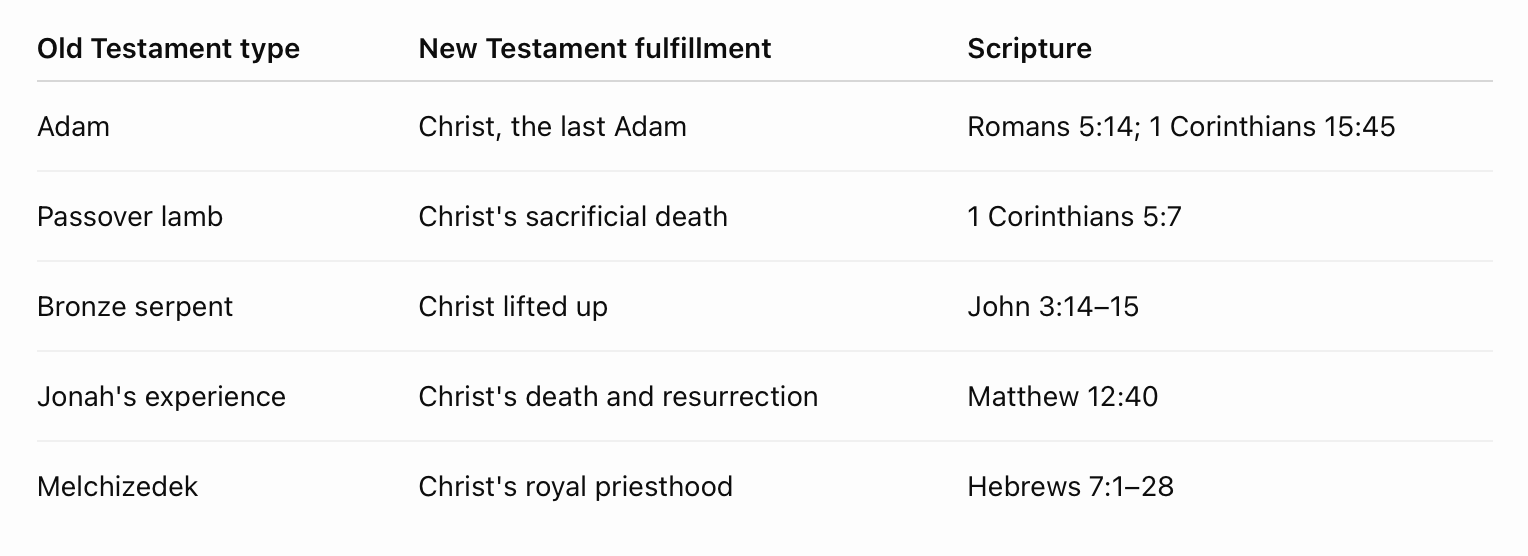
Adam was not Jesus Christ. Neither was the Passover lamb literally Christ.
These historical persons and institutions possessed characteristics that anticipated greater redemptive realities.
Similarly, Melchizedek need not have been Jesus Christ in order to foreshadow Him.
Indeed, the distinction between the historical type and its ultimate fulfillment is central to understanding biblical typology.
Melchizedek as a type of Christ
The correspondences between Melchizedek and Jesus Christ are particularly significant.
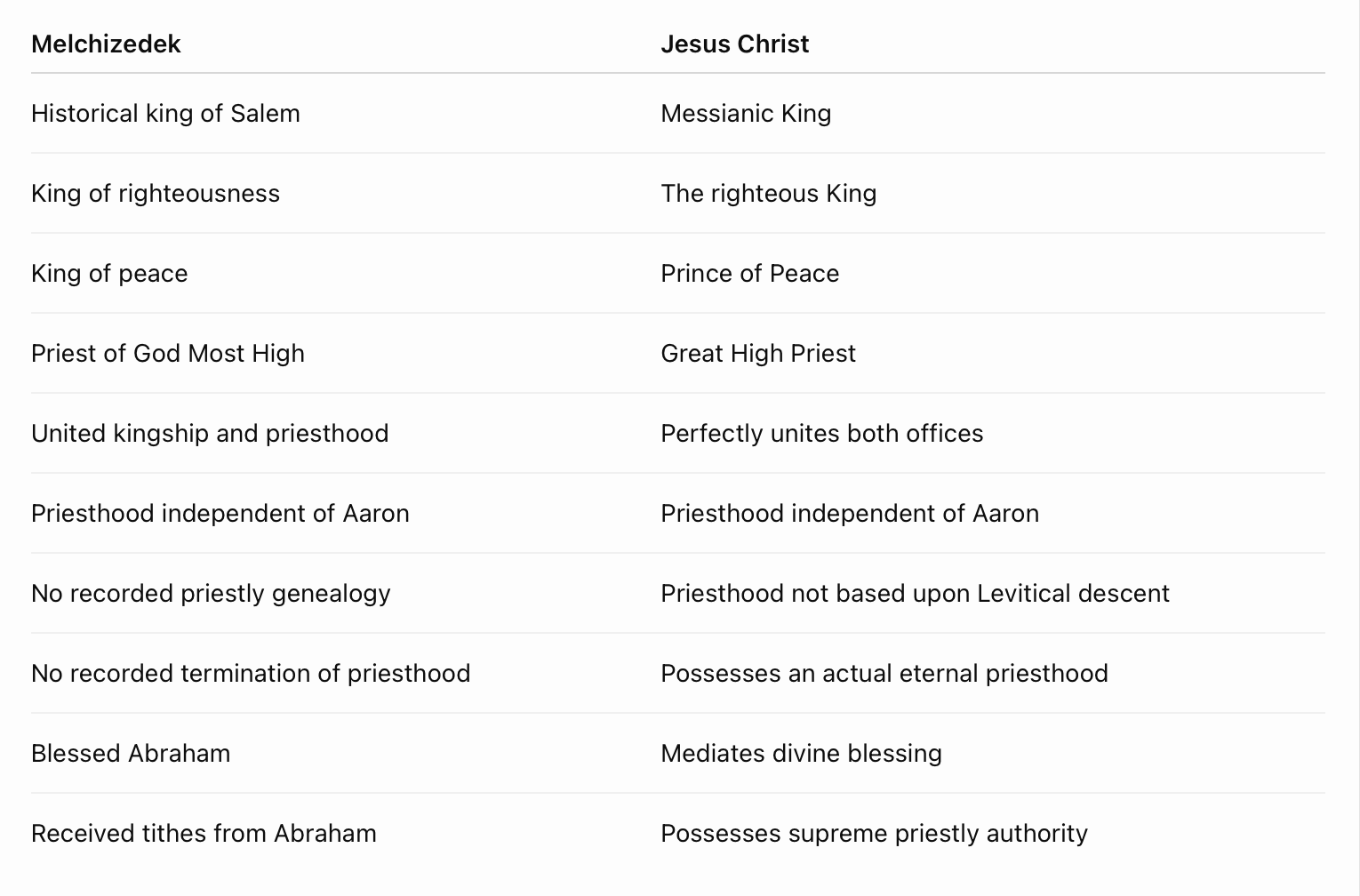
The distinction between the absence of a recorded termination of Melchizedek's priesthood and the actual eternality of Christ's priesthood is especially important.
What Melchizedek represents typologically, Jesus Christ fulfills actually and eternally.
The historical identity of Melchizedek does not diminish the supernatural identity of Jesus Christ. Rather, it provides the historical framework through which the unique nature of Christ's priesthood becomes more readily understandable.
12. The Superiority of Christ's Priesthood
The ultimate concern of Hebrews is not to establish the personal identity of Melchizedek, but to demonstrate the superiority of Jesus Christ.
Melchizedek serves the larger Christological argument.
A priesthood established through an indestructible life
Hebrews 7:15–16 declares:
“And it is yet far more evident if, in the likeness of Melchizedek, there arises another priest who has come, not according to the law of a fleshly commandment, but according to the power of an endless life.”
The contrast concerns the basis upon which priesthood is established.
The Aaronic priesthood depended upon physical descent and continued through successive generations.
Christ's priesthood rests upon His indestructible life.
Having conquered death through His resurrection, Jesus possesses a priesthood that cannot be terminated by death or transferred to a successor.
A permanent priesthood
Hebrews 7:23–24 explains:
“Also there were many priests, because they were prevented by death from continuing. But He, because He continues forever, has an unchangeable priesthood.”
Under the Aaronic system, the continuity of the priesthood depended upon successive generations of priests.
Individual priests died and were replaced.
Christ, however, possesses an unchangeable priesthood because He lives forever.
His priesthood does not require succession.
The eternal Son personally continues in the office to which He has been appointed.
A superior sacrifice
The superiority of Christ's priesthood is also demonstrated through the nature of His sacrifice.
The Levitical priests repeatedly offered sacrifices, while the high priest entered the Most Holy Place annually on the Day of Atonement.
Jesus Christ, by contrast, offered Himself as the definitive sacrifice for sin.
Hebrews 7:27 states:
“For this He did once for all when He offered up Himself.”
Christ is both the Priest who offers the sacrifice and the sacrifice through which redemption is accomplished.
His sacrifice does not require repetition because it possesses complete and enduring efficacy.
Letham emphasizes that Christ's fulfillment of the Melchizedekian priesthood provides believers with access to God that surpasses the limitations of the former priestly system.¹⁷
A priesthood that brings believers near to God
The ultimate benefit of Christ's priesthood is expressed in Hebrews 7:25:
“Therefore He is also able to save to the uttermost those who come to God through Him, since He always lives to make intercession for them.”
Christ's eternal priesthood provides the foundation for the believer's confidence before God.
His intercession is not temporary, uncertain, or dependent upon another priest assuming His responsibilities.
The same Savior who offered Himself for our sins continues to represent us before the Father.
The permanence of His priesthood guarantees the enduring sufficiency of His saving work.
13. The Messiah as Both King and Priest
Although Hebrews concentrates primarily upon the priestly ministry of Christ, the union of kingship and priesthood remains an important feature of Melchizedek's typological significance.
The Old Testament anticipates a messianic figure in whom these offices would ultimately be united.
Zechariah 6:12–13 provides a particularly significant prophetic declaration:
“Behold, the Man whose name is the BRANCH!
From His place He shall branch out,
And He shall build the temple of the LORD;
Yes, He shall build the temple of the LORD.
He shall bear the glory,
And shall sit and rule on His throne;
So He shall be a priest on His throne,
And the counsel of peace shall be between them both.”
Within its immediate historical setting, the passage involves the symbolic crowning of Joshua the high priest.
Although interpreters differ concerning the precise relationship between the royal and priestly figures in the passage, its prophetic imagery, read alongside Psalm 110 and the New Testament's presentation of Jesus, contributes to the biblical expectation of a Messiah who exercises both royal and priestly functions.
Jesus Christ possesses legitimate royal authority through His Davidic descent.
He possesses legitimate priestly authority through divine appointment according to the order of Melchizedek.
These offices are not in competition with one another.
The One who reigns over His people is also the One who represents them before God.
The One who possesses supreme authority is also the One who offered Himself for their redemption.
The One who will execute righteous judgment is also the One who presently intercedes on behalf of those who come to God through Him.
Melchizedek provides an early historical illustration of the union of these offices, while Jesus Christ embodies their perfect and everlasting fulfillment.
14. The Progressive Revelation of Melchizedek's Significance
One of the most remarkable aspects of the biblical presentation of Melchizedek is the progressive manner in which his theological significance unfolds.
Genesis 14 — The historical precedent
Melchizedek appears as a historical king and priest whose authority exists independently of the Mosaic covenant and the Aaronic priesthood.
His simultaneous occupation of these offices establishes that God had recognized a priesthood outside the hereditary system subsequently established through Aaron.
Joshua, Judges, and Samuel — The historical continuity of Jerusalem
The biblical narrative identifies Jerusalem as an ancient Canaanite city associated with local kingship and Jebusite occupation.
David's conquest subsequently establishes the city as the center of the Davidic monarchy.
This historical development provides a meaningful background for the prophetic association of Davidic kingship with the priesthood of Melchizedek.
Psalm 110 — The prophetic promise
God declares through an irrevocable oath that the promised messianic ruler will possess an everlasting priesthood according to the order of Melchizedek.
The historical precedent is thereby given an explicitly prophetic significance.
Hebrews 5–7 — The Christological fulfillment
The author of Hebrews explains that Jesus Christ fulfills this prophetic promise through a superior priesthood established by divine appointment and sustained by the power of His endless life.
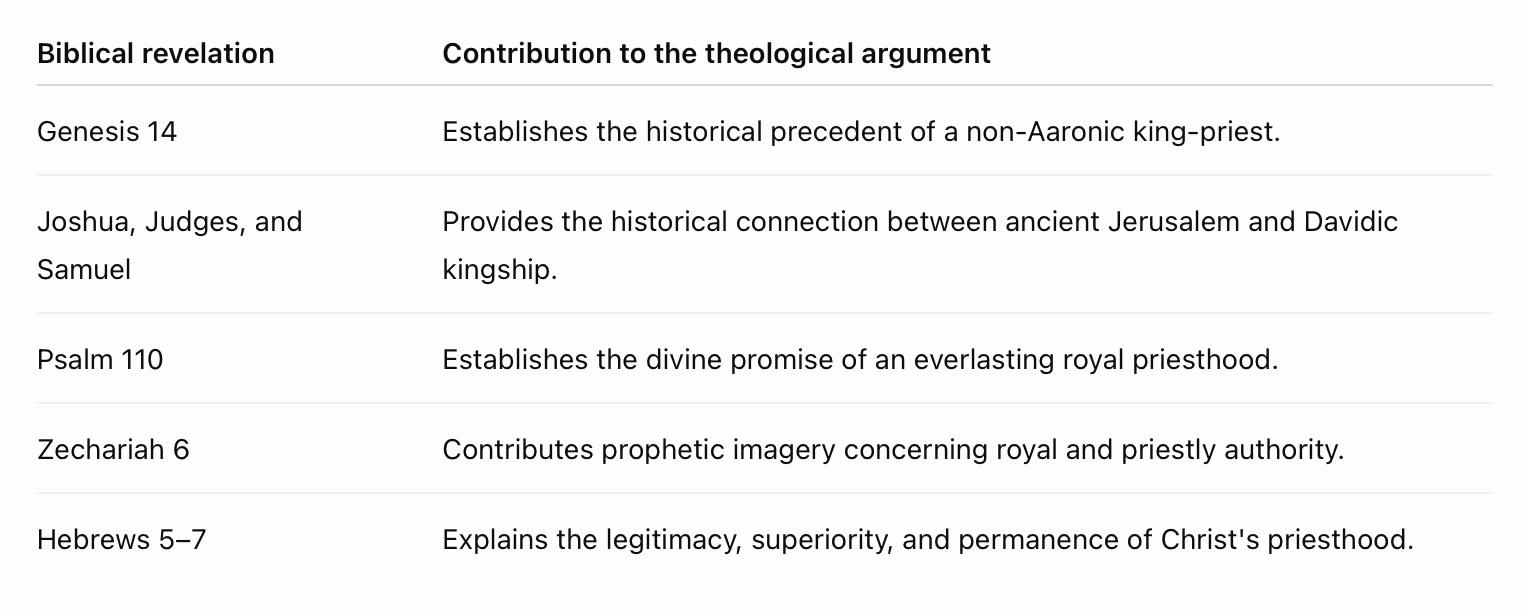
The progression demonstrates the remarkable theological unity of Scripture.
An otherwise brief historical encounter recorded in Genesis becomes the foundation for a prophetic declaration centuries later, which in turn becomes central to the New Testament's explanation of Christ's redemptive ministry.
Melchizedek's significance is therefore not diminished by understanding him as a historical person.
On the contrary, his historical existence illustrates the providential manner in which God prepares the way for subsequent revelation.
15. Evaluating the Major Interpretations of Melchizedek
Having examined the historical, biblical, and theological evidence, it is helpful to summarize the principal interpretations of Melchizedek.
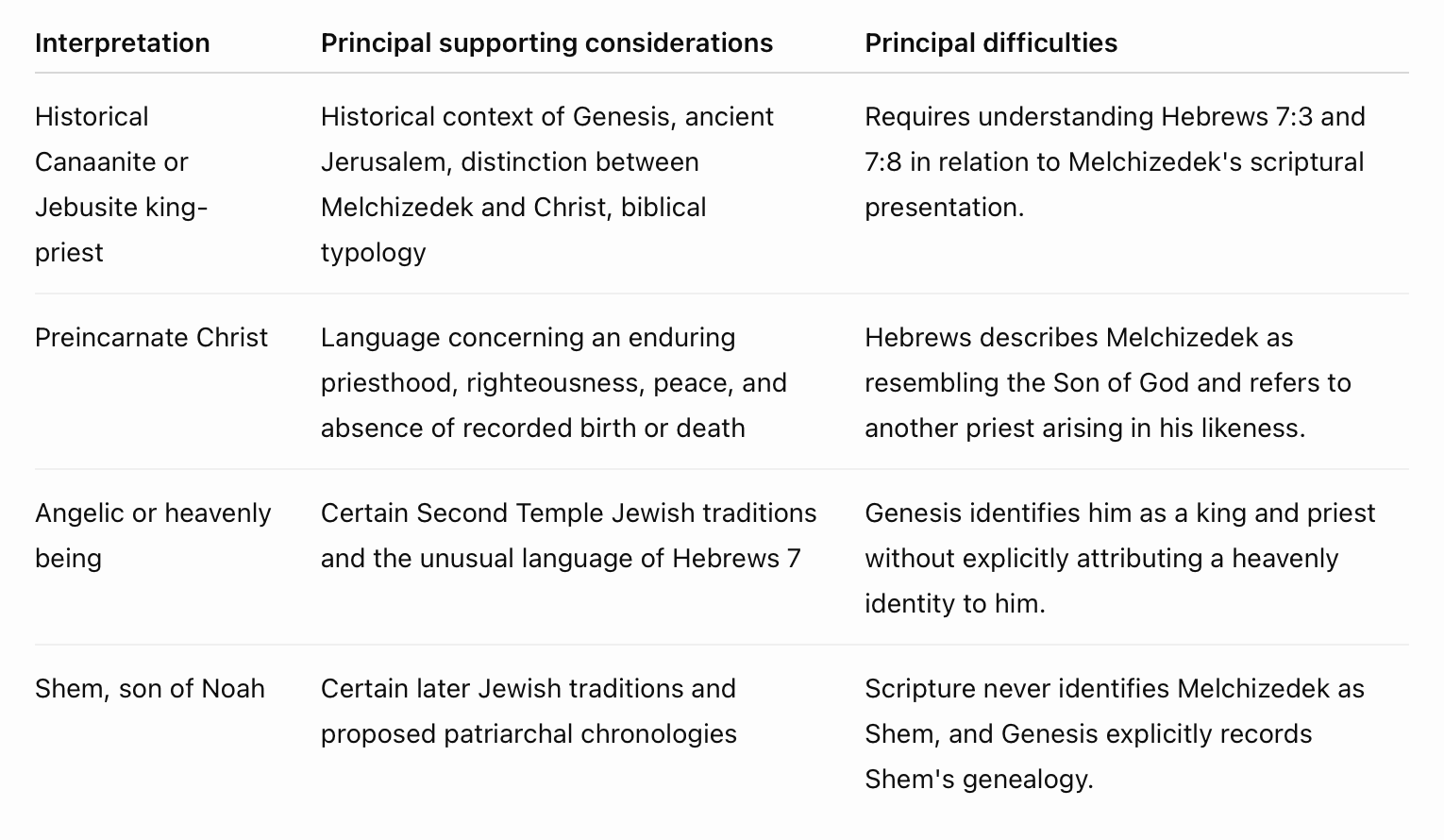
The historical interpretation is not without exegetical difficulties, particularly concerning the language of Hebrews 7.
Nevertheless, it provides a coherent explanation of the cumulative biblical evidence while requiring fewer assumptions concerning information not explicitly revealed in Scripture.
It also allows the historical context of Genesis, the history of Jerusalem, the prophetic significance of Psalm 110, and the Christological argument of Hebrews to contribute to a unified interpretation.
Conclusion
Who was Melchizedek?
The most persuasive interpretation of the biblical evidence is that Melchizedek was a historical king and priest of ancient Salem, most likely the pre-Israelite Canaanite city of Jerusalem, and plausibly a ruler belonging to its early Jebusite tradition.
Archaeological evidence establishes the antiquity of Jerusalem and its development as a fortified settlement. Ancient Egyptian records and the Amarna correspondence confirm that Jerusalem possessed an established political identity and local kingship centuries before David.
The biblical accounts concerning Adoni-Zedek, the Jebusites, and David's conquest provide further historical context for understanding the city over which Melchizedek probably ruled.
Although these sources do not independently establish Melchizedek's personal identity or ethnicity, they provide a credible historical and cultural setting for the account recorded in Genesis.
His ancestry, personal history, and the circumstances of his priestly appointment remain unknown. Nevertheless, Scripture provides sufficient information to establish his theological significance.
His priesthood existed before the Mosaic covenant.
He simultaneously occupied the offices of king and priest.
He received tithes from Abraham and pronounced a blessing upon him.
His priestly authority is presented without dependence upon a recorded hereditary succession.
These characteristics providentially prepared the way for the prophetic declaration of Psalm 110 and its fulfillment in Jesus Christ.
The supernatural interpretations of Melchizedek are understandable, particularly in light of the unusual language of Hebrews 7:3 and the speculative traditions that developed within ancient Judaism.
Nevertheless, the historical-typological interpretation provides a more coherent explanation of the cumulative biblical and historical evidence.
Melchizedek was made like the Son of God; he is not explicitly identified as the Son of God.
His priesthood anticipated an everlasting priesthood; Christ actually possesses that everlasting priesthood.
His royal and priestly offices provided a historical precedent; Christ fulfills those offices perfectly and eternally.
The theological significance of Melchizedek does not require him to have been a supernatural being. His historical existence as a king-priest is precisely what makes him such a compelling precedent for understanding how Jesus Christ could legitimately occupy both offices without belonging to the Aaronic priesthood.
The ultimate purpose of Scripture's presentation of Melchizedek is not to direct our attention toward an obscure ancient ruler, but toward the greatness of the Savior whom he foreshadowed.
As Christians, our confidence rests not in resolving every historical mystery surrounding Melchizedek, but in knowing that Jesus Christ is our eternal King and High Priest.
Because He lives forever, His priesthood will never end.
Because His sacrifice was sufficient, no further sacrifice for sin is necessary.
Because He continually intercedes for us, we may approach God with confidence.
The appropriate response to the study of Melchizedek is therefore the invitation extended to every believer in Hebrews:
“Seeing then that we have a great High Priest who has passed through the heavens, Jesus the Son of God, let us hold fast our confession.” — Hebrews 4:14
And again:
“Let us therefore come boldly to the throne of grace, that we may obtain mercy and find grace to help in time of need.” — Hebrews 4:16
References
1. D. G. Peterson, “Melchizedek,” in New Dictionary of Biblical Theology, ed. T. Desmond Alexander and Brian S. Rosner (Downers Grove, IL: InterVarsity Press, 2000), 658–60.
2. Alan R. Millard, “David and Solomon’s Jerusalem: Do the Bible and Archaeology Disagree?,” in Israel: Ancient Kingdom or Late Invention? (Nashville, TN: B&H Academic, 2008), 190.
3. Millard, “David and Solomon’s Jerusalem,” 190.
4. A. A. Anderson, 2 Samuel, vol. 11, Word Biblical Commentary (Dallas: Word Books, 1989), 81–82.
5. John D. Barry et al., eds., “Salem,” in The Lexham Bible Dictionary (Bellingham, WA: Lexham Press, 2016); Peterson, “Melchizedek,” 658–60; Flavius Josephus, Antiquities of the Jews 1.10.2; Genesis Apocryphon (1Q20), col. 22.
6. Anderson, 2 Samuel, 81–82.
7. Anderson, 2 Samuel, 81–82; LaMoine F. De Vries, “Jebus,” in Eerdmans Dictionary of the Bible, ed. David Noel Freedman, Allen C. Myers, and Astrid B. Beck (Grand Rapids, MI: Wm. B. Eerdmans, 2000), 676.
8. Paul Rainbow, “Melchizedek as a Messiah at Qumran,” Bulletin for Biblical Research 7 (1997): 179–94.
9. J. Maxwell Miller, “Jerusalem,” in Eerdmans Dictionary of the Bible, ed. David Noel Freedman, Allen C. Myers, and Astrid B. Beck (Grand Rapids, MI: Wm. B. Eerdmans, 2000), 695.
10. Horst Dietrich Preuss, Old Testament Theology, trans. Leo G. Perdue, vol. 2, Old Testament Library (Louisville, KY: Westminster John Knox Press, 1996), 41.
11. Robert Letham, The Work of Christ, ed. Gerald Bray, Contours of Christian Theology (Downers Grove, IL: InterVarsity Press, 1993), 107–8.
12. Peterson, “Melchizedek,” 658–60.
13. Rainbow, “Melchizedek as a Messiah at Qumran,” 179–94.
14. Peterson, “Melchizedek,” 658–60.
15. Letham, The Work of Christ, 107–8.
16. Peterson, “Melchizedek,” 658–60.
17. Letham, The Work of Christ, 112.
Scripture References
Old Testament
Genesis 10:15–16
Genesis 11:10–32
Genesis 12:1–3
Genesis 14:1–24
Genesis 15:18–21
Genesis 49:8–10
Exodus 18:1–12
Exodus 28:1–4
Leviticus 16:1–34
Numbers 3:5–10
Numbers 18:1–7
Joshua 10:1–5
Joshua 15:63
Joshua 18:28
Judges 1:8
Judges 1:21
Judges 19:10–12
2 Samuel 5:6–9
2 Samuel 6:12–19
2 Samuel 7:12–16
1 Chronicles 11:4–9
2 Chronicles 26:16–21
Ezra 2:61–63
Job 1:1–5
Psalm 2:7
Psalm 76:1–2
Psalm 110:1–7
Isaiah 9:6–7
Zechariah 6:9–15
New Testament
Matthew 12:40
Matthew 22:41–46
John 3:14–15
Acts 2:29–36
Romans 5:12–21
1 Corinthians 5:7
1 Corinthians 15:45–49
Hebrews 1:1–14
Hebrews 2:14–18
Hebrews 4:14–16
Hebrews 5:1–10
Hebrews 6:19–20
Hebrews 7:1–28
Hebrews 8:1–13
Hebrews 9:11–15
Hebrews 9:24–28
Hebrews 10:11–22