The Future Reign of Jesus Christ, the Fulfillment of God's Covenants, and the Hope of His Coming Kingdom
Theological Abstract
The millennium, described in Revelation 20:1–10, concerns the thousand-year reign of Jesus Christ, the binding of Satan, the resurrection and reign of the saints, and the final defeat of evil. Although Christians agree concerning the bodily return of Christ, the resurrection, final judgment, and eternal state, they differ significantly concerning the nature and timing of the millennium.
This study examines Revelation 20 within its literary and canonical contexts, evaluating the principal arguments for a future, earthly reign of Christ following His second coming. Particular attention is given to the chronological relationship between Revelation 19–22, the binding of Satan, the first resurrection, the interpretation of the thousand years, and the relationship between the millennial kingdom and God's promises to Abraham, David, and Israel.
The study argues that futuristic premillennialism offers a coherent interpretation of Revelation 20 when understood alongside Old Testament kingdom prophecies and the biblical covenants. While recognizing legitimate interpretive disagreements among Christians, it maintains that the millennium anticipates the historical manifestation of Christ's righteous rule, the vindication of His people, and the fulfillment of God's redemptive purposes before the establishment of the new heavens and new earth.
The ultimate significance of the millennium is not merely its duration or chronological placement. It is the certainty that Jesus Christ, the crucified and risen Messiah, will reign, that evil will be decisively defeated, and that God will faithfully accomplish everything He has promised.
Keywords and Phrases: Millennium; Premillennialism; Futuristic Premillennialism; Revelation 20; Millennial Kingdom; Second Coming; First Resurrection; Binding of Satan; Davidic Covenant; Abrahamic Covenant; Israel; Messianic Kingdom; Great White Throne Judgment; Eternal State; New Heavens and New Earth.
I. Introduction: What Is the Millennium?
The word millennium derives from the Latin words mille, meaning thousand, and annus, meaning year. The term refers to the thousand-year period described six times in Revelation 20:2–7.
The passage presents a remarkable sequence of events. Satan is bound and confined to the abyss. Certain believers who have died are raised to life and reign with Christ. At the conclusion of the thousand years, Satan is released for a brief period, deceives the nations, and leads a final rebellion. God defeats that rebellion, Satan is cast into the lake of fire, and the final judgment follows (Rev. 20:1–15).
The central interpretive questions concern the nature and timing of these events.
Does Revelation describe a future kingdom that Jesus Christ will establish upon the earth following His second coming? Or does the thousand-year period symbolize Christ's present heavenly reign during the age of the church?
These questions have generated three principal theological positions: premillennialism, amillennialism, and postmillennialism.
John F. Walvoord emphasizes that the debate cannot be confined to Revelation 20 alone. The interpretation of the millennium necessarily involves the broader biblical teaching concerning the kingdom of God, the promises to Israel, the Davidic covenant, the second coming, and the consummation of redemptive history.¹
Consequently, the proper method of study must begin with Revelation 20 in its own context and then consider its relationship to the rest of Scripture.
The goal should not be to impose an established theological system upon the text, but to determine what the biblical authors communicated within their historical, grammatical, literary, and theological contexts.
II. The Three Principal Views of the Millennium
Premillennialism: Christ Returns Before the Millennium
Premillennialism maintains that Jesus Christ will return bodily and visibly before establishing His millennial reign.
According to this understanding, Revelation 19 describes Christ's victorious return, Revelation 20 describes His subsequent thousand-year reign, and Revelation 21–22 describe the eternal state.
Premillennialists generally understand the first resurrection as bodily and the final resurrection and judgment as occurring after the millennium.
Two principal forms of premillennialism should be distinguished.
Historic premillennialism anticipates a future earthly reign of Christ but commonly understands the relationship between Israel and the church differently from dispensational premillennialism. Historic premillennialists also differ concerning the timing of the rapture and the interpretation of Old Testament kingdom promises.
Dispensational or futuristic premillennialism emphasizes the future fulfillment of God's covenant promises to national Israel, including the Davidic promise of a Messianic ruler. Traditional dispensationalists generally understand the kingdom as awaiting its future inauguration, while progressive dispensationalists recognize an already-present dimension of Christ's Messianic reign alongside its future consummation.²
Both approaches affirm the central premillennial claim that Christ returns before the future millennial kingdom.
Amillennialism: The Millennium as the Present Age
Amillennialism does not deny Christ's reign or the reality of His kingdom. Rather, it understands the thousand years symbolically, usually referring to the period between Christ's first and second comings.
Many amillennialists understand Satan's binding as a restriction upon his ability to prevent the gospel from reaching the nations, rather than the complete cessation of all satanic activity.
The first resurrection may be interpreted as spiritual regeneration or the heavenly life of deceased believers. The final resurrection, judgment, and inauguration of the eternal state occur at Christ's return.
An important feature of this interpretation is recapitulation: Revelation 20 is understood to revisit the present age from another visionary perspective rather than necessarily describing events chronologically following Revelation 19.
Postmillennialism: Christ Returns After the Millennium
Postmillennialism generally understands the millennium as a period of extraordinary gospel influence and kingdom advancement before Christ returns.
The thousand years may be understood symbolically rather than as an exact chronological duration.
The expectation is that the gospel will exercise an increasingly transformative influence upon the world, producing an extended era characterized by widespread righteousness and peace.
Christ returns after this millennial period to bring final judgment and the eternal state.
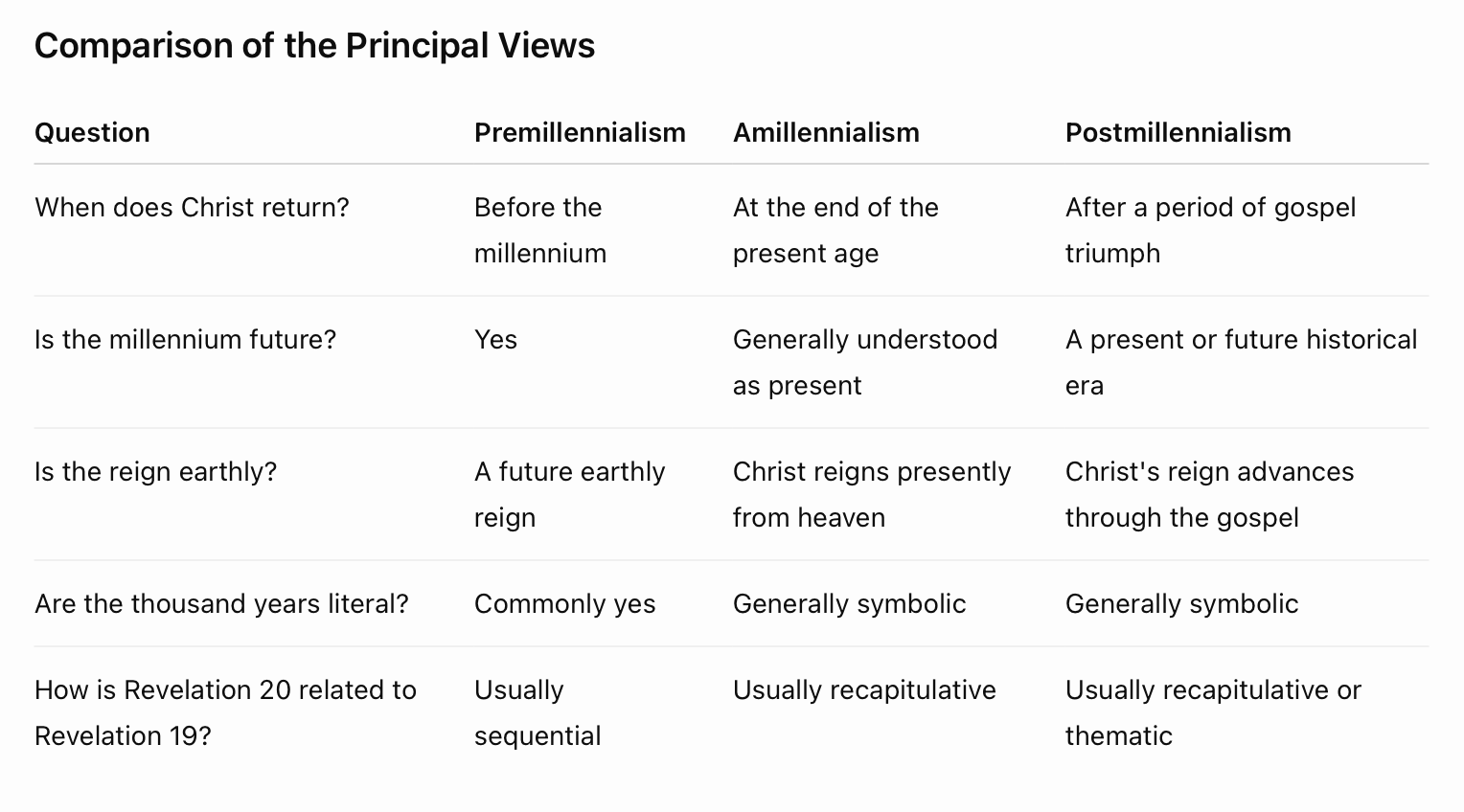
These distinctions are important because each position seeks to account for the same biblical revelation while approaching its literary structure and prophetic imagery differently.
The question is therefore not simply which theological tradition has the longest history or greatest number of adherents, but which interpretation most adequately explains the text.
III. Interpreting Revelation 20 Within Its Literary Context
Revelation is apocalyptic prophecy. Its visions contain symbols, heavenly scenes, dramatic imagery, and descriptions of future divine intervention.
A grammatical-historical interpretation does not require that every image be understood as physically literal.
For example, Revelation identifies the dragon as Satan (Rev. 20:2). The dragon is symbolic imagery representing a real personal being.
Similarly, the great chain and key in Revelation 20:1 may communicate divine authority and effective restraint without requiring that a spiritual being be confined by an ordinary physical chain.
The question is not whether Revelation employs symbols. It clearly does.
The question is what realities those symbols communicate.
Richard Mayhue emphasizes that the grammatical-historical approach must recognize figurative language while preserving the meaning communicated by the biblical text.³
A sound interpretation must therefore avoid two opposite errors: treating every apocalyptic image as a literal physical object, or assuming that symbolic imagery eliminates the possibility of actual historical fulfillment.
Does Revelation 20 Follow Revelation 19 Chronologically?
Revelation 19:11–21 depicts the heavenly rider identified as Faithful and True, the Word of God, and King of kings and Lord of lords.
Christ appears in judgment and victory over the beast, the false prophet, and the hostile armies gathered against Him.
Revelation 20 then introduces an angel descending from heaven to bind Satan.
The premillennial interpretation understands these events sequentially.
First, Christ returns and defeats His enemies. Second, Satan is confined. Third, the saints reign with Christ for a thousand years. Fourth, Satan is released and finally destroyed. Fifth, the final judgment takes place.
Robert L. Thomas argues that the narrative movement between Revelation 19 and 20 supports this chronological progression. He further maintains that the confinement of Satan in Revelation 20 is substantially different from the activity attributed to him elsewhere in Revelation.⁴
The recurring expression “And I saw” introduces successive visions. Although that expression alone does not prove chronological succession, premillennial interpreters argue that the subject matter and relationships among these visions favor a sequential reading.
Amillennial interpreters respond that Revelation frequently revisits the same historical period through successive visions. Therefore, the order in which John sees the visions does not necessarily establish the chronological order of their fulfillment.
This objection deserves consideration because the structure of Revelation is complex.
Nevertheless, the premillennial position maintains that the movement from Christ's victory to Satan's confinement, followed by the final rebellion and judgment, provides a coherent sequence of future events.
IV. The Binding of Satan: Revelation 20:1–3
John describes an angel descending from heaven with authority over the abyss. The angel seizes Satan, binds him for a thousand years, and confines him so that he can no longer deceive the nations until the appointed period has ended.
The stated purpose of the binding is particularly important: Satan is prevented from deceiving the nations during this period.
Is Satan Bound Today?
The New Testament teaches that Christ decisively defeated Satan through His death and resurrection (Col. 2:15; Heb. 2:14).
Jesus also spoke of binding the strong man in connection with His authority over demonic powers (Matt. 12:28–29).
These passages form an important part of the amillennial argument.
According to that understanding, Satan has been restrained in a particular respect through Christ's first coming. Although Satan remains active, he cannot prevent the worldwide proclamation of the gospel or ultimately frustrate God's redemptive purposes.
Premillennialists acknowledge Christ's victory at the cross but question whether the present condition of the world corresponds to Revelation 20:1–3.
Peter describes the devil as an active adversary seeking someone to devour (1 Pet. 5:8). Paul warns believers concerning spiritual warfare and satanic deception (Eph. 6:11–12; 2 Cor. 11:14).
Revelation itself portrays Satan as deceiving the world and persecuting God's people (Rev. 12:9–17).
Thomas argues that the language of imprisonment in the abyss suggests a more comprehensive restraint than the limitations presently imposed upon Satan.⁵
The distinction is therefore between Satan's defeat through Christ's redemptive work and his future confinement from the sphere of earthly activity.
The premillennial interpretation understands Revelation 20 as describing the latter.
Why Is Satan Released?
Revelation 20:3 states that Satan must be released for a little while after the thousand years.
The passage does not explicitly explain every divine purpose behind this release.
However, the resulting rebellion demonstrates that even after an extended period of righteous government, human opposition to God remains possible.
The final rebellion reveals the continuing seriousness of sin and the necessity of God's ultimate judgment.
The text also establishes that Satan's final defeat is certain. His release is temporary, his rebellion is unsuccessful, and his judgment is permanent.
V. The First Resurrection and the Reign of the Saints: Revelation 20:4–6
John next sees thrones occupied by those to whom judgment has been committed.
He particularly identifies those who suffered martyrdom because of their testimony to Jesus and their refusal to worship the beast or receive his mark.
They live and reign with Christ for a thousand years.
John identifies this as the first resurrection and declares that those who participate in it are blessed and holy.
The second death has no power over them.
Is the First Resurrection Bodily or Spiritual?
This is one of the most consequential exegetical questions in the passage.
Premillennialists understand the first resurrection as a bodily resurrection of believers.
The argument rests partly upon the relationship between Revelation 20:4 and 20:5.
Those who participate in the first resurrection live and reign with Christ, while the remainder of the dead do not live again until the thousand years are completed.
The same language of coming to life appears in close proximity.
Premillennialists argue that the natural reading favors resurrection in both cases, although occurring at different times.
Mappes and House identify the distinction between the two resurrections as a central feature of premillennial interpretation.⁶
Amillennial interpreters understand the first resurrection differently, commonly relating it to regeneration or the heavenly life of deceased believers. They understand the final resurrection as bodily.
The premillennial objection is that the immediate context strongly associates the first resurrection with people who have physically died, particularly martyrs, and who subsequently live and reign.
Furthermore, the contrast between the first resurrection and the later resurrection of the remaining dead appears to distinguish two stages in the resurrection program.
Who Reigns With Christ?
Revelation 20:4 explicitly identifies those martyred for their faithfulness to Jesus.
Other passages speak more broadly of believers sharing in Christ's reign (Rev. 3:21; 5:9–10; 2 Tim. 2:12).
Premillennial interpreters therefore commonly understand the millennial reign as including the resurrected saints more generally, while recognizing the particular emphasis placed upon the martyrs in Revelation 20.
This participation in Christ's reign represents the vindication of those who suffered because of their faithfulness.
Those who appeared defeated in the eyes of the world are revealed as participants in the victory of Christ.
What Does It Mean to Reign as Priests?
Revelation 20:6 describes the resurrected saints as priests of God and Christ.
The priestly imagery points to their consecration, access to God, and participation in His purposes.
Their reign does not imply independence from Christ. Rather, it expresses their union with Him and their participation in the authority of the victorious Messiah.
The passage offers extraordinary encouragement to suffering believers.
Faithfulness to Christ may involve rejection, persecution, or even death, but none of these can overturn the destiny God has prepared for His people.
VI. Why Understand the Thousand Years as a Future Historical Period?
The expression “a thousand years” appears six times in Revelation 20:2–7.
Premillennialists argue that this repetition naturally identifies a definite period within God's future redemptive program.
Mayhue observes that Revelation frequently employs numerical descriptions of time and argues that the thousand years should ordinarily be understood as an actual duration unless the context requires otherwise.⁷
However, repetition alone does not settle the question.
Revelation contains numerous symbolic numbers, and the number one thousand can communicate fullness or completeness in biblical literature.
Amillennial interpreters therefore argue that the thousand years may symbolize the complete period appointed by God for Christ's present reign.
The strongest premillennial argument is not merely that the number appears six times.
Rather, it is the cumulative relationship between the specified duration, the confinement and release of Satan, the resurrection of the saints, the final rebellion, and the judgment that follows.
These elements together appear to describe a distinctive period within redemptive history.
The Old Testament also anticipates a Messianic reign characterized by justice, peace, restored creation, and the worldwide recognition of God's authority.
Although those passages do not explicitly specify a thousand-year duration, premillennialists understand Revelation 20 as providing additional chronological detail concerning the kingdom previously promised through the prophets.
VII. The Millennium and the Old Testament Kingdom Promises
The premillennial interpretation cannot be adequately evaluated without considering the Old Testament.
The prophets repeatedly anticipated a future reign of the Messiah characterized by righteousness, peace, the restoration of Israel, and the submission of the nations to God's appointed King.
The Davidic Covenant
In 2 Samuel 7:12–16, God promises David a continuing royal dynasty and establishes the expectation of an enduring kingdom.
Psalm 89:3–4, 28–37 reiterates God's covenant commitment to David's descendants.
Isaiah 9:6–7 anticipates a righteous ruler whose government and peace will continue without end upon David's throne.
Jeremiah 23:5–6 describes a righteous Branch from David who will reign as King and execute justice.
The New Testament identifies Jesus Christ as the promised Son of David (Luke 1:32–33; Acts 2:29–36).
The question is not whether Jesus is the Davidic Messiah. The New Testament clearly affirms that He is.
The interpretive question concerns how the promised Davidic reign is fulfilled.
Some Christian interpreters understand Christ's present heavenly exaltation as the fulfillment or inauguration of His Davidic kingship, with its consummation occurring at His return.
Traditional dispensational premillennialists distinguish Christ's present heavenly session from His future earthly Davidic reign.
Progressive dispensationalists recognize a present inauguration of Davidic kingship while maintaining its future earthly fulfillment.
The premillennial interpretation presented here understands Revelation 20 as describing the future historical manifestation of the reign promised to David.
The Abrahamic Covenant and the Future of Israel
God promised Abraham descendants, a land, and blessing extending to the nations (Gen. 12:1–3; 15:1–21; 17:1–8).
The New Testament teaches that the promised blessing reaches the nations through Jesus Christ (Gal. 3:8, 14, 16).
Yet Paul also addresses God's continuing purposes for Israel in Romans 9–11.
Romans 11:25–29 is especially significant because Paul describes Israel's partial hardening, anticipates a future divine work of salvation, and emphasizes the irrevocable character of God's calling.
Richard Mayhue argues that the unconditional Abrahamic and Davidic covenants provide substantial theological support for a future restoration of Israel within the Messianic kingdom.⁸
The premillennial understanding maintains that the inclusion of Gentile believers in the blessings of Christ does not require the cancellation of God's promises to Israel.
This conclusion should not be confused with the claim that ethnic descent guarantees individual salvation.
Salvation remains grounded in Jesus Christ, and both Jews and Gentiles are reconciled to God through Him (Rom. 10:9–13; Eph. 2:11–22).
The issue concerns the continuing faithfulness of God to His covenant commitments.
The Prophetic Vision of the Kingdom
Isaiah 2:2–4 anticipates the nations coming to the mountain of the Lord and learning His ways.
Isaiah 11:1–10 describes the righteous reign of the Davidic Branch, the judgment of the wicked, and remarkable peace within creation.
Isaiah 65:17–25 portrays restoration, longevity, and peace, although its relationship to the new creation and the millennium remains debated.
Micah 4:1–8 anticipates peace among the nations and the Lord's reign from Zion.
Zechariah 14:9 anticipates the universal kingship of the Lord.
These passages present a cumulative vision of divine rule extending beyond individual salvation to the restoration of justice and peace within creation.
Premillennialists understand this prophetic expectation as consistent with a future earthly reign of Christ.
Nevertheless, careful interpretation must recognize that prophetic passages may combine near and distant events, employ figurative imagery, and anticipate the final new creation as well as the Messianic kingdom.
Not every prophetic description can automatically be assigned to the millennium without additional exegetical argument.
VIII. What Will the Millennial Kingdom Be Like?
Revelation 20 provides relatively little descriptive detail concerning daily life during the thousand years.
It emphasizes the restraint of Satan, the resurrection and reign of the saints, and the events that conclude the period.
Premillennial descriptions of the kingdom therefore draw upon additional biblical passages.
The Personal Reign of Christ
The kingdom is governed by Jesus Christ, the promised Messiah and Son of David.
His rule is characterized by righteousness and justice (Isa. 9:6–7; 11:1–5).
Unlike earthly rulers, whose judgments are frequently compromised by ignorance, corruption, or self-interest, Christ reigns in perfect wisdom and righteousness.
Peace and Justice Among the Nations
Isaiah 2:4 and Micah 4:3 anticipate the transformation of instruments of warfare into instruments of peaceful labor.
The prophetic vision emphasizes a world in which the authority of God establishes justice and restrains violence.
Premillennial interpreters understand these passages as anticipating conditions associated with Christ's earthly reign.
The Restoration of Creation
Isaiah 11:6–9 describes extraordinary peace within the created order.
Romans 8:19–23 speaks of creation awaiting liberation from its bondage to corruption.
These passages establish the biblical expectation that God's redemptive purposes extend to the created world.
The precise relationship between millennial restoration and the final renewal of creation remains a subject of interpretation.
The Presence of Resurrected and Mortal People
Revelation 20 explicitly describes resurrected believers reigning with Christ.
Many dispensational premillennialists also understand people who survive the preceding judgment as entering the kingdom in mortal bodies.
This interpretation is commonly developed from Matthew 25:31–46 and various Old Testament prophecies.
The presence of mortal people is offered as an explanation for the nations that Satan deceives after his release.
However, Revelation 20 does not itself provide a detailed account of population, marriage, childbirth, or governmental administration during the millennium.
These conclusions are theological inferences drawn from the broader prophetic framework rather than explicit descriptions within Revelation 20.
The Millennium Is Not Yet the Eternal State
This distinction is essential.
During the millennium, Satan is confined but eventually released. A final rebellion still occurs.
By contrast, Revelation 21–22 describes the final removal of death, mourning, pain, and the curse.
The millennial kingdom therefore represents an extraordinary stage in God's redemptive program, but not the ultimate condition of the new heavens and new earth.
The eternal state is the final and everlasting consummation of God's purposes.
IX. Satan's Final Rebellion and Defeat: Revelation 20:7–10
At the conclusion of the thousand years, Satan is released from his confinement and once again deceives the nations.
John identifies the rebellious nations with the names Gog and Magog, recalling the prophetic imagery of Ezekiel 38–39.
They gather against the people of God, but the rebellion is immediately defeated by divine intervention.
Fire comes down from heaven, and Satan is cast into the lake of fire, where the beast and false prophet have already been consigned.
His judgment is final.
Why Does God Permit One Final Rebellion?
The passage does not explicitly explain every reason for Satan's release.
Nevertheless, the narrative reveals a profound theological truth: even the presence of righteous government and the removal of satanic deception for an extended period do not, by themselves, eliminate the possibility of human rebellion.
The final rebellion demonstrates that humanity's fundamental problem cannot be resolved merely through improved social conditions or political government.
The human heart requires the transforming grace of God.
It also demonstrates the absolute sovereignty of Christ.
Satan's final attempt to overthrow God's purposes fails completely. The rebellion is neither prolonged nor uncertain in its outcome.
The enemy who deceived humanity in Eden is permanently defeated.
Is Gog and Magog the Same Battle Described in Ezekiel 38–39?
The relationship between Ezekiel's prophecy and Revelation 20 is debated among premillennial interpreters.
Some understand the two passages as describing different conflicts, with John employing the names Gog and Magog to identify the character and worldwide scope of the final rebellion.
Others seek a closer chronological relationship between the passages.
The safest conclusion is that John intentionally invokes Ezekiel's prophetic imagery to describe a final gathering of rebellious nations against God's people.
Revelation 20 clearly establishes the outcome: the rebellion fails, and Satan's judgment is irreversible.
X. The Great White Throne Judgment: Revelation 20:11–15
Following Satan's final defeat, John sees a great white throne and the One seated upon it.
The dead, great and small, stand before the throne.
Books are opened, including the Book of Life, and judgment is rendered according to what is written.
Death and Hades are ultimately cast into the lake of fire.
John identifies this as the second death.
The Final Resurrection and Judgment
Within the premillennial interpretation, the judgment described in Revelation 20:11–15 follows the thousand-year reign and concerns those who did not participate in the first resurrection.
This understanding follows the distinction between the first resurrection and the remaining dead in Revelation 20:4–6.
The passage emphasizes the universality, righteousness, and finality of divine judgment.
No earthly distinction of status, wealth, power, or influence exempts anyone from accountability before God.
Judgment According to Works
Revelation 20:12–13 describes judgment according to works.
This does not contradict the New Testament teaching that salvation is by grace through faith rather than human merit (Eph. 2:8–9).
Scripture consistently teaches that human conduct reveals moral responsibility and provides evidence concerning the character of one's life (Matt. 7:16–23; Rom. 2:6–11; James 2:14–26).
The Book of Life emphasizes the decisive importance of belonging to God.
The passage should therefore be read alongside the broader biblical testimony concerning salvation through Jesus Christ and the certainty of divine judgment.
The Second Death
The second death represents final judgment and exclusion from the life of God's eternal kingdom.
Revelation 20:6 declares that those who participate in the first resurrection are beyond its power.
For believers, this is a remarkable promise of security.
The final judgment does not threaten the victory accomplished by Christ. Rather, it demonstrates that His victory includes the final removal of evil and the establishment of perfect righteousness.
XI. The New Heavens and New Earth: Revelation 21–22
The biblical story does not conclude with the millennium.
John next sees a new heaven and a new earth.
The holy city, New Jerusalem, descends from heaven, and God dwells with His people.
The final chapters of Revelation describe the removal of death, sorrow, crying, pain, and the curse.
The relationship between the millennium and the eternal state is especially important.
The millennium demonstrates Christ's victorious reign within history. The new creation represents the final consummation of God's redemptive purposes.
The distinction is not between a temporary Christ and an eternal Christ.
Jesus Christ reigns forever (Luke 1:32–33; Rev. 11:15).
Rather, the distinction concerns successive stages in the manifestation and consummation of His kingdom.
Paul's teaching in 1 Corinthians 15:20–28 provides a significant theological connection. Christ reigns until every enemy has been subjected to Him, and death itself is finally destroyed.
Premillennialists understand this passage as consistent with a sequence in which Christ returns, reigns, defeats His enemies, and brings God's redemptive purposes to their consummation.
Other interpreters understand Paul's description as encompassing Christ's present heavenly reign and its completion at His return.
Although the precise relationship between 1 Corinthians 15 and Revelation 20 is debated, both passages affirm the same essential truth: every enemy of God will ultimately be defeated through Jesus Christ.
XII. Did the Early Church Believe in a Literal Millennium?
The testimony of the early Christian church provides important historical evidence concerning how Christians in the generations following the apostles understood the kingdom described in Revelation 20.
Although the writings of the church fathers do not possess the authority of Scripture, they offer valuable insight into the interpretation of biblical prophecy during the earliest centuries of Christianity.
A number of influential second- and third-century Christian writers anticipated a future resurrection of the righteous followed by an earthly reign of Christ. This expectation was commonly known as chiliasm, from the Greek word chilia, meaning thousand.
Papias of Hierapolis (Early Second Century)
Papias, an early Christian bishop associated with Hierapolis in Asia Minor, is among the earliest witnesses to a future earthly kingdom.
Although his principal writings have not survived intact, portions of his teaching are preserved by Irenaeus and Eusebius.
In Ecclesiastical History 3.39.12, Eusebius reports that Papias anticipated a period of approximately one thousand years following the resurrection, during which Christ's kingdom would be established upon the earth.¹¹
Eusebius himself disagreed with this interpretation, believing that Papias had misunderstood figurative apostolic teaching. Nevertheless, his historical account preserves valuable evidence that such expectations existed among early Christians.
Irenaeus also refers to Papias when discussing the blessings of the future kingdom in Against Heresies 5.33.3–4.¹²
Papias therefore provides an early historical witness to the expectation of a future earthly reign, although the surviving fragments do not permit a complete reconstruction of his eschatology.
Justin Martyr (ca. AD 100–165)
Justin Martyr offers one of the clearest surviving statements of early Christian millennial belief.
In Dialogue with Trypho 80–81, Justin explicitly defends the expectation that the righteous will be raised and participate in a future thousand-year period associated with Jerusalem.
He connects this expectation with the prophecies of Isaiah and Ezekiel and with John's Revelation.
Justin also acknowledges that other sincere Christians disagreed with his interpretation. This qualification is historically important because it demonstrates that differing millennial expectations already existed in the second century.¹³
Justin's testimony establishes that belief in a future earthly millennium was not a later invention of modern dispensational theology.
At the same time, his acknowledgment of disagreement cautions against claiming that every early Christian held the premillennial position.
Irenaeus of Lyons (ca. AD 130–202)
Irenaeus provides one of the most extensive early Christian defenses of a future earthly kingdom.
In Against Heresies 5.32–36, he connects the resurrection of the righteous with the fulfillment of God's promises to Abraham, the restoration of creation, and the future reign of Christ.
Irenaeus argues that the righteous will inherit the promised blessings following their resurrection and that the final judgment will occur afterward.¹⁴
His interpretation is especially significant because it relates the future kingdom to God's covenant promises rather than treating the millennium as an isolated passage in Revelation.
He also understands Old Testament prophecies concerning restored creation and Jerusalem as anticipating a future fulfillment.
Irenaeus therefore provides substantial historical evidence for a premillennial understanding that integrates resurrection, covenant fulfillment, and the earthly reign of Christ.
Tertullian of Carthage (ca. AD 155–220)
Tertullian also anticipated a future earthly kingdom following the resurrection.
In Against Marcion 3.25, he describes a kingdom promised to believers upon the earth for a thousand years, followed by the final judgment and heavenly consummation.¹⁵
His discussion distinguishes the future millennial kingdom from the ultimate eternal condition of the redeemed.
Although aspects of Tertullian's prophetic expectations differ from contemporary premillennial systems, his writings provide explicit testimony to the belief that the resurrection would be followed by a future period of earthly blessing.
The Historical Significance of Early Premillennialism
These writings demonstrate that belief in a future earthly millennium was present among influential Christians during the earliest centuries of church history.
Nathan Busenitz surveys this evidence in Christ's Prophetic Plans, drawing attention to the testimony of Papias, Justin Martyr, Irenaeus, and other early Christian writers.¹⁶
The historical evidence supports three conclusions.
First, premillennial expectations existed long before the development of modern dispensational theology.
Second, the expectation of a future earthly kingdom was associated with important early Christian teachers and their understanding of biblical prophecy.
Third, millennial interpretations were not entirely uniform, even during the earliest centuries.
The historical testimony therefore supports the antiquity of premillennialism without establishing that all early Christians embraced the same interpretation.
Augustine and the Development of Amillennialism
During the fourth and fifth centuries, Augustine of Hippo developed an interpretation of Revelation 20 that became highly influential in Western Christianity.
Rather than anticipating a future thousand-year earthly kingdom following Christ's return, Augustine increasingly understood the millennium as describing the present period of Christ's reign.
In The City of God 20.7–9, he interprets the thousand years in relation to the present age and discusses the first resurrection in spiritual terms.¹⁷
This interpretation became foundational for later amillennial theology.
The development of Augustine's position demonstrates that Christian interpretation of Revelation 20 changed over time and that differing approaches to apocalyptic prophecy influenced the understanding of the kingdom.
Historical Testimony and Biblical Authority
The early church fathers provide meaningful evidence that a future earthly reign of Christ was an established interpretation during the early centuries of Christianity.
Nevertheless, historical precedent alone cannot determine the correct interpretation of Revelation 20.
The final authority must remain Scripture itself.
The significance of these early witnesses is that they demonstrate the antiquity of premillennial expectations and provide historical support for an interpretation that must ultimately be evaluated through careful biblical exegesis.
XIII. Evaluating the Premillennial Interpretation
The case for futuristic premillennialism rests upon several interconnected considerations.
First, Revelation 19–20 can be read as a coherent chronological sequence beginning with Christ's return and culminating in Satan's final defeat.
Second, the binding of Satan in Revelation 20 appears to describe a condition more restrictive than his present activity as described elsewhere in the New Testament.
Third, the contrast between the first resurrection and the later resurrection of the remaining dead favors, within the premillennial reading, two distinguishable resurrection events.
Fourth, the repeated references to the thousand years naturally suggest a defined period, although the symbolic character of apocalyptic literature must be considered.
Fifth, the Old Testament contains substantial promises concerning the reign of the Davidic Messiah, the restoration of Israel, and the establishment of righteousness and peace among the nations.
Sixth, the distinction between Revelation 20 and Revelation 21–22 suggests that the millennial kingdom and the eternal state are not identical.
Finally, early Christian testimony demonstrates that a future earthly kingdom was a prominent interpretation during the earliest centuries of church history.
Remaining Interpretive Questions
A responsible defense of premillennialism must also acknowledge the questions that continue to be debated.
The literary structure of Revelation does not settle the chronological question merely through the appearance of successive visions.
The symbolic character of the book requires careful consideration before assigning exact numerical or physical meanings to its imagery.
The New Testament's teaching concerning Christ's present reign must be integrated with promises concerning His future manifestation.
Likewise, the relationship between Israel and the church requires close attention to Romans 9–11, Ephesians 2–3, Galatians 3, and the prophetic covenants.
These questions should not be dismissed as though they arise merely from unwillingness to accept Scripture.
Faithful Christian interpreters have reached different conclusions while affirming the inspiration and authority of the Bible.
Nevertheless, this study concludes that the cumulative biblical evidence provides substantial support for a future, earthly reign of Jesus Christ following His second coming and preceding the eternal state.
XIV. Theological Conclusion and Pastoral Exhortation: Why the Millennium Matters Today
The millennium is more than an intriguing subject of biblical prophecy.
It concerns the faithfulness of God, the ultimate triumph of Jesus Christ, the vindication of His people, and the certainty that evil will not have the final word.
Christians may disagree concerning the precise chronology of the end times, but the central truths of Revelation remain profoundly encouraging.
1. God Will Keep Every Promise He Has Made
The promises of God do not depend upon the changing circumstances of human history.
God made covenant commitments to Abraham and David, and Scripture repeatedly affirms His faithfulness to His Word (Gen. 17:7–8; 2 Sam. 7:12–16; Ps. 89:34; Rom. 11:28–29).
From a premillennial perspective, the future kingdom provides a historical manifestation of those promises.
The same God who fulfilled His promise to send the Messiah will fulfill His remaining purposes.
For the Christian facing uncertainty, this truth provides a foundation for hope.
Circumstances may change, nations may rise and fall, and human promises may fail. Yet the purposes of God remain secure.
2. Jesus Christ Will Reign in Perfect Righteousness
Human history bears witness to the limitations of earthly government.
Even the most capable rulers cannot eliminate injustice, corruption, oppression, or suffering.
The prophets anticipated a King who would rule with perfect wisdom and righteousness (Isa. 9:6–7; 11:1–5).
Revelation identifies that victorious King as Jesus Christ.
The One who suffered humiliation, rejection, and crucifixion will be openly revealed as King of kings and Lord of lords.
For believers troubled by the injustice of the present world, the promise of Christ's reign provides reassurance that righteousness will ultimately prevail.
3. Evil Will Not Have the Final Word
Revelation 20 presents the decisive defeat of Satan.
The adversary who deceived humanity and opposed the purposes of God will be permanently judged.
The final rebellion will fail, and evil will be removed from God's eternal kingdom.
This promise does not minimize the suffering experienced by believers today.
Rather, it places present suffering within the larger context of God's ultimate victory.
Christians are not promised exemption from every trial in this life. They are promised that no evil power can overturn the final purposes of God (Rom. 8:31–39).
4. Faithfulness to Christ Is Never Wasted
Revelation 20 places special emphasis upon those who suffered and died because of their faithfulness to Jesus.
The world may have regarded them as defeated, but John sees them alive and reigning with Christ.
Their suffering was not forgotten.
Their testimony was not meaningless.
Their faithfulness was not in vain.
This provides extraordinary encouragement to Christians who experience persecution, rejection, hardship, or sacrifice because of their commitment to Christ.
The final assessment of a believer's life does not belong to the world. It belongs to Jesus Christ.
5. God's Purposes for Israel Demonstrate His Covenant Faithfulness
Paul reminds believers that God's gifts and calling are irrevocable (Rom. 11:29).
The premillennial interpretation understands God's promises to Israel as anticipating future fulfillment through the Messiah.
This expectation should produce neither spiritual pride nor hostility toward others.
Paul's discussion of Israel in Romans 11 calls Gentile believers to humility rather than arrogance.
God's covenant faithfulness should inspire gratitude, reverence, and confidence in His redemptive purposes.
6. Our Ultimate Hope Is the Eternal Presence of God
The millennium is not the final destination of the Christian hope.
Revelation moves beyond the thousand-year kingdom to the new heavens and new earth.
There, God dwells with His people, death is abolished, and the curse is removed.
The ultimate promise is not merely a better world, a righteous government, or an extended period of peace.
It is everlasting fellowship with God through Jesus Christ.
The culmination of biblical prophecy is therefore deeply personal: the redeemed will belong to God, dwell in His presence, and enjoy the fullness of His salvation forever.
A Final Word of Encouragement
The study of prophecy should never become merely an exercise in constructing timelines or debating theological systems.
Its proper purpose includes strengthening faith, encouraging perseverance, and directing the believer's attention toward Jesus Christ.
Revelation was given to churches facing real pressures, temptations, and suffering. Its message assured them that their circumstances did not determine the ultimate outcome of history.
Jesus Christ does.
For the believer who is weary, the promise of Christ's kingdom offers hope.
For the believer who is discouraged by injustice, it promises righteous judgment.
For the believer who is suffering, it promises vindication and resurrection.
For the believer who fears the future, it declares that history remains under the sovereign authority of God.
And for every Christian, it provides a renewed reason to live faithfully in anticipation of the Lord's return.
The central message of the millennium is not simply that Christ will reign for a thousand years. It is that the crucified and risen Savior will fulfill God's promises, defeat every enemy, establish righteousness, and bring His people into the everlasting joy of His presence.
The appropriate Christian response is therefore not fear or speculation, but faith, obedience, perseverance, and worship.
Scripture Passages Examined
The Millennium and the Second Coming: Revelation 19:11–21; 20:1–15; Matthew 24:29–31; Acts 1:9–11; Hebrews 9:28.
The Binding of Satan: Matthew 12:28–29; Luke 8:12; John 12:31; 2 Corinthians 11:14; Ephesians 6:11–12; Colossians 2:15; Hebrews 2:14; 1 Peter 5:8; Revelation 12:9–17; 20:1–3, 7–10.
Resurrection and Judgment: Daniel 12:1–3; John 5:24–29; 1 Corinthians 15:20–28, 50–58; 2 Timothy 2:12; Revelation 3:21; 5:9–10; 20:4–15.
The Abrahamic and Davidic Covenants: Genesis 12:1–3; 15:1–21; 17:1–8; 2 Samuel 7:12–16; Psalm 89:3–4, 28–37; Isaiah 9:6–7; Jeremiah 23:5–6; Luke 1:32–33; Acts 2:29–36; Romans 9–11; Galatians 3:8–16.
Old Testament Kingdom Prophecies: Psalm 2; Psalm 72; Isaiah 2:1–4; 11:1–10; 35:1–10; 65:17–25; Jeremiah 31:31–37; Ezekiel 36–37; 38–39; Micah 4:1–8; Zechariah 14:1–21.
The Eternal State: Romans 8:18–25; 1 Corinthians 15:20–28; 2 Peter 3:10–13; Revelation 21–22.
Questions for Reflection
How does the promise of Christ's future reign influence the way Christians understand present suffering, injustice, and uncertainty?
What is the significance of Satan's binding and eventual final defeat in Revelation 20?
How does the first resurrection provide encouragement to believers who suffer because of their faithfulness to Jesus Christ?
What relationship do you see between the Davidic covenant and the reign of Christ described in Revelation 20?
How should God's promises to Israel shape the Christian understanding of His faithfulness and covenant commitments?
Why is it important to distinguish between the millennial kingdom and the eternal state described in Revelation 21–22?
How can Christians maintain humility and fellowship with other believers who hold different interpretations of the millennium?
In what practical ways should the certainty of Christ's return influence our priorities, obedience, and witness today?
References
John F. Walvoord, “The Theological Context of Premillennialism,” Bibliotheca Sacra 150 (1993), opening discussion on the biblical and theological scope of premillennialism.
David Mappes and H. Wayne House, “A Biblical and Theological Discussion of Traditional Dispensational Premillennialism,” Journal of Ministry and Theology 17, no. 1 (2013), 1–2.
Richard Mayhue, “Why Futuristic Premillennialism?” in Christ's Prophetic Plans: A Futuristic Premillennial Primer (Chicago: Moody Publishers, 2012), section “A Consistent Hermeneutic.”
Robert L. Thomas, Revelation 8–22: An Exegetical Commentary (Chicago: Moody Publishers, 1995), commentary on Revelation 20:1–3.
Thomas, Revelation 8–22, commentary on Revelation 20:1–3.
Mappes and House, “A Biblical and Theological Discussion,” 2.
Mayhue, “Why Futuristic Premillennialism?” discussion of the thousand years and the interpretation of biblical numbers.
Richard L. Mayhue, “New Covenant Theology and Futuristic Premillennialism,” The Master's Seminary Journal18, no. 2 (Fall 2007): 221–22 and subsequent discussion of the Abrahamic and Davidic covenants.
Nathan Busenitz, “Did the Early Church Believe in a Literal Millennial Kingdom?” in Christ's Prophetic Plans: A Futuristic Premillennial Primer (Chicago: Moody Publishers, 2012), opening discussion of early premillennial witnesses.
Walvoord, “The Theological Context of Premillennialism”; Mayhue, “Why Futuristic Premillennialism?” discussion of early church history.
Eusebius of Caesarea, Ecclesiastical History 3.39.12–13, in Nicene and Post-Nicene Fathers, 2nd ser., vol. 1, ed. Philip Schaff and Henry Wace (Buffalo, NY: Christian Literature Publishing, 1890).
Irenaeus, Against Heresies 5.33.3–4, in Ante-Nicene Fathers, vol. 1, ed. Alexander Roberts and James Donaldson (Buffalo, NY: Christian Literature Publishing, 1885).
Justin Martyr, Dialogue with Trypho 80–81, in Ante-Nicene Fathers, vol. 1, ed. Alexander Roberts and James Donaldson (Buffalo, NY: Christian Literature Publishing, 1885).
Irenaeus, Against Heresies 5.32.1–2; 5.33.3–4; 5.35.1–2.
Tertullian, Against Marcion 3.25, in Ante-Nicene Fathers, vol. 3, ed. Alexander Roberts and James Donaldson (Buffalo, NY: Christian Literature Publishing, 1885).
Nathan Busenitz, “Did the Early Church Believe in a Literal Millennial Kingdom?” in Christ's Prophetic Plans: A Futuristic Premillennial Primer, ed. John MacArthur and Richard Mayhue (Chicago: Moody Publishers, 2012), chap. 9.
Augustine, The City of God 20.7–9, in Nicene and Post-Nicene Fathers, 1st ser., vol. 2, ed. Philip Schaff (Buffalo, NY: Christian Literature Publishing, 1887).