What is the meaning of Daniel's seventy weeks? Is the prophecy Messianic? Can the date of Messiah's arrival in Jerusalem actually be calculated?
Theological Abstract
Daniel 9:24–27 is among the most significant and debated prophetic passages in the Old Testament. Given in response to Daniel's prayer concerning Israel's Babylonian captivity and the restoration of Jerusalem, the prophecy introduces a period of seventy sevens, commonly interpreted as 490 years. Within this period, six divine purposes are announced, including the removal of sin, the accomplishment of atonement, the establishment of everlasting righteousness, and the fulfillment of prophetic revelation.
This study examines the historical and literary context of Daniel 9, its relationship to Jeremiah's prophecy of seventy years, the meaning of the seventy weeks, and the identity of the anticipated Messiah or Anointed One. Particular attention is given to the chronological divisions of seven, sixty-two, and one week, and to the interpretation of the Messiah being cut off and the subsequent destruction of Jerusalem and its sanctuary.
The study also evaluates the claim that Daniel's prophecy predicts the exact date of Jesus Christ's triumphal entry into Jerusalem. Although several chronological calculations have been proposed, these depend upon disputed starting dates, ancient calendar systems, and identifications of the prophecy's endpoint. The differences between the Babylonian lunisolar calendar, the Julian calendar, and the modern Gregorian calendar introduce additional difficulties for claims of exact-day precision.
The argument favors a Messianic interpretation that understands the prophecy as anticipating the coming and redemptive work of Jesus Christ, while recognizing legitimate chronological difficulties. It also considers the evidence for understanding the seventieth week as a future period associated with Israel's restoration and the consummation of God's prophetic purposes.
Beyond these technical considerations, the prophecy reveals the faithfulness of God to His covenant promises, His continuing purposes for Israel, and the fulfillment of His promises concerning the Messiah and the Davidic kingdom. These truths provide enduring encouragement for Christians to trust God's Word, persevere through uncertainty, and anticipate the ultimate triumph of Jesus Christ.
Keywords: Daniel's Seventy Weeks, Daniel 9:24–27, Messianic Prophecy, Daniel's Seventy Sevens, Jeremiah's Seventy Years, Messiah the Prince, Artaxerxes, Nehemiah, Triumphal Entry, Babylonian Calendar, Prophetic Chronology, Seventieth Week, Davidic Covenant, Israel's Restoration, Biblical Eschatology.
Introduction: Can Daniel's Prophecy Predict the Coming of Jesus Christ?
Few passages of Old Testament prophecy have generated as much discussion concerning the timing of the Messiah's arrival as Daniel 9:24–27.
For centuries, Christian interpreters have understood this prophecy as announcing the coming of Jesus Christ, His sacrificial death, the destruction of Jerusalem, and the ultimate fulfillment of God's purposes for Israel.
Some have gone further, arguing that the prophecy provides sufficient chronological information to calculate the precise day Jesus entered Jerusalem shortly before His crucifixion.
Others maintain that such calculations depend upon assumptions not explicitly established by Scripture.
The disagreement raises several important questions.
What did Daniel originally understand about the prophecy? What relationship does it bear to Jeremiah's seventy years of captivity? What do the seventy weeks represent? Who is the Messiah or Anointed One identified in the passage? And can the chronology genuinely establish a precise date for Jesus' arrival?
These questions must be answered by beginning with the biblical text itself.
A sound interpretation should neither dismiss the prophetic significance of Daniel 9 nor force its chronological details to conform to a predetermined theological conclusion.
The purpose of this study is to examine the passage in its historical, grammatical, literary, and theological contexts, carefully distinguishing what Scripture explicitly states from conclusions reached through historical reconstruction.
I. The Historical Context: Daniel, Jeremiah, and the Babylonian Captivity
Daniel's concern for Jerusalem
Daniel 9 opens during the first year of Darius, following the downfall of Babylon.
Daniel had spent much of his life in exile, having been taken from Judah during the Babylonian domination of Jerusalem.
His attention turned to the writings of the prophet Jeremiah, who had announced that the Babylonian domination and Jerusalem's desolation would be associated with a period of seventy years (Jer. 25:11–12; 29:10).
Daniel recognized that the anticipated period was approaching its completion.
Yet Jerusalem remained devastated, the temple had been destroyed, and the Jewish people continued to experience the consequences of covenant disobedience.
The prophet's response was prayer.
Daniel's prayer of confession and restoration
Daniel 9:3–19 contains one of Scripture's most remarkable prayers of national confession.
Daniel identifies himself with the sins of his people, acknowledges the righteousness of God's judgment, and appeals to divine mercy.
His concern is not merely the termination of political captivity.
He pleads for the restoration of Jerusalem, the sanctuary, and the people who bear God's name.
The covenantal background is essential.
Israel's exile was not an unforeseen political catastrophe. It was consistent with the covenant warnings recorded in the Law of Moses (Lev. 26; Deut. 28–30).
Daniel understood that restoration must ultimately depend upon God's faithfulness and mercy.
Daniel Wiley's study of Jeremiah's seventy years emphasizes the importance of Daniel's own interpretation of Jeremiah. Wiley argues that Daniel understood the seventy-year period as a genuine historical interval approaching completion, rather than merely a symbolic number detached from the Babylonian captivity.¹
This observation establishes an important interpretive principle: Gabriel's prophecy of seventy weeks is an answer to Daniel's prayer about Israel, Jerusalem, sin, and restoration.
Any interpretation that neglects that context risks separating the prophecy from the very questions that prompted its revelation.
Why seventy years becomes seventy sevens
Gabriel's response extends Daniel's attention beyond the approaching conclusion of Babylonian captivity.
Jeremiah's seventy years concerned the period of Babylonian domination and exile.
Daniel's seventy sevens concern the larger purposes God has determined for Daniel's people and holy city.
The relationship between the two periods is significant.
Israel's return from Babylon would be a genuine restoration, but it would not accomplish everything promised in the prophetic writings.
The deeper problems of sin, covenant unfaithfulness, and the need for everlasting righteousness remained.
Gabriel therefore announces a larger prophetic program.
II. What Are the Seventy Weeks of Daniel?
The prophecy begins with Daniel 9:24:
"Seventy weeks are determined For your people and for your holy city" (Dan. 9:24, NKJV).
The Hebrew expression translated seventy weeks is shavuʿim shivʿim, meaning seventy sevens.
The Hebrew noun shavuaʿ refers to a unit of seven. Its precise unit must be established from the context.
In ordinary usage, a week consists of seven days.
However, the context of Daniel 9 concerns years, including Jeremiah's seventy-year prophecy and the restoration of Israel.
The Mosaic Law also employed cycles of seven years in connection with sabbatical observance (Lev. 25:1–7).
For these reasons, many interpreters understand the seventy sevens as seventy periods of seven years.
The calculation is straightforward:
70 × 7 = 490 years
This interpretation is supported by the larger chronological context, although the Hebrew word shavuaʿ does not independently mean seven years in every occurrence.
Christopher A. Hughes discusses this distinction and notes that Daniel 10:2–3 explicitly identifies weeks of days, whereas Daniel 9 uses the more general expression.²
The three chronological divisions
Daniel 9:25–27 divides the seventy sevens into three periods.
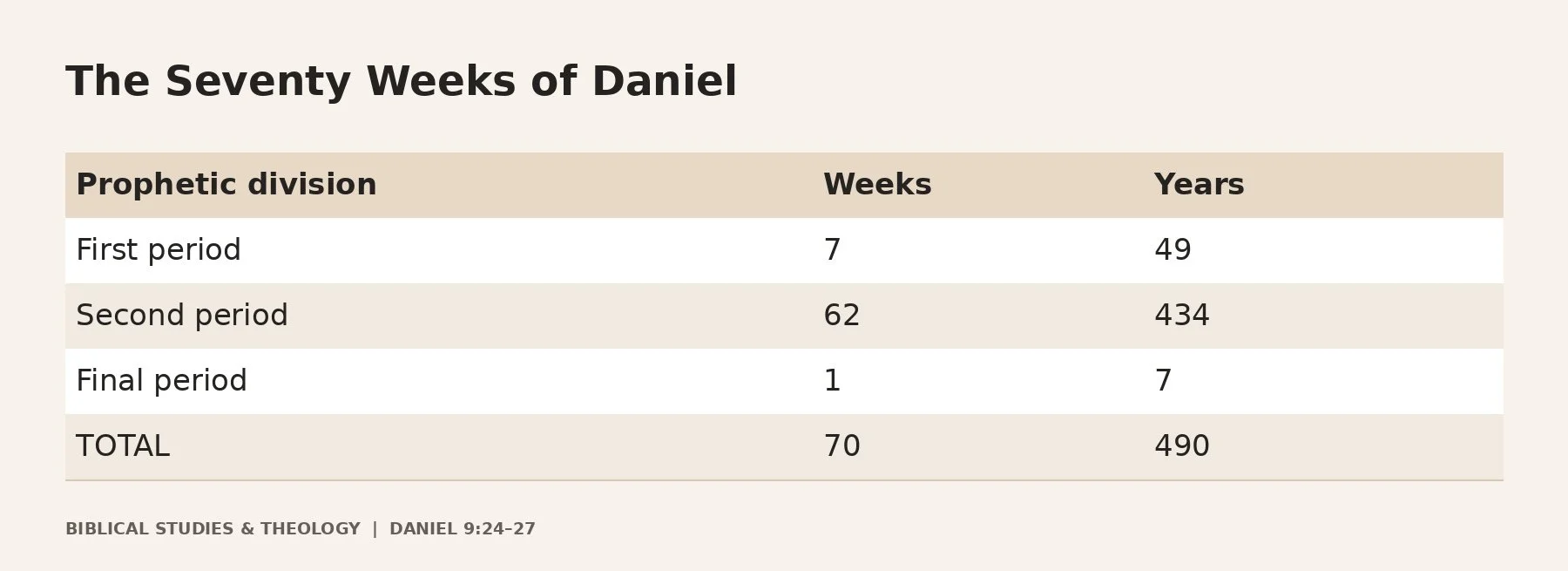
The first two periods total sixty-nine weeks, or 483 years.
(7 + 62) × 7 = 483 years
The final week accounts for the remaining seven years.
The significance of these divisions becomes clearer when the events associated with each period are examined.
III. The Six Purposes of the Seventy Weeks
Daniel 9:24 identifies six purposes to be accomplished concerning Daniel's people and holy city.
These objectives provide the theological foundation for the prophecy.
1. To finish the transgression
The first objective concerns the resolution of transgression.
Within the immediate context, Daniel has confessed Israel's repeated covenant unfaithfulness.
The promised conclusion of transgression therefore addresses the fundamental spiritual problem underlying the exile.
2. To make an end of sins
This purpose extends beyond political restoration.
It anticipates God's decisive dealing with sin.
Christian interpretation naturally connects this objective with the redemptive work of Jesus Christ (Heb. 9:26; 10:12–14).
However, the complete removal of sin's consequences awaits the consummation of God's redemptive purposes.
3. To make reconciliation for iniquity
This expression is especially significant for a Messianic interpretation.
The Hebrew verb kaphar is associated with atonement or expiation.
The prophecy therefore anticipates a decisive provision for human iniquity.
Christians understand Jesus' sacrificial death as the fulfillment of the need for atonement (Rom. 3:24–26; Heb. 9:11–15).
4. To bring in everlasting righteousness
The establishment of everlasting righteousness reaches beyond the return from Babylon.
Although Christ's redemptive work establishes the basis of righteousness for those who believe, the complete realization of righteousness throughout creation remains future (2 Pet. 3:13; Rev. 21:1–4).
5. To seal up vision and prophecy
This expression has been interpreted as the fulfillment, confirmation, or completion of prophetic revelation.
The verb seal does not necessarily mean that prophetic Scripture will cease to exist.
Within this context, the expression may indicate that God's prophetic purposes will be brought to their appointed fulfillment.
6. To anoint the Most Holy
The final expression is debated.
Some interpreters understand it as referring to the consecration of a holy sanctuary.
Others understand it in relation to the Messiah Himself or the ultimate fulfillment of God's presence among His people.
The Hebrew expression qodesh qodashim frequently refers to especially holy places or objects in the Old Testament.
This gives substantial support to a sanctuary-related interpretation, although the precise referent in Daniel 9:24 remains disputed.
Randall Price and Thomas Ice interpret the six purposes as extending from the Messiah's redemptive work to Israel's ultimate restoration, with some objectives accomplished through Christ's first advent and others awaiting His return.³
The essential observation is that Gabriel's answer addresses both the problem of Israel's sin and the completion of God's redemptive purposes.
IV. Is Daniel's Seventy-Weeks Prophecy Messianic?
The Messianic interpretation rests especially upon Daniel 9:25–26.
Daniel 9:25 identifies an anticipated figure whom the NKJV calls Messiah the Prince. Verse 26 then announces that the Messiah will be cut off.
The Hebrew word mashiach means an anointed person.
In the Old Testament, the designation can refer to kings, priests, and individuals appointed for particular purposes. Cyrus, for example, is described as God's anointed in Isaiah 45:1.
Consequently, the occurrence of mashiach does not automatically establish that every reference concerns Jesus Christ.
The identity must be determined from the passage's context.
The case for identifying the Messiah as Jesus Christ
Several considerations favor a Christological interpretation.
First, the prophecy anticipates an anointed figure whose appearance is associated with a significant period of restoration and redemptive expectation.
Second, the Messiah is subsequently described as being cut off.
Third, the prophecy connects the anticipated events with the resolution of sin and the accomplishment of atonement.
Fourth, the cutting off of the Messiah precedes the destruction of Jerusalem and its sanctuary.
These elements are consistent with the historical sequence of Jesus' ministry, crucifixion, and the Roman destruction of Jerusalem in AD 70.
The New Testament also presents Jesus' death as the decisive sacrifice for sin (Heb. 9:26; 10:10–14).
For these reasons, the interpretation that identifies the Messiah of Daniel 9:25–26 with Jesus Christ is theologically compelling.
However, the passage should not be presented as though its Messianic identification were universally accepted or without exegetical difficulty.
An alternative interpretation: Is the anointed one Nehemiah?
Leslie McFall offers a substantially different interpretation in his article, “Do the Sixty-Nine Weeks of Daniel Date the Messianic Mission of Nehemiah or Jesus?”
McFall argues that the immediate anointed figure in Daniel 9:25 is Nehemiah rather than Jesus Christ. His proposal depends upon a revised chronology of Nehemiah's governorship and a different understanding of the relationship between the seventy weeks and the sixty-nine weeks.⁴
McFall's argument correctly draws attention to the broader Old Testament meaning of mashiach.
The term itself cannot settle the question.
However, his interpretation requires substantial revisions to commonly accepted Persian-period chronology. It also understands the relationship between the prophetic periods differently from the more familiar reading of Daniel 9:24–27.
The fact that Nehemiah was a divinely significant leader does not establish that he is the intended figure in Gabriel's prophecy.
Furthermore, the larger context of atonement, everlasting righteousness, and the subsequent destruction of Jerusalem provides a substantial basis for understanding the passage in relation to Christ.
McFall's interpretation is valuable because it demonstrates why the Messianic identification must be argued from context rather than assumed from the English translation alone.
The significance of the Messiah being cut off
Daniel 9:26 announces that the Messiah will be cut off after the sixty-two-week period.
The Hebrew verb karath can describe cutting off, removing, or destroying.
In this context, the expression naturally permits the interpretation that the anticipated anointed figure will experience a violent or untimely death.
Christian interpreters commonly identify this event with the crucifixion of Jesus Christ.
The chronological wording is important.
The text says that the Messiah will be cut off after the sixty-two weeks.
It does not explicitly state that His death occurs on the final day of the sixty-ninth week.
This distinction becomes particularly important when evaluating attempts to calculate the exact date of Jesus' triumphal entry.
V. When Do the Events of the Seventy Weeks Take Place?
The chronological structure of Daniel 9:25–27 associates the prophecy with several identifiable events.
The beginning: A command to restore and rebuild Jerusalem
Daniel 9:25 identifies the starting point as the issuing of a command concerning Jerusalem's restoration and rebuilding.
The challenge is determining which historical decree corresponds to that description.
Several Persian-period decrees are relevant.
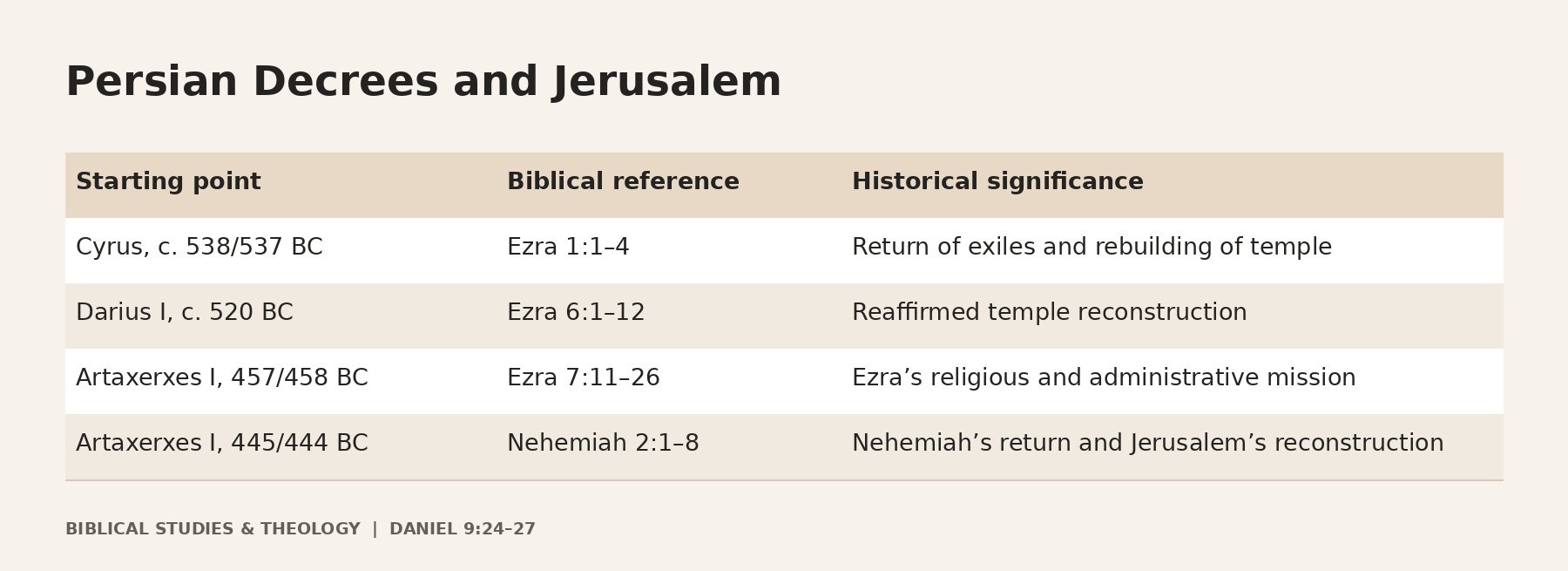
The distinction between restoring the temple and restoring Jerusalem as a functioning city is important.
Those who favor the decree to Nehemiah emphasize that Nehemiah 2 directly concerns Jerusalem's ruined condition, its gates, and the rebuilding work.
Those who favor Ezra 7 emphasize the broader administrative and judicial restoration associated with Ezra's commission.
The biblical text does not explicitly identify the Persian decree by naming Cyrus, Darius, Artaxerxes, or Nehemiah in Daniel 9:25.
Consequently, selecting the correct starting point requires historical and contextual interpretation.
The first seven weeks: Forty-nine years
The first seven weeks correspond to forty-nine years.
Daniel 9:25 associates the rebuilding of Jerusalem with difficult circumstances.
The book of Nehemiah records significant opposition to Jerusalem's reconstruction, including threats, political resistance, and internal difficulties (Neh. 4–6).
These circumstances are consistent with the prophecy's description of restoration amid trouble.
However, Daniel does not explicitly identify which rebuilding milestone concludes the first seven weeks.
This is another reason for caution when attempting exact chronological calculations.
The following sixty-two weeks: Four hundred thirty-four years
The sixty-two weeks, added to the initial seven, produce sixty-nine weeks.
Under the year-week interpretation, the total is 483 years.
This period is commonly understood to lead to the appearance of the anticipated Messiah.
The major question is whether the endpoint should be identified with Jesus' baptism, the beginning of His public ministry, His triumphal entry into Jerusalem, His crucifixion, or another event.
The Hebrew wording and its punctuation have been interpreted differently, particularly concerning how the seven and sixty-two weeks relate to the anointed figure.
The familiar Christian reading combines the seven and sixty-two weeks as a period leading to the Messiah.
That interpretation is substantial, but the text does not itself provide a modern calendar date.
After the sixty-ninth week: The Messiah and Jerusalem
Daniel 9:26 identifies two major developments following the sixty-two weeks:
The Messiah is cut off.
Jerusalem and the sanctuary are destroyed by the people of a coming prince.
Under the Christological interpretation, the first event corresponds to Jesus' crucifixion, commonly dated to AD 30 or AD 33.
The second corresponds to the destruction of Jerusalem and the Second Temple by Roman forces in AD 70.
The destruction of Jerusalem is particularly significant because it occurred after the ministry and death of Jesus.
The historical sequence is consistent with the Messianic reading.
However, it also introduces an important chronological issue.
If the first sixty-nine weeks terminate during the lifetime of Jesus, and the seventieth week follows immediately, how should the destruction of Jerusalem several decades later be understood?
This question is central to the debate over whether the seventy weeks unfold continuously or include an interval between the sixty-ninth and seventieth weeks.
VI. Can the Exact Date of Messiah's Arrival in Jerusalem Be Calculated?
This is perhaps the most fascinating—and most frequently overstated—claim associated with Daniel's prophecy.
Some interpreters maintain that Daniel 9:25 provides a mathematical prediction identifying the precise day Jesus entered Jerusalem in fulfillment of Zechariah 9:9.
The argument is not merely that Daniel predicted the general period of the Messiah's coming.
It is that the prophecy supplies enough chronological information to identify a specific date in the first century.
To evaluate that claim, we must examine both the calculations and their underlying assumptions.
1. The famous calculation of 173,880 days
The calculation begins with the assumption that each prophetic year consists of 360 days.
Under this interpretation:
69 weeks × 7 years × 360 days = 173,880 days
This calculation is associated particularly with Sir Robert Anderson's The Coming Prince and later refinements by Harold W. Hoehner.
Anderson's calculations led to an AD 32 endpoint. Hoehner proposed an adjusted chronology beginning in 444 BC and ending in AD 33.
The source material supplied for this study includes Hoehner's argument that the decree to Nehemiah should be dated to March 5, 444 BC, and that the 173,880-day interval terminates on March 30, AD 33, identified as Jesus' triumphal entry into Jerusalem.⁵
Under this reconstruction, Daniel's prophecy would identify the very day Jesus publicly presented Himself to Jerusalem shortly before His crucifixion.
This is an impressive proposal.
But does the biblical text establish every element necessary for the calculation?
2. Why use a 360-day prophetic year?
Supporters of the calculation appeal to the relationship between several prophetic expressions.
Revelation refers to forty-two months (Rev. 11:2; 13:5) and 1,260 days (Rev. 11:3; 12:6).
When these expressions are understood as equivalent periods, they imply months of thirty days.
Forty-two months of thirty days produce 1,260 days.
Twelve such months produce a year of 360 days.
This correspondence provides a biblical basis for the use of schematic 360-day years in prophetic chronology.
Hughes develops this argument in his examination of the sixty-nine weeks, connecting Daniel's time periods with the chronological expressions found in Revelation.⁶
However, an important distinction must be maintained.
The use of 1,260 days and forty-two months in Revelation does not explicitly state that Daniel's entire 483-year period must be calculated using uninterrupted 360-day years.
Ancient Israel's calendar was lunisolar, employing adjustments to maintain correspondence with the seasons.
Therefore, a 360-day prophetic year is a defensible interpretive proposal, but it is not an indisputable chronological requirement established by Daniel 9 itself.
3. The Calendar Problem: Babylonian, Julian, and Gregorian Reckoning
An additional difficulty arises from the differences between the calendar systems employed in the ancient Near East and those used in modern chronological calculations.
During the Persian period, Jewish calendrical reckoning was influenced by the Babylonian lunisolar calendar, which organized months according to lunar cycles and periodically inserted an additional month to maintain correspondence with the solar year.
Consequently, the historical Babylonian calendar should not be confused with the proposed 360-day prophetic year employed in some interpretations of Daniel 9.
An ordinary Babylonian calendar year consisted of twelve lunar months totaling approximately 354 days. An additional month was periodically inserted to keep the calendar aligned with the seasons.
The modern Gregorian calendar, by contrast, follows the solar year, employing years of 365 days and leap years of 366 days.
The Julian calendar, introduced during the Roman period, used a different leap-year system.
These distinctions become especially important when attempting to identify the exact date of Artaxerxes' authorization to Nehemiah.
Nehemiah 2:1 specifies the month of Nisan but does not identify the day of the month.
Assigning the decree to Nisan 1 therefore requires an assumption not explicitly established by Scripture.
Furthermore, converting ancient Babylonian or Jewish dates into Julian or Gregorian dates requires careful attention to lunar observations, intercalation, and the calendar conventions used in historical reconstruction.
The Gregorian calendar itself was not introduced until AD 1582.
Consequently, modern calculations involving dates in the Persian period and the first century commonly employ the Julian calendar projected backward into earlier centuries, or astronomical systems such as the Julian Day Number.
These systems can be used to calculate elapsed days, but the dates must be handled consistently.
The disagreement between Hoehner and Hughes
Christopher A. Hughes identifies a significant difficulty in Harold Hoehner's influential calculation.
Whereas Hoehner identifies Nisan 1 in 444 BC with March 5 on the Julian calendar, Hughes argues from astronomical calculations and evidence associated with the Elephantine papyri that Nisan 1 should instead be dated to approximately April 2, 444 BC.⁷
This difference of approximately twenty-eight days substantially affects the proposed endpoint of the sixty-nine weeks.
Using the same 173,880-day interval, Hughes calculates that the later starting date produces an endpoint of April 23, AD 33, rather than the date traditionally associated with Jesus' triumphal entry.⁸
The significance of this disagreement should not be underestimated.
Both calculations proceed from a broadly Messianic understanding of Daniel's prophecy, yet they produce different chronological conclusions because of their treatment of the ancient calendar.
The issue is therefore not simply whether the arithmetic is correct.
The more fundamental question concerns whether the historical dates and calendrical assumptions employed in the calculation can be established with sufficient certainty.
A calculation may be mathematically exact while the historical assumptions upon which it depends remain uncertain.
These difficulties do not invalidate the Messianic interpretation of Daniel 9:24–27.
They do, however, caution against claiming that the prophecy provides an indisputably exact prediction of the day Jesus entered Jerusalem.
4. The problem of the starting date
Even if the 360-day year is accepted, the calculation still depends upon identifying the correct decree.
As previously observed, several Persian decrees have been proposed.
The difference between a decree in 457 BC and one in 444 BC is approximately thirteen years.
That difference is far too substantial to dismiss when claiming day-level chronological precision.
Furthermore, the decree to Nehemiah is dated to the month of Nisan in the twentieth year of Artaxerxes (Neh. 2:1).
The biblical text does not provide the precise day of that month.
Hoehner's reconstruction identifies Nisan 1 through historical and astronomical calculations.
Such a reconstruction may be reasonable, but the precise date is derived from historical inference rather than explicitly supplied by Nehemiah.
A calculation cannot establish greater certainty than its starting assumptions permit.
5. The problem of the endpoint
The endpoint presents another difficulty.
Daniel 9:25 speaks of the period leading to an anointed prince.
Daniel 9:26 subsequently describes the Messiah being cut off.
Neither verse explicitly mentions Jesus' triumphal entry.
The identification of that event as the endpoint comes from connecting Daniel's prophecy with the Gospel accounts of Jesus entering Jerusalem.
This connection has theological appeal, especially because the entry fulfills the royal expectation of Zechariah 9:9.
Nevertheless, the identification must be argued rather than assumed.
Could the endpoint instead refer to Jesus' baptism and public manifestation as Messiah?
Could it refer to the beginning of His ministry?
Or does the prophecy anticipate His death?
These questions remain disputed even among scholars who affirm that Daniel's prophecy refers to Jesus Christ.
6. Christopher Hughes and a revised endpoint
Christopher A. Hughes directly examines this problem in his study, “The Terminus Ad Quem of Daniel's 69th Week: A Novel Solution.”
Hughes broadly accepts Hoehner's proposed starting period and the 360-day prophetic-year calculation.
However, he questions the identification of the triumphal entry as the required endpoint and proposes a modification of the chronology.
His analysis is especially important because it demonstrates that even scholars who share a literal, Messianic interpretation of Daniel's prophecy can disagree about precisely which event should terminate the sixty-nine weeks.⁹
The dispute is not necessarily over whether Daniel anticipates Christ.
It concerns how the chronological language should be applied.
7. Comparing the proposed calculations
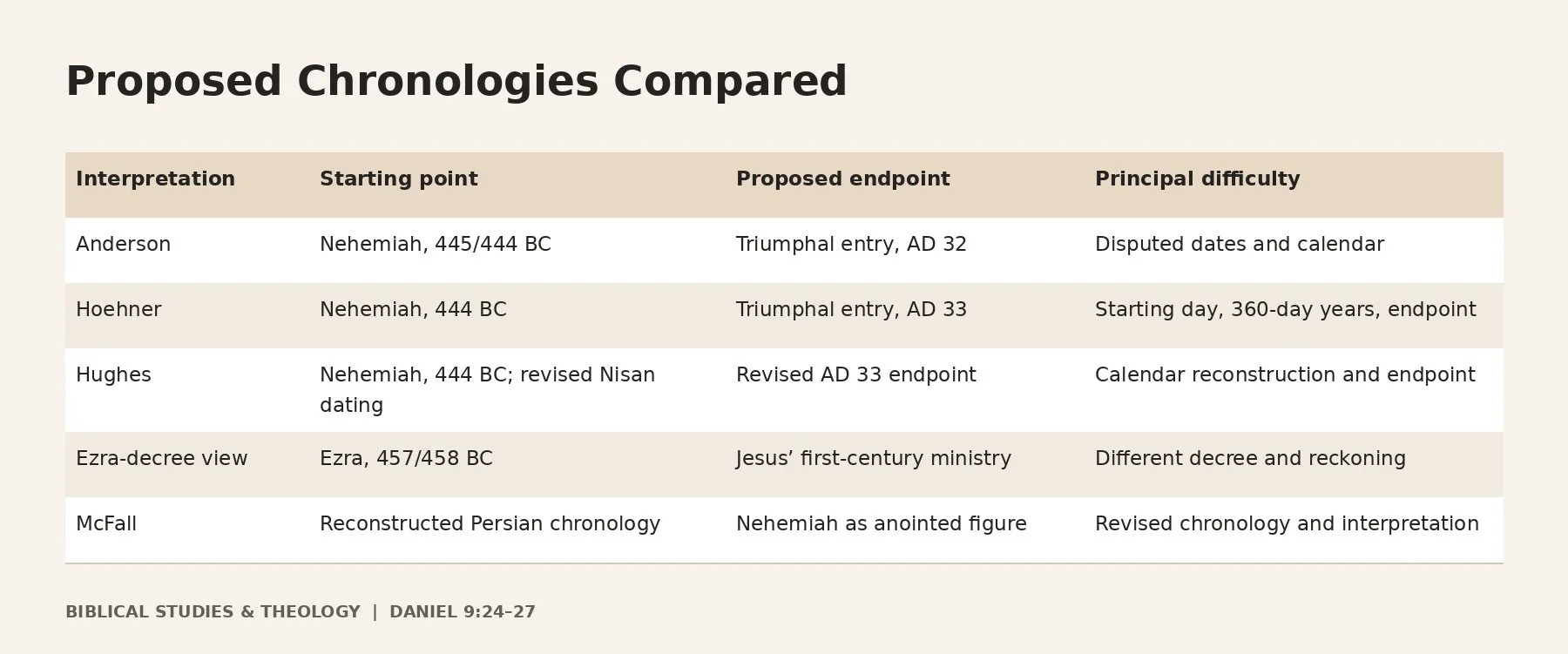
The differences are significant.
They demonstrate that the mathematical calculation is not self-interpreting.
The result depends upon a series of historical, linguistic, and theological decisions.
8. What can we responsibly conclude?
The strongest conclusion is not that Daniel 9 establishes an independently verifiable prediction of the precise day Jesus entered Jerusalem.
Rather, the passage provides a prophetic chronology that, under a substantial Christian interpretation, anticipates the appearance and death of the Messiah during the Second Temple period.
The proposed 173,880-day calculation is mathematically coherent once its assumptions are accepted.
However, mathematical precision does not automatically establish historical or exegetical certainty.
A calculation can be exact while the dates and interpretive premises upon which it depends remain disputed.
This distinction does not diminish the theological importance of the prophecy.
It prevents an otherwise persuasive Messianic argument from depending upon a degree of chronological certainty that Scripture itself does not explicitly provide.
The Messianic interpretation of Daniel 9 does not stand or fall upon proving that Jesus entered Jerusalem on March 30, AD 33.
VII. What Happens During the Seventieth Week?
Daniel 9:27 describes the final week.
The passage introduces a figure who confirms a covenant for one week, interrupts sacrifice and offering halfway through the period, and is associated with abomination and desolation.
If the week represents seven years, its midpoint occurs after three and one-half years.
This naturally connects with other prophetic references to three and one-half years, forty-two months, and 1,260 days (Dan. 7:25; 12:7; Rev. 11:2–3; 12:6; 13:5).
The central interpretive question concerns the identity of the figure who confirms the covenant and the timing of these events.
The future seventieth-week interpretation
Under the futurist interpretation, the seventieth week remains to be fulfilled.
The coming prince is understood as a future ruler who will establish or confirm a covenant, then violate it midway through the seven-year period.
The interruption of sacrifice and the abomination of desolation are connected with the future rebellion described in 2 Thessalonians 2:3–4 and the activities of the beast in Revelation 13.
Jesus' reference to Daniel's abomination of desolation in Matthew 24:15 is especially important to this interpretation.
Because Jesus spoke of this event as future during His earthly ministry, futurist interpreters understand His teaching as evidence that Daniel's prophecy extends beyond the events associated with Antiochus IV Epiphanes in the second century BC.
The futurist position also understands the final week as particularly associated with God's purposes for Israel and Jerusalem.
The prophecy was explicitly given concerning Daniel's people and holy city.
The future restoration anticipated by Jeremiah 30–33, Ezekiel 36–37, Zechariah 12–14, and Romans 11 is therefore understood as relevant to the completion of the seventy weeks.
Price and Ice develop this interpretation by distinguishing the accomplishments of Messiah's first advent from the remaining objectives associated with His future reign.¹⁰
Is there a gap between the sixty-ninth and seventieth weeks?
The futurist interpretation commonly proposes an interval between the sixty-ninth and seventieth weeks.
This interval is often associated with the present church age.
The argument rests partly upon Daniel 9:26, which describes the Messiah being cut off and the subsequent destruction of Jerusalem before the events of verse 27 are completed.
If the Messiah's death occurred around AD 30–33 and Jerusalem was destroyed in AD 70, the two events cannot both fit within a single seven-year period immediately following the sixty-ninth week.
The futurist interpretation therefore understands the events of verse 26 as occurring during an interval before the final week begins.
The prophecy does not explicitly call this interval the church age, nor does it specify its length.
The proposed gap is an inference drawn from the sequence of events and their relationship to other prophetic passages.
An interval between prophetic events is not inherently impossible.
Nevertheless, it must be recognized that Daniel 9 does not explicitly announce a suspension of the seventy-week chronology.
This is one of the principal objections raised by interpreters who understand the seventy weeks as a continuous period.
The continuous fulfillment interpretation
Other Christian interpreters understand the seventieth week as associated with Jesus' earthly ministry, death, and the establishment of the new covenant.
Under this interpretation, the figure who confirms the covenant is Christ rather than a future Antichrist.
The cessation of sacrifice is understood in relation to Christ's once-for-all atonement.
This approach emphasizes the redemptive accomplishment of Jesus and avoids inserting a long chronological interval between the sixty-ninth and seventieth weeks.
However, it faces its own difficulties.
Daniel 9:27 describes the interruption of sacrifice in connection with abomination and desolation.
Identifying these events directly with Christ's atoning work requires careful explanation, particularly because the destruction of Jerusalem occurred decades after His crucifixion.
Furthermore, the continued future orientation of certain prophetic passages, including Matthew 24 and 2 Thessalonians 2, must be accounted for.
The Antiochus IV interpretation
A third major approach connects the prophecy primarily with events surrounding Antiochus IV Epiphanes and the desecration of the Jerusalem temple in the second century BC.
This interpretation is especially prominent in historical-critical scholarship.
It understands the seventy weeks in relation to the crises of the Second Temple period and the persecution associated with Antiochus.
This approach has the advantage of recognizing the importance of Antiochus in Daniel's wider prophetic material, particularly Daniel 8 and 11.
However, the interpretation must explain how the chronology, the anticipated anointed figures, and the six objectives of Daniel 9:24 relate to those historical events.
It also raises questions about the relationship between Daniel's prophecy and Jesus' later reference to the abomination of desolation.
The historical-critical interpretation therefore deserves consideration, but it does not eliminate the substantial biblical arguments for a prophecy extending beyond the second century BC.
VIII. A Synopsis of Daniel's Seventy Weeks
Under the futurist Messianic interpretation, the prophetic sequence may be summarized as follows:
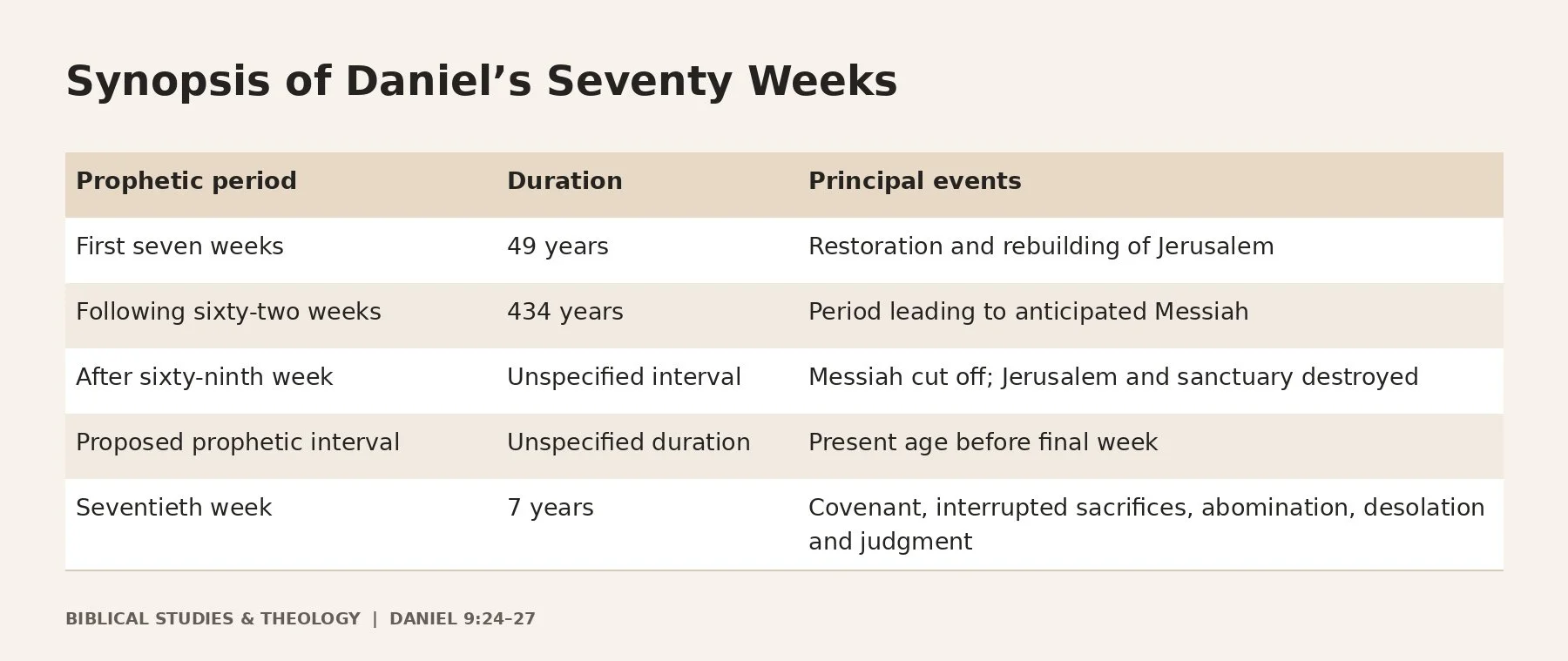
This interpretation understands the seventy weeks as a prophetic program that begins with Jerusalem's restoration, anticipates the Messiah's coming and death, and concludes with the fulfillment of God's purposes for Israel.
The principal theological strength of the futurist interpretation is that it allows the six purposes of Daniel 9:24 to encompass both the accomplished work of Christ and the future consummation of God's promises.
Its principal chronological difficulty is the proposed interval between the sixty-ninth and seventieth weeks.
That difficulty should be acknowledged rather than minimized.
IX. The Relationship Between Daniel's Seventy Weeks and the New Testament
The New Testament does not provide a complete chronological commentary on Daniel 9:24–27.
Nevertheless, several passages are particularly relevant.
Jesus and the abomination of desolation
In Matthew 24:15, Jesus refers explicitly to the abomination of desolation spoken of by Daniel.
This establishes that Daniel's prophecy remained significant to Jesus' teaching concerning future judgment.
The precise relationship between Jesus' warning, the Roman destruction of Jerusalem in AD 70, and any final eschatological fulfillment remains debated.
However, the reference demonstrates that Daniel's prophetic material cannot be evaluated in isolation from the New Testament.
Paul and the man of lawlessness
Second Thessalonians 2:3–12 describes a future rebellion and the revelation of the man of lawlessness.
Paul associates this figure with extraordinary opposition to God and eventual destruction through the appearing of Jesus Christ.
The similarities to Daniel's descriptions of arrogant rulers and desecration provide substantial grounds for interpreting these passages together.
Nevertheless, Paul does not explicitly identify the man of lawlessness as the prince of Daniel 9:26–27.
That identification is a theological synthesis.
Revelation and the final period of judgment
Revelation repeatedly employs periods of forty-two months and 1,260 days.
These expressions correspond naturally with the division of Daniel's final week into two halves.
The relationship is especially significant when Revelation's descriptions of persecution, the beast, and divine judgment are considered alongside Daniel 7, 9, and 12.
The resulting prophetic framework is coherent within a futurist interpretation.
However, the relationship between these texts must be established by their language and context rather than simply assuming that every reference to three and one-half years describes the same event.
God's continuing purposes for Israel
Romans 11:25–29 anticipates a future expression of divine mercy toward Israel and emphasizes the continuing significance of God's calling.
This passage is relevant because Daniel 9:24 explicitly concerns Daniel's people and Jerusalem.
A future fulfillment of the seventieth week is therefore consistent with the expectation that God's purposes for national Israel have not been exhausted.
Nevertheless, Romans 11 does not explicitly identify Daniel's seventieth week or specify its chronological relationship to the church's rapture.
These are related but distinct interpretive questions.
X. Theological Conclusion: The Faithfulness of God and the Certainty of His Promises
Daniel's seventy-weeks prophecy is among the most remarkable and complex passages of biblical prophecy. Its interpretation requires careful consideration of historical events, ancient calendars, Hebrew terminology, and the relationship between Old Testament promises and their fulfillment in Jesus Christ.
Yet beneath these technical questions lies a far more important theological truth: God is faithful to His Word, and His redemptive purposes cannot be thwarted.
Daniel received this revelation while contemplating the devastation of Jerusalem, the destruction of the temple, and the exile of his people. From a human perspective, Israel's future appeared uncertain. The nation had experienced divine judgment, its monarchy had collapsed, and the promises concerning Jerusalem and David's royal descendants seemed distant from fulfillment.
Nevertheless, God had not abandoned His people or forgotten His promises.
Gabriel's revelation assured Daniel that the history of Israel was not unfolding by chance. God had determined a future in which sin would be dealt with, atonement accomplished, everlasting righteousness established, and His redemptive purposes brought to completion (Dan. 9:24).
For Christians today, this prophecy offers several enduring truths that should strengthen our faith, deepen our confidence in Scripture, and encourage us to persevere in the hope of Christ's return.
1. God's promises cannot be thwarted
Perhaps the greatest encouragement found in Daniel's prophecy is the assurance that God accomplishes what He promises.
The Babylonian captivity had not invalidated God's covenant purposes. Israel's disobedience had brought severe consequences, but even divine judgment did not mean that God had abandoned His promises.
The Lord declared through Isaiah:
"So shall My word be that goes forth from My mouth; It shall not return to Me void" (Isa. 55:11, NKJV).
God's faithfulness does not depend upon favorable circumstances, political stability, or human ability. What He has promised, He possesses both the authority and the power to accomplish.
This truth extends beyond the nation of Israel to every believer who places confidence in the promises of Scripture.
Christians may experience suffering, disappointment, uncertainty, and circumstances that seem inconsistent with God's goodness. Yet the apparent delay of divine promises should never be confused with their failure.
Peter reminds believers that the Lord is not negligent concerning His promises (2 Pet. 3:9).
Daniel's prophecy teaches us that God's purposes are not defeated by human rebellion, historical upheaval, or the passage of time.
What God has determined will ultimately come to pass.
2. God has not forgotten His covenant promises to Israel
Daniel 9:24 specifically identifies the recipients of the prophecy as Daniel's people and his holy city.
This distinction is significant.
The prophecy was given in response to Daniel's prayer concerning Israel and Jerusalem. Its promises must therefore be considered in light of God's continuing covenant relationship with the descendants of Abraham, Isaac, and Jacob.
The New Testament affirms that God's purposes for Israel have not been permanently set aside.
Paul asks:
"Has God cast away His people? Certainly not!" (Rom. 11:1, NKJV).
He later explains that Israel's present hardening is partial and anticipates a future expression of divine mercy (Rom. 11:25–29).
Although Christians differ concerning the precise manner and timing of these events, Daniel's prophecy provides substantial support for the expectation that God's redemptive purposes concerning Israel and Jerusalem have not yet reached their final consummation.
This should encourage Christians to recognize the consistency of God's covenant faithfulness.
If God were to abandon His promises to Israel, what confidence could believers have that He would remain faithful to His promises concerning the church?
Yet Scripture assures us that God's faithfulness is grounded in His own unchanging character.
As Paul writes:
"For the gifts and the calling of God are irrevocable" (Rom. 11:29, NKJV).
The future of Israel therefore serves as a continuing testimony to the faithfulness of the God who keeps His covenant promises.
3. Daniel's prophecy strengthens our confidence that Jesus is the promised Messiah
One of the most significant features of Daniel 9:24–27 is its anticipation of an anointed figure who would appear and subsequently be cut off.
The Messianic interpretation finds its fulfillment in Jesus of Nazareth, whose ministry, sacrificial death, and resurrection stand at the center of God's redemptive purposes.
Although the precise chronological calculations remain debated, the broader correspondence between Daniel's prophecy and the historical ministry of Jesus is theologically compelling.
Daniel anticipated a Messiah who would be cut off. The New Testament proclaims that Jesus Christ was crucified, not for His own sins, but as the sacrifice through which God provides redemption for sinners (Isa. 53:5–6; Rom. 3:24–26; Heb. 9:26).
The prophecy's emphasis upon atonement and everlasting righteousness finds its decisive foundation in Christ's redemptive work.
Jesus Himself taught that the Scriptures testify concerning Him (John 5:39). Following His resurrection, He explained to His disciples how the Law, the Prophets, and the Psalms anticipated His suffering and glory (Luke 24:25–27, 44–47).
Daniel's seventy-weeks prophecy belongs within this larger testimony of Scripture.
For believers, the significance is profound.
Our confidence in Jesus Christ does not rest upon religious sentiment alone. It rests upon the testimony of Scripture, the historical reality of His life and death, and the apostolic witness to His resurrection.
The Messianic significance of Daniel's prophecy provides yet another reason to affirm that Jesus of Nazareth is God's promised and anointed Messiah.
4. God's promise to David finds its fulfillment in Jesus Christ, the eternal King
Daniel's prophecy must also be understood within the larger biblical expectation of a coming Davidic King.
Centuries before Daniel, God established a covenant with David, promising that his royal house and kingdom would endure (2 Sam. 7:12–16).
Although individual Davidic kings would die and the earthly monarchy would experience judgment, God's promise anticipated an enduring royal dynasty culminating in an everlasting reign.
The prophets repeatedly affirmed this expectation.
Isaiah announced that a coming Son would reign upon David's throne and establish a kingdom characterized by justice and righteousness (Isa. 9:6–7).
Jeremiah likewise anticipated a righteous Branch from David's line who would reign as King (Jer. 23:5–6).
When the angel Gabriel announced the birth of Jesus to Mary, he explicitly connected Jesus with this covenant promise:
"The Lord God will give Him the throne of His father David" (Luke 1:32, NKJV).
Gabriel further declared that Christ's kingdom would have no end (Luke 1:33).
The New Testament identifies Jesus as the promised Son of David (Matt. 1:1; Rom. 1:3–4). His resurrection and exaltation confirm that death cannot overthrow His kingship (Acts 2:29–36).
Within a premillennial understanding of biblical prophecy, Christ's future reign will bring the promises concerning David's throne and Israel's restoration to their full historical expression. His kingdom, however, is ultimately everlasting, extending beyond the millennium into the consummation of God's eternal purposes.
Daniel's prophecy contributes to this larger biblical expectation by anticipating the Messiah's appearance, His being cut off, and the ultimate establishment of everlasting righteousness.
The apparent defeat of the Messiah through crucifixion was not the failure of God's promise.
It was central to the accomplishment of redemption.
The risen Jesus Christ is the promised Son of David, whose kingship cannot be overturned and whose kingdom will never end.
5. Prophecy should produce confidence, holiness, and hope—not merely speculation
The purpose of biblical prophecy is not simply to satisfy human curiosity about future events.
Its greater purpose is to reveal the character, sovereignty, and faithfulness of God.
Daniel did not receive the seventy-weeks prophecy while pursuing an intellectual exercise. He received it while praying, confessing sin, and pleading for God's mercy upon His people.
That context should influence how Christians approach prophetic Scripture today.
The interpretation of Daniel 9 involves legitimate questions about historical dates, calendars, and the sequence of future events. These questions deserve careful scholarly examination.
Yet believers should not become so absorbed in prophetic calculations that they overlook the spiritual significance of the revelation.
The God who revealed the future to Daniel is the same God who sustains His people today.
He has not lost control of history.
He has not forgotten His promises.
He has not abandoned Israel.
He has not failed to provide redemption through His Son.
And He will not fail to bring His kingdom to its appointed fulfillment.
The apostle Paul reminds believers:
"For all the promises of God in Him are Yes, and in Him Amen" (2 Cor. 1:20, NKJV).
This is where the study of Daniel's seventy weeks should ultimately lead us—not merely to greater knowledge of prophecy, but to deeper confidence in Jesus Christ.
Final Exhortation: Trust the God Who Keeps His Word
Daniel lived during a period when the circumstances surrounding God's people seemed to contradict the promises they had received.
Jerusalem lay in ruins. The temple had been destroyed. The nation had experienced exile, and the Davidic monarchy appeared to have come to an end.
Yet heaven's answer to Daniel was that God had not forgotten.
The Lord was accomplishing a purpose far greater than Daniel could have imagined.
The same truth remains relevant to Christians today.
We may not understand every detail of God's providence. We may struggle to reconcile His promises with the suffering and uncertainty of our circumstances. We may even find ourselves wondering why the fulfillment of His Word appears delayed.
But Daniel's prophecy reminds us that God's faithfulness is not measured by our ability to understand His timing.
The God who promised a Messiah has sent His Son. The God who promised redemption has provided atonement through Christ. The God who promised David an enduring kingdom has raised up the eternal King. And the God who has preserved His covenant purposes for Israel will bring His remaining promises to fulfillment.
Therefore, let the study of Daniel's seventy weeks produce more than an interest in prophetic chronology.
Let it strengthen our confidence in Scripture.
Let it encourage us to trust God's promises even when circumstances seem uncertain.
Let it deepen our gratitude for the redeeming work of Jesus Christ.
And let it renew our expectation of the day when the King of kings will establish righteousness and bring God's redemptive purposes to their glorious completion.
For the Christian, the ultimate assurance is not that we can calculate every prophetic date, but that we know the God who holds every moment of history in His hands.
And He is faithful.
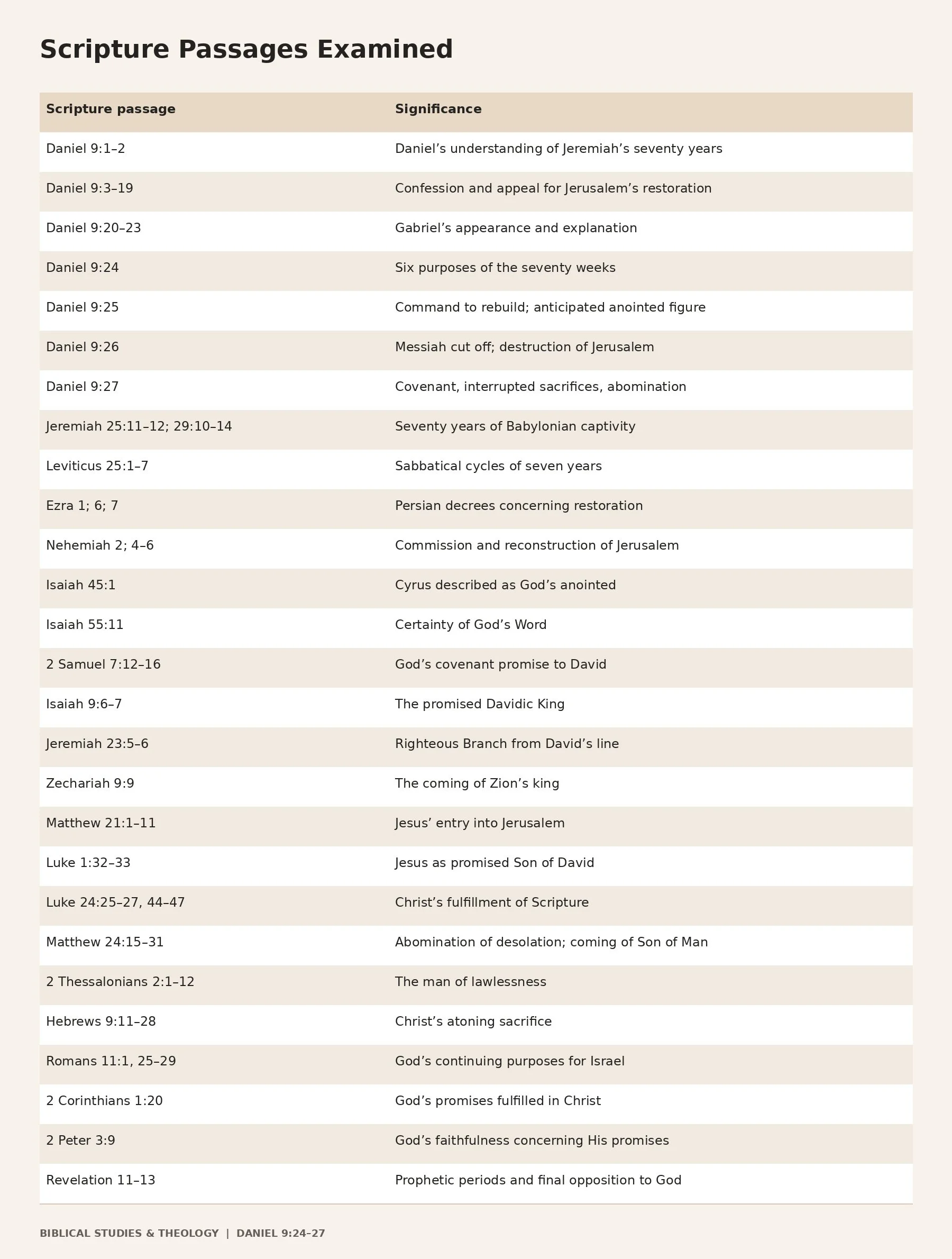
Questions for Reflection
Why is Daniel's prayer in Daniel 9:3–19 essential for understanding Gabriel's prophecy?
How does Jeremiah's prophecy of seventy years relate to Daniel's seventy sevens?
What evidence supports interpreting the seventy weeks as 490 years?
What are the six purposes identified in Daniel 9:24, and which have already been accomplished through Christ?
Why is the Hebrew meaning of mashiach important when identifying the anticipated anointed figure?
What evidence favors understanding the Messiah of Daniel 9:25–26 as Jesus Christ?
Which Persian decree best corresponds to the command to restore and rebuild Jerusalem?
What assumptions are required to calculate the 173,880 days proposed by Anderson and Hoehner?
How do the differences between the Babylonian, Julian, and Gregorian calendars affect claims that Daniel's prophecy predicts an exact calendar date?
Does the prophecy explicitly identify Jesus' triumphal entry as the endpoint of the sixty-nine weeks?
What arguments support or challenge an interval between the sixty-ninth and seventieth weeks?
How does Jesus' reference to Daniel in Matthew 24 influence our interpretation of the prophecy?
What does Daniel's prophecy reveal about God's faithfulness to His promises concerning Israel?
How does the Messianic interpretation of Daniel 9 strengthen our confidence that Jesus of Nazareth is God's promised Messiah?
How does the fulfillment of the Davidic covenant in Jesus Christ encourage our expectation of His everlasting kingdom?
How does God's faithfulness in fulfilling His promises concerning Israel, the Messiah, and David's eternal kingdom strengthen your confidence in His promises during seasons of personal suffering, uncertainty, or apparent delay?
Footnotes
Daniel Wiley, “Jeremiah's Seventy Years According to Daniel: An Evaluation of the Major Views and Their Implications for the Interpretation of Prophecy,” Journal of Dispensational Theology 22 (2018), 3–4. Wiley argues that Daniel understood Jeremiah's seventy years as a historical period associated with the Babylonian captivity and the decree of Cyrus.
Christopher A. Hughes, “The Terminus Ad Quem of Daniel's 69th Week: A Novel Solution,” Journal of Dispensational Theology 17, nos. 50–52 (2013): 3–4. Hughes discusses the meaning of the Hebrew term for weeks, the relationship to sabbatical years, and the proposed use of 360-day prophetic years.
Randall Price and Thomas Ice, “Seventy Weeks of Daniel,” in The Harvest Handbook of Bible Prophecy, ed. Ed Hindson, Mark Hitchcock, and Tim LaHaye (Eugene, OR: Harvest House Publishers, 2020), 391. See also David Olander, The Greatness of the Rapture: The Pre-Day of the Lord Rapture, ed. Kenneth R. Cooper and Christopher Cone (Fort Worth, TX: Tyndale Seminary Press, 2009), 221–24.
Leslie McFall, “Do the Sixty-Nine Weeks of Daniel Date the Messianic Mission of Nehemiah or Jesus?” Journal of the Evangelical Theological Society 52, no. 4 (December 2009): 673–76. McFall argues for identifying Nehemiah as the immediate anointed figure and proposes an alternative chronology.
Harold W. Hoehner, Chronological Aspects of the Life of Christ (Grand Rapids: Zondervan, 1977), 115–39; see also Hoehner, “Chronological Aspects of the Life of Christ, Part VI: Daniel's Seventy Weeks and New Testament Chronology,” Bibliotheca Sacra 132 (January–March 1975): 47–65. The supplied compilation reproduces Hoehner's calculation of March 5, 444 BC, to March 30, AD 33.
Hughes, “Terminus Ad Quem,” 3–4. His discussion appeals to the relationship between 1,260 days, forty-two months, and three and one-half years in Daniel and Revelation.
Hughes, “Terminus Ad Quem,” 13–14 and subsequent discussion. Hughes challenges Hoehner's reconstruction of Nisan 1 in 444 BC using astronomical calculations and evidence associated with the Elephantine papyri.
Hughes, “Terminus Ad Quem,” discussion of the Julian Day calculation beginning April 2, 444 BC, and terminating April 23, AD 33. The precise page span for this calculation should be checked against the original source before publication.
Hughes, “Terminus Ad Quem,” 1–2. Hughes challenges the certainty of Hoehner's endpoint while retaining important features of his chronological framework.
Price and Ice, “Seventy Weeks of Daniel,” 391 and the accompanying supplied excerpt. See also Olander, Greatness of the Rapture, 221–24.