A Biblical and Research-Based Assessment of Spiritual Growth, Christian Motivation, and the Great Commission
Biblical Studies & Theology | Discipleship Series
Theological Abstract
The American church faces a significant challenge in fulfilling Christ's command to make disciples. Although churches provide worship services, biblical instruction, small groups, and numerous ministry programs, research raises important questions about whether these activities consistently contribute to spiritual maturity.
George Barna identified this problem more than two decades ago in Growing True Disciples, arguing that many Christians recognize the importance of spiritual growth without demonstrating the priorities, motivation, perseverance, or personal accountability necessary to pursue it.¹ His critique also challenged churches to distinguish religious participation from genuine spiritual transformation.
Recent research from Barna Group and the Cultural Research Center at Arizona Christian University suggests that many of these concerns remain relevant. Studies examining intentional discipleship relationships, biblical worldview, Christian identity, and spiritual engagement reveal substantial differences between identifying with Christianity, participating in church activities, and developing a life increasingly shaped by biblical truth.
Additional research, including Willow Creek Community Church's historical REVEAL study and Stephen McQuoid's examination of spiritual formation, underscores the importance of intentional discipleship, meaningful Christian relationships, and personal responsibility.
This study examines the discipleship crisis from three perspectives: the responsibility of church leadership, the attitudes and motivations of individual believers, and the biblical nature of spiritual formation.
Central Thesis: The discipleship crisis in the American church is not merely an institutional failure to provide opportunities for spiritual growth. It is also a widespread misunderstanding of discipleship and a failure to cultivate the motivation, priorities, relationships, and personal commitment necessary for believers to pursue maturity in Jesus Christ.
I. Introduction: A Church Rich in Resources but Questioned About Results
The American church possesses extraordinary resources for biblical education and spiritual development.
Churches provide preaching, Bible studies, conferences, small groups, leadership training, digital libraries, podcasts, and extensive educational materials.
Yet the abundance of these resources raises an uncomfortable question:
Why does spiritual immaturity remain a significant concern within American Christianity?
The answer cannot be reduced to a single explanation.
Some congregations may provide inadequate biblical instruction. Others may emphasize attendance and programming without developing meaningful discipling relationships.
However, church leadership is not the only consideration.
Individual believers may misunderstand what discipleship entails or lack sufficient motivation to pursue spiritual growth.
A person may attend church for years, listen to hundreds of sermons, and participate in numerous Bible studies without intentionally developing habits of prayer, biblical obedience, personal accountability, or Christian service.
This does not necessarily mean that the individual lacks genuine faith.
It does raise questions about the relationship between religious participation and spiritual maturity.
The Great Commission establishes a responsibility extending beyond attendance or religious affiliation.
Jesus commanded His followers to make disciples and teach them to observe His commandments (Matt. 28:18–20).
Paul similarly described the purpose of his ministry as presenting believers mature in Christ (Col. 1:28–29).
The biblical objective is therefore not simply the communication of information.
It is the formation of believers whose lives increasingly reflect the character and teaching of Jesus Christ.
II. George Barna's Warning: The Problem Is Not Merely a Lack of Opportunity
More than two decades ago, George Barna examined the effectiveness of discipleship within American Christianity.
In Growing True Disciples, he identified a troubling difference between what Christians professed concerning spiritual growth and the priorities reflected in their everyday lives.
Barna argued that the principal obstacles frequently involved motivation, priorities, perseverance, inadequate accountability, and the absence of church environments intentionally designed to support spiritual maturity.¹
His analysis is especially important because it challenges the assumption that providing additional religious activities will necessarily produce more mature Christians.
The Difference Between Recognizing Importance and Establishing Priorities
Many believers understand that studying Scripture, praying, obeying Christ, and growing spiritually are important.
However, recognizing the importance of an activity does not necessarily mean making it a priority.
A Christian may sincerely believe that prayer is essential while rarely establishing time for prayer.
Another may affirm the authority of Scripture without regularly studying it.
Still another may agree that Christian fellowship and accountability are important while avoiding relationships that encourage personal examination and growth.
Barna identified this disconnect as a significant barrier to effective discipleship.
The concern is not simply a shortage of information.
It is the failure to translate acknowledged convictions into sustained priorities.
Jesus addressed a similar problem in the parable of the sower.
In Matthew 13:22, He described the concerns of this world and the deceitfulness of riches as influences that hinder the fruitfulness of God's Word.
The passage does not teach that ordinary responsibilities are inherently sinful.
It warns that competing concerns can become so dominant that spiritual fruitfulness is diminished.
The Difference Between Participation and Transformation
Barna also challenged the assumption that participation in a discipleship activity establishes spiritual maturity.
A believer may attend a small group without meaningfully applying Scripture.
A church may offer numerous Bible studies without cultivating personal accountability.
Participants may complete a curriculum without becoming more capable of encouraging or discipling others.
This is a critical distinction.
Religious participation provides opportunities for spiritual growth. It does not, by itself, establish that spiritual growth has occurred.
Barna's criticism was not that programs or small groups should be abandoned.
Rather, churches should evaluate whether these activities contribute to the intended outcome: believers who increasingly understand and follow Jesus Christ.
III. Do Christians Understand What Discipleship Actually Means?
One of the central problems in contemporary Christianity is the lack of a consistently understood definition of discipleship.
The term may describe a Bible study, a church class, a mentoring relationship, a leadership program, or a short period of instruction for new converts.
These activities may contribute to discipleship.
However, none adequately defines discipleship in its entirety.
Discipleship Is Not Merely a Program
A program has an established beginning and end.
Christian discipleship is a continuing relationship with Jesus Christ.
Jesus declared:
“If anyone desires to come after Me, let him deny himself, and take up his cross daily, and follow Me.” (Luke 9:23, NKJV)
The instruction is not limited to a particular period of religious education.
It describes the continuing calling of those who follow Christ.
Discipleship Is Not Merely Biblical Knowledge
Biblical understanding is indispensable.
However, knowledge alone does not establish spiritual maturity.
James warned believers against hearing God's Word without practicing it (James 1:22–25).
Paul identified love as essential to Christian maturity and warned against knowledge that produces pride (1 Cor. 8:1).
A person may possess considerable theological knowledge while demonstrating little patience, humility, generosity, or concern for others.
This does not diminish the importance of sound doctrine.
It demonstrates that biblical knowledge must influence character and conduct.
Discipleship Is Not Reserved for an Advanced Class of Christians
Some churches implicitly treat discipleship as a higher level of commitment for believers who desire greater spiritual involvement.
Yet Acts 11:26 identifies the Christian community at Antioch as disciples.
The New Testament recognizes differences in spiritual maturity, but it does not ordinarily establish discipleship as an optional identity for Christians.
Every believer is called to follow Christ.
Not every believer demonstrates the same maturity.
The distinction is essential.
Discipleship Is a Lifelong Process of Spiritual Formation
Biblical discipleship involves learning from Christ, growing in understanding, developing obedience, participating in Christian community, and helping others follow Him.
It is relational, instructional, practical, and continuing.
A church that fails to communicate this understanding may unintentionally encourage believers to regard discipleship as an activity they attend rather than a calling that shapes their lives.
IV. What Recent Research Reveals About Discipleship
Recent studies provide important evidence concerning the spiritual practices and attitudes of American Christians.
However, the findings must be interpreted carefully.
Different studies examine different populations and define discipleship in different ways.
Their results should not be treated as interchangeable measurements of spiritual maturity.
1. Intentional Discipleship Relationships
Barna Group's Discipleship in Community research, conducted with RightNow Media, examined the extent to which Christians participate in intentional spiritual relationships.
The research distinguished between receiving discipleship and helping others grow spiritually.
Reported findings included:
28 percent participating in both receiving and providing discipleship.
28 percent receiving discipleship without discipling others.
5 percent discipling others without currently receiving discipleship.
39 percent participating in neither direction.
These findings suggest that a substantial proportion of Christians remain disconnected from intentional discipling relationships.²
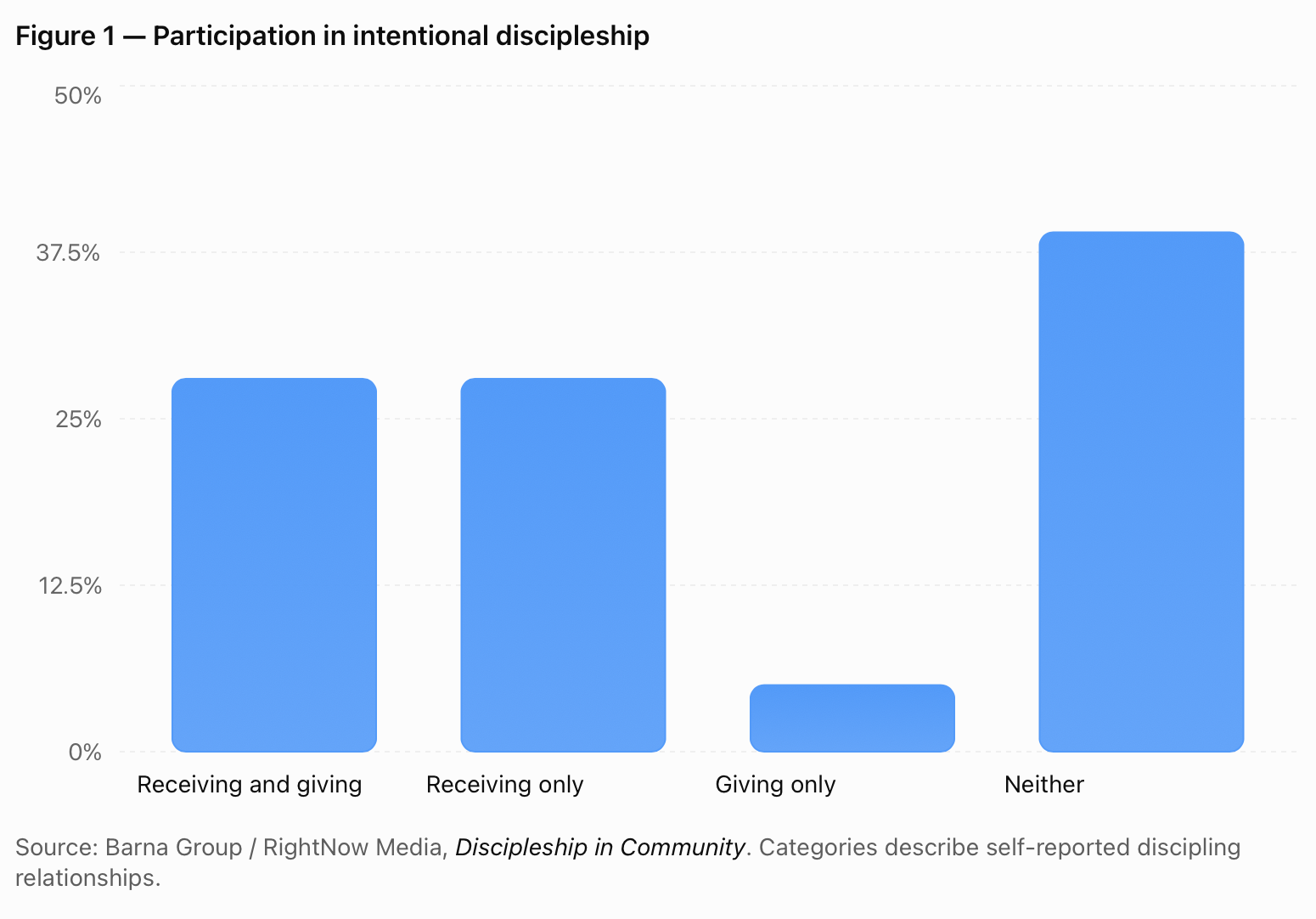
The findings also raise an important question concerning the reproduction of mature disciples.
If Christians are receiving spiritual instruction but relatively few are helping others grow, churches may need to reconsider how they prepare believers for mutual ministry.
Second Timothy 2:2 emphasizes the importance of entrusting biblical truth to faithful people capable of teaching others.
The passage specifically concerns the faithful transmission of apostolic teaching, but its underlying principle supports the church's continuing responsibility to prepare future generations of believers.
2. The Difference Between Christian Identification and Spiritual Formation
Barna's 2026 State of the Church findings identified encouraging signs of spiritual openness and interest in Jesus.
However, the research also suggested that increased spiritual interest had not been accompanied by equivalent improvements in several indicators of sustained Christian formation.³
This distinction is important.
Interest in Christianity may create an opportunity for evangelism.
It does not necessarily establish that individuals are developing consistent habits of biblical obedience, prayer, fellowship, and Christian service.
The church must therefore distinguish between attracting spiritual interest and developing mature disciples.
3. Biblical Worldview and Christian Identity
The Cultural Research Center's American Worldview Inventory 2026, associated with George Barna, reported that approximately 4 percent of American adults met its criteria for possessing a biblical worldview.⁴
The reported percentage remained approximately unchanged from its 2023 and 2025 findings.
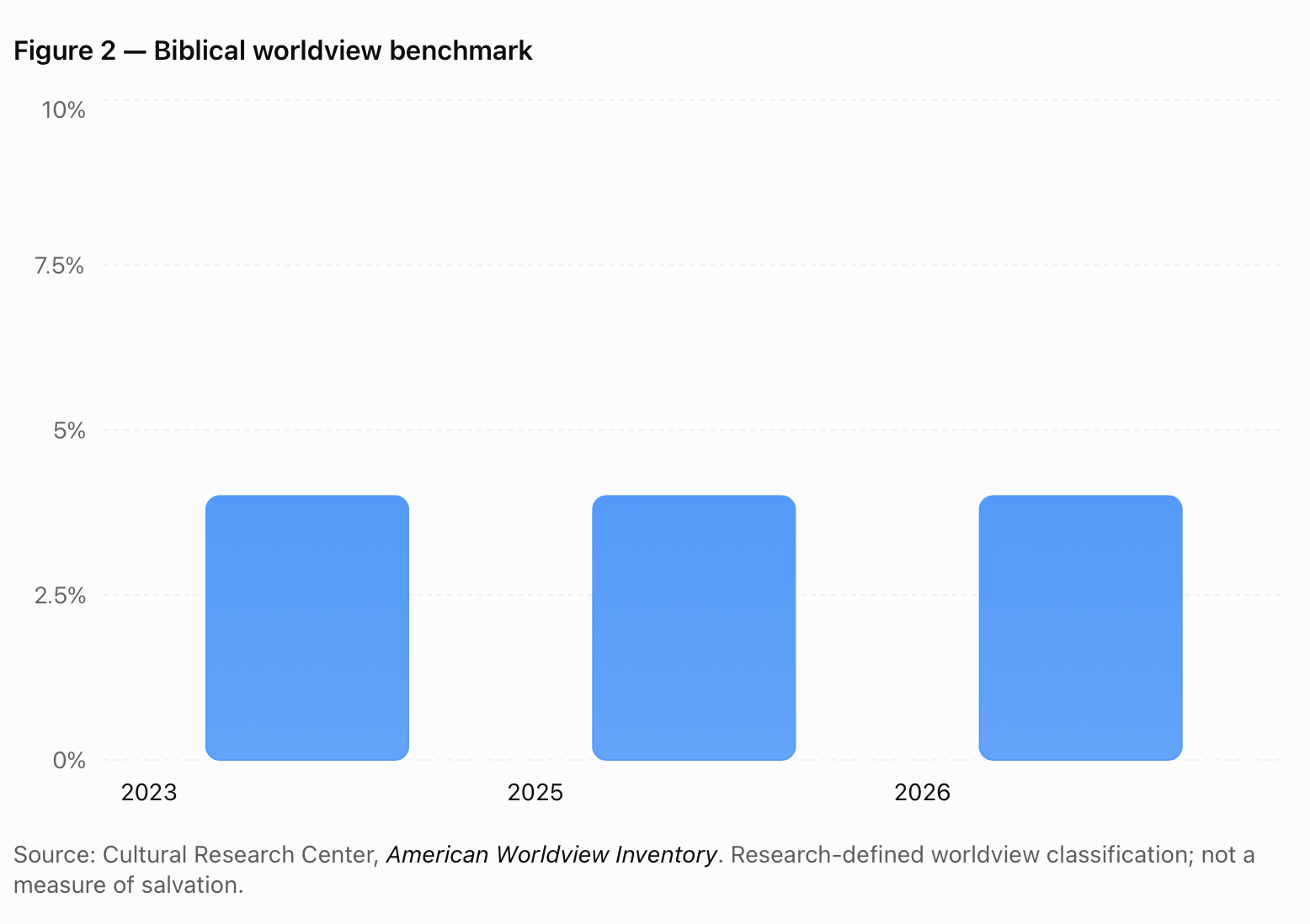
This statistic should not be interpreted as demonstrating that only 4 percent of Americans are genuinely Christian.
The study measures a research-defined set of beliefs and behaviors rather than regeneration.
Nevertheless, it raises questions concerning the relationship between Christian identification and biblical understanding.
If individuals identify as Christians while holding beliefs substantially inconsistent with Scripture, churches should examine whether their teaching and discipleship ministries are effectively developing biblical discernment.
4. Spiritual Formation Among Younger Christians
Barna's 2026 research conducted with Christ In Youth examined multiple dimensions of spiritual engagement among teenagers.
The study reported that 57 percent of Christian teenagers had recently attended youth group, while 18 percent met the researchers' threshold for active faith across multiple dimensions.⁵
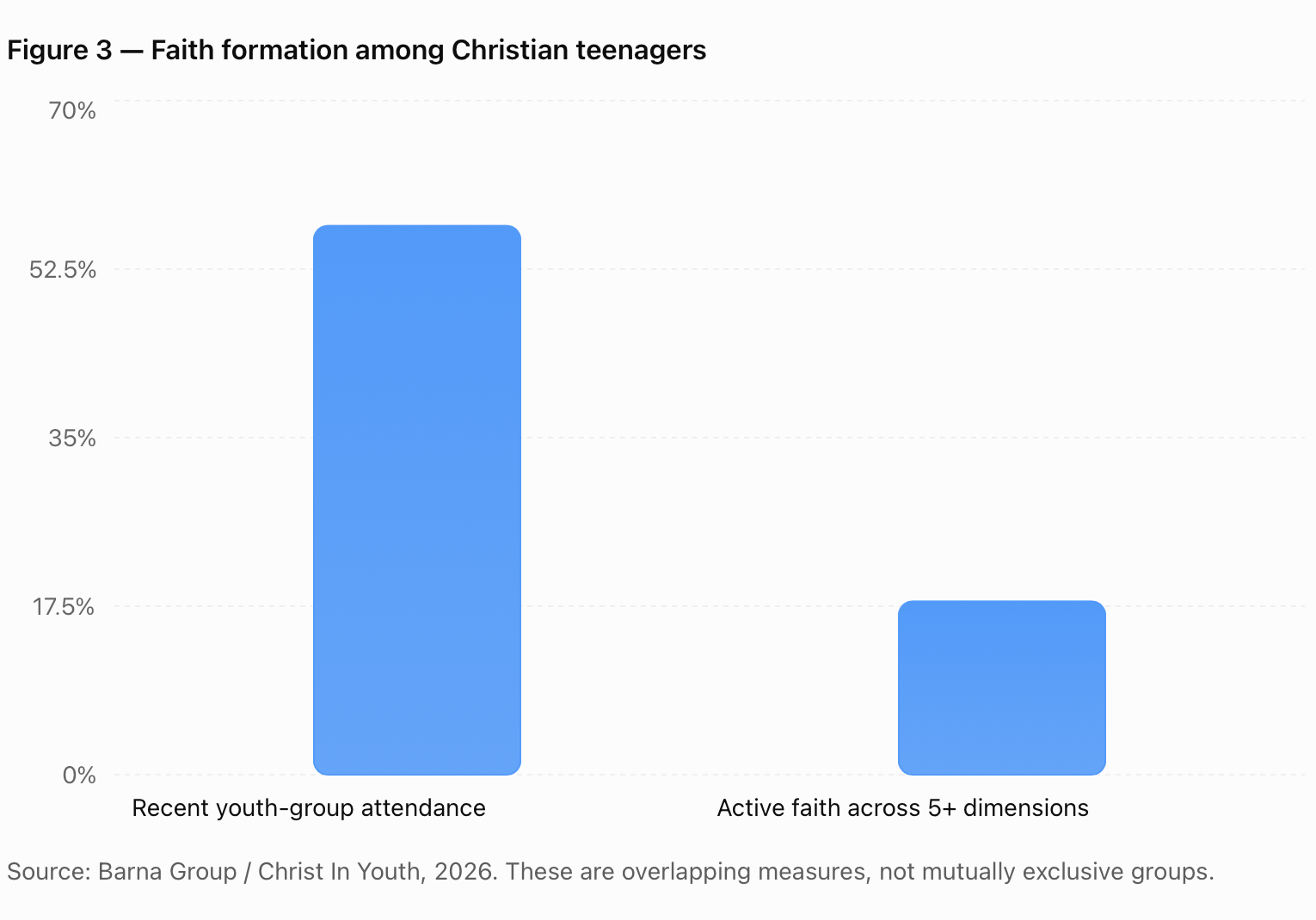
These measurements do not represent opposite categories.
Some teenagers who attended youth group may also have met the active-faith criteria.
Nevertheless, the research demonstrates why attendance alone cannot establish comprehensive spiritual formation.
Churches should evaluate whether younger believers are developing biblical understanding, meaningful relationships, prayer, service, and the ability to integrate Christian convictions into everyday life.
V. The Crisis of Personal Motivation: Why Do Believers Neglect Spiritual Growth?
The findings raise a question that deserves more attention than statistics alone can provide.
Why do Christians who acknowledge the importance of spiritual growth so often fail to pursue it intentionally?
Barna's research identified several recurring obstacles among churches attempting to develop mature disciples.
These included competing demands upon time, insufficient motivation, inadequate role models, negative assumptions about discipleship, and difficulty sustaining long-term commitments.⁶
These observations do not establish that every spiritually immature believer is unwilling to grow.
Some Christians face illness, disability, caregiving responsibilities, economic pressures, or other circumstances that limit their participation in organized ministry.
Nevertheless, the findings suggest that personal motivation and spiritual priorities deserve serious consideration.
1. Spiritual Growth Is Often Treated as Desirable Rather Than Necessary
Many Christians regard spiritual maturity as beneficial.
They may admire believers who demonstrate substantial biblical knowledge, prayerfulness, or Christian service.
However, they may not understand that spiritual growth is an ordinary expectation of Christian life.
The writer of Hebrews rebuked believers who had remained immature despite having sufficient time to develop greater understanding (Heb. 5:11–14).
The problem was not merely their lack of information.
It involved their failure to develop the discernment associated with spiritual maturity.
Similarly, Peter instructed believers to grow in the grace and knowledge of Jesus Christ (2 Pet. 3:18).
These passages demonstrate that spiritual development is not an optional religious accomplishment.
It belongs to the continuing responsibilities of those who follow Christ.
2. Competing Priorities Gradually Displace Spiritual Development
Modern life contains numerous legitimate responsibilities.
Employment, family obligations, education, recreation, and personal concerns require time and attention.
However, a believer's schedule may reveal that spiritual growth has become a secondary consideration.
This does not mean Christians must spend every available moment in formal religious activity.
Rather, their relationship with Christ should influence how they understand and organize their lives.
Paul instructed believers to walk carefully and make wise use of their time (Eph. 5:15–17).
The issue is not simply whether a Christian has sufficient time for discipleship.
It is whether spiritual growth has become an intentional priority within the time and responsibilities available.
3. Believers May Lack a Clear Understanding of Spiritual Maturity
A person cannot intentionally pursue a goal that remains poorly defined.
If discipleship is understood merely as church attendance, then attendance may become the primary measure of spiritual development.
If discipleship is understood as completing Bible studies, then the accumulation of biblical information may become the objective.
If discipleship is understood as serving in church programs, then activity may be mistaken for maturity.
The New Testament presents a more comprehensive objective.
Spiritual maturity involves increasing conformity to Christ, sound biblical understanding, discernment, obedience, love, and participation in the life and ministry of the church (Rom. 8:29; Eph. 4:11–16; Col. 1:28–29).
Churches must therefore help believers understand not only that they should grow spiritually but also what biblical maturity involves.
4. The Absence of Personal Accountability
Spiritual growth is personal, but it is not intended to occur in isolation.
The New Testament repeatedly emphasizes mutual encouragement, correction, and care.
Believers are instructed to encourage one another (1 Thess. 5:11), bear one another's burdens (Gal. 6:2), and consider how to stimulate one another toward love and good works (Heb. 10:24–25).
Without meaningful Christian relationships, believers may find it easier to avoid difficult questions concerning spiritual priorities, obedience, and personal conduct.
Accountability must be characterized by love, humility, and respect.
It should never become coercive or controlling.
Nevertheless, its absence can leave believers without the encouragement and correction necessary for sustained growth.
VI. Spiritual Growth Is Not Automatic: The Problem of Christian Complacency
One of the most persistent misunderstandings within the contemporary church is the assumption that spiritual maturity develops naturally through years of church attendance.
A Christian who regularly attends worship, listens to sermons, and participates in church activities may reasonably expect to grow spiritually.
Yet the New Testament does not present spiritual maturity as an automatic consequence of religious involvement.
Stephen McQuoid, in Discipline with Care, argues that spiritual maturity requires intentional commitment. He also observes that the number of years a person has professed Christianity does not necessarily correspond to that person's spiritual development.⁷
This distinction has substantial implications.
A believer may have attended church for thirty years while demonstrating limited biblical understanding, little spiritual discipline, or persistent immaturity in personal relationships.
Another believer may have followed Christ for a comparatively short period while demonstrating significant growth in understanding, obedience, and Christian character.
Spiritual maturity is not measured by the passage of time alone.
The Biblical Responsibility to Pursue Growth
Paul instructed the Philippians to work out their salvation with fear and trembling (Phil. 2:12).
The following verse explains that God works within believers both to will and to accomplish His good pleasure (Phil. 2:13).
These verses establish an important theological balance.
Believers do not earn salvation through spiritual effort. Salvation is God's gracious gift (Eph. 2:8–9).
Nevertheless, those who have received salvation are responsible to pursue the practical implications of their new life in Christ.
The believer's effort and God's transforming work are not competing explanations of sanctification.
Rather, Christian obedience is possible because God is at work within His people.
Why Christians Become Spiritually Complacent
Several factors may contribute to complacency.
First, believers may misunderstand discipleship as an optional program rather than the continuing responsibility of following Christ.
Second, they may equate attendance with maturity, assuming that listening to biblical teaching necessarily produces transformation.
Third, they may lack meaningful relationships through which other Christians encourage, challenge, and support their spiritual development.
Fourth, competing priorities may gradually displace intentional spiritual practices.
Finally, some believers may have no clear understanding of what spiritual growth should look like in everyday life.
These concerns correspond closely with the obstacles identified in Barna's Growing True Disciples.
However, spiritual stagnation should not automatically be attributed to indifference. Suffering, illness, discouragement, inadequate instruction, and other circumstances may affect a believer's development.
The responsibility of the church is therefore not merely to demand greater commitment but to provide compassionate, biblically grounded relationships that encourage continuing growth.
VII. When Church Activity Fails to Produce Spiritual Maturity: The REVEAL Study
An important historical example comes from Willow Creek Community Church's REVEAL research.
Rod Dempsey, discussing the study in Disciple Making Is . . ., describes findings that challenged the assumption that extensive church participation necessarily produces spiritual maturity.⁸
The research found that highly active church participants did not invariably demonstrate stronger spiritual attitudes or practices than less active participants.
It also identified believers who considered themselves spiritually stalled.
Dempsey reports that 17 percent expressed dissatisfaction with the church's role in their spiritual development and discusses a 41 percent figure associated with church dropout.
These percentages should be understood within the study's original definitions and populations, not interpreted as percentages of all American Christians.
The significance of the research extends beyond Willow Creek.
It suggests that a church can successfully attract people, provide meaningful activities, and maintain extensive programming while still struggling to cultivate sustained spiritual transformation.
The Four Stages of Spiritual Development
The REVEAL study described a spiritual continuum:
Exploring Christ
Growing in Christ
Close to Christ
Christ-centered living
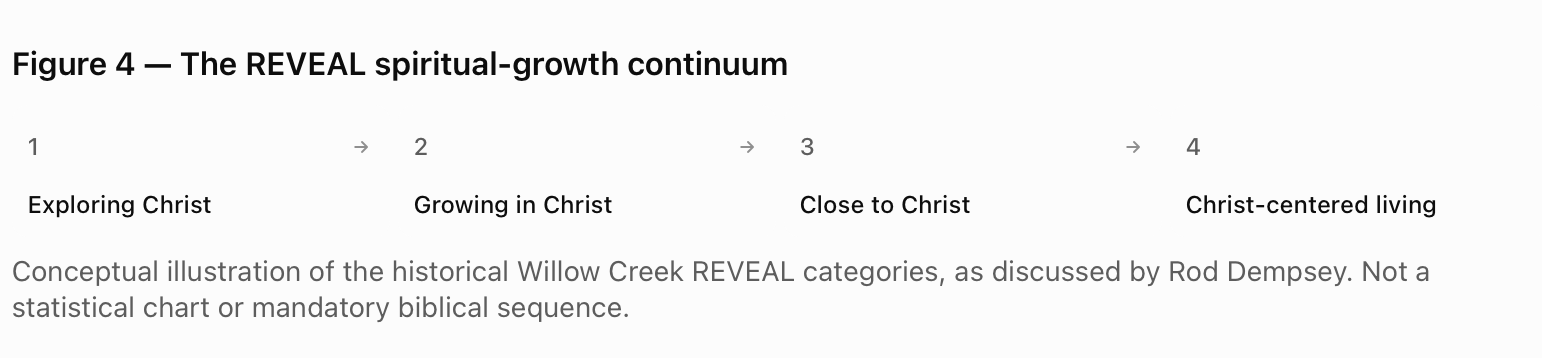
These categories are research classifications, not biblical stages that every Christian must follow in a prescribed sequence.
Nevertheless, they highlight an important principle: believers differ in their spiritual understanding, priorities, and practices.
A church should not assume that everyone attending its services requires identical instruction or encouragement.
Those exploring Christianity need clear explanations of the gospel.
Newer believers require foundational biblical instruction.
Developing Christians benefit from relationships that encourage prayer, obedience, and spiritual discernment.
Mature believers should be equipped to serve and strengthen others.
The Role of Christian Community
McQuoid also emphasizes that meaningful Christian community does not develop automatically simply because people attend the same congregation.⁹
Relationships require time, shared experience, mutual concern, and trust.
He identifies accountability, love, and empathy as essential characteristics of a healthy Christian community.
This is particularly important because accountability without love may become judgmental, while fellowship without accountability may fail to encourage meaningful spiritual development.
Small groups and mentoring relationships can provide environments in which these responsibilities are practiced.
However, as Barna's research also demonstrates, the existence of a small group does not guarantee spiritual transformation.
The group's purpose, leadership, biblical instruction, and relational character are critical.
The objective is not simply to bring Christians together more frequently. It is to develop relationships in which believers encourage one another toward greater faithfulness to Jesus Christ.
VIII. The Small-Group Problem: Fellowship Is Not the Same as Discipleship
Small groups have become a familiar feature of evangelical church ministry.
They provide opportunities for fellowship, prayer, discussion, and personal relationships.
These are valuable activities.
However, Barna questioned whether participation in a small group necessarily produces spiritual transformation.
His concern was that groups can succeed in creating fellowship while failing to develop meaningful biblical maturity.
This distinction remains important.
A small group can become a comfortable social environment without consistently challenging participants to apply Scripture.
Members may develop friendships while avoiding difficult questions concerning obedience, repentance, spiritual priorities, or personal responsibility.
The problem is not fellowship itself.
Christian fellowship is a biblical responsibility (Acts 2:42).
The problem arises when fellowship becomes disconnected from the larger objective of spiritual formation.
What Makes a Small Group Effective?
An intentional discipleship group should include several interconnected elements.
Biblical instruction: Participants study Scripture carefully and seek to understand its meaning.
Practical application: Biblical truth is connected to attitudes, relationships, decisions, and conduct.
Personal relationships: Members develop sufficient trust to encourage and support one another.
Prayer: Participants learn to depend upon God and intercede for others.
Accountability: Believers are encouraged to apply Scripture and address spiritual struggles with humility and grace.
Christian service: Members have opportunities to practice their faith through ministry and care for others.
Multiplication: Mature participants are gradually equipped to encourage and disciple additional believers.
These principles are consistent with the relational emphasis of Jesus' ministry, Paul's mentoring relationships, and the practices of the early church.
They also reflect the recommendations of contemporary discipleship writers such as Jim Putman, Bobby Harrington, and Robert Coleman.¹⁰
Small Groups Must Not Become Isolated Programs
Small groups should support the broader ministry of the local church.
They must remain connected to biblical preaching, congregational worship, pastoral oversight, and the shared responsibilities of the Christian community.
A healthy discipleship ministry does not replace the gathered church with a collection of independent groups.
Rather, it provides relational environments through which the teaching and ministry of the congregation can be reinforced.
IX. The Biblical Standard: What Is the Church Supposed to Produce?
Research can identify patterns and weaknesses.
Scripture must establish the theological standard by which those patterns are evaluated.
Matthew 28:18–20 — Making Disciples
The central command of the Great Commission is μαθητεύσατε (mathēteusate), meaning to make disciples.
Jesus instructed His followers to make disciples among all nations through activities that include baptizing and teaching obedience to His commandments.
The objective is therefore not simply the communication of religious information.
It is the formation of people who follow Christ.
Colossians 1:28–29 — Maturity in Christ
Paul described his ministry as proclaiming Christ, warning and teaching people with wisdom, so that they might be presented mature in Christ.
The adjective τέλειον (teleion) communicates the idea of maturity or completeness.
Paul's objective was not merely that believers possess correct information.
He sought their continuing development in Christ.
Ephesians 4:11–16 — Equipping the Saints
Paul explained that Christ provided leadership gifts to the church for the equipping of the saints and the building up of the body.
The goal includes unity in faith, knowledge of Christ, spiritual maturity, and growth in love.
Importantly, the passage identifies the participation of the whole body in its own growth.
The church is not intended to function as a permanent audience dependent upon the activity of a small number of professional ministers.
Its members are to be equipped for ministry.
Second Timothy 2:2 — Reproducing Faithful Teachers
Paul instructed Timothy to entrust apostolic teaching to faithful people capable of teaching others.
This establishes a continuing pattern of doctrinal transmission and preparation for ministry.
The church must think beyond the immediate generation.
It should intentionally develop believers who can preserve and communicate biblical truth to others.
X. The Responsibility of Church Leadership
The discipleship crisis cannot be attributed exclusively to individual believers.
Church leadership also bears responsibility for establishing environments that encourage spiritual growth.
Peter instructed elders to shepherd God's flock willingly and serve as examples to those entrusted to their care (1 Pet. 5:1–4).
Paul instructed Timothy to devote attention to reading, exhortation, and doctrine, while also demonstrating an example in conduct, love, faith, and purity (1 Tim. 4:12–16).
These responsibilities extend beyond public speaking.
Pastors and elders must help believers grow toward maturity.
The Difference Between Managing a Church and Shepherding a Congregation
Contemporary churches require administrative leadership.
Buildings must be maintained.
Financial responsibilities must be managed.
Staff and volunteers must be coordinated.
These activities are necessary, but they are not the ultimate purpose of pastoral ministry.
A pastor may become so occupied with organizational responsibilities that relatively little time remains for the personal instruction and spiritual care of believers.
Churches must therefore evaluate whether their organizational structures support or hinder the biblical responsibilities of shepherding and equipping.
Developing Disciple-Making Leaders
No pastor can personally mentor every believer in a congregation.
The biblical solution is not to abandon personal discipleship.
It is to equip mature Christians who can participate in that responsibility.
Second Timothy 2:2 provides a foundation for this approach.
Qualified believers should be prepared to teach, encourage, and mentor others.
This requires intentional investment.
Churches must identify potential leaders, develop their biblical understanding, evaluate their character, and provide appropriate opportunities for ministry.
A congregation that continually depends upon the same small group of leaders without preparing others will struggle to sustain a growing discipleship ministry.
XI. The Responsibility of Individual Believers
Although church leadership bears substantial responsibility, believers cannot assign the entire burden of discipleship to pastors and organized ministries.
Jesus' call to follow Him extends to everyone who would come after Him (Luke 9:23).
Paul instructed believers to pursue spiritual growth and to contribute to the well-being of the body of Christ.
Hebrews 5:12–14 rebukes spiritual immaturity among those who should have developed greater understanding.
Second Peter 3:18 calls believers to grow in grace and in the knowledge of Jesus Christ.
These passages establish that spiritual growth is not merely an optional church activity.
It belongs to the continuing responsibilities of Christian life.
The Problem of Competing Priorities
Barna's earlier critique is especially relevant here.
Christians may sincerely acknowledge the importance of spiritual maturity while consistently directing their time and attention elsewhere.
Work, family, recreation, entertainment, and other responsibilities occupy substantial portions of ordinary life.
Many of these activities are legitimate and necessary.
The issue is not whether believers should abandon them.
The question is whether following Christ meaningfully shapes their priorities.
Jesus instructed His followers to seek first the kingdom of God and His righteousness (Matt. 6:33).
Paul encouraged believers to redeem the time because the days are evil (Eph. 5:15–17).
These passages call for intentional living.
Spiritual Growth Requires Perseverance
Christian maturity ordinarily develops over time.
It involves learning, obedience, repentance, correction, prayer, and perseverance.
The believer who expects spiritual growth to occur automatically may become discouraged or complacent.
The believer who understands discipleship as a continuing relationship with Christ is better prepared to recognize that spiritual formation requires sustained attention.
Nevertheless, growth must never be reduced to self-improvement through human determination.
The Christian life depends upon God's grace and the work of the Holy Spirit (Gal. 5:16–25; Phil. 2:12–13).
XII. What About Churches That Are Making Disciples Effectively?
A responsible assessment must recognize that many congregations are faithfully engaged in meaningful discipleship.
The existence of national concerns does not establish that every church has failed.
Some churches intentionally develop mature believers through biblical teaching, mentoring relationships, small groups, pastoral care, and opportunities for service.
Others may accomplish similar objectives through different organizational structures.
The New Testament does not prescribe a single modern discipleship program.
Consequently, effectiveness should not be evaluated merely by whether a congregation adopts a particular curriculum or small-group model.
The more important questions concern whether believers are receiving sound biblical instruction, growing in Christlike character, participating in meaningful Christian relationships, and becoming equipped to serve others.
Research can identify promising practices.
Scripture establishes the underlying theological objectives.
The challenge is to organize church ministry so that those objectives remain central.
XIII. A Biblical Response to the Discipleship Crisis
The evidence suggests that churches should move beyond merely acknowledging the importance of discipleship.
They must establish intentional processes through which believers can grow.
1. Recover a Biblical Definition of Discipleship
Churches should clearly teach that discipleship is not an advanced classification reserved for particularly committed Christians.
Every believer is called to follow Jesus Christ.
Although Christians differ in maturity, gifts, and circumstances, the universal call remains.
2. Establish Spiritual Maturity as a Ministry Objective
Church leadership should identify the biblical characteristics it seeks to cultivate.
These include sound doctrine, Christlike character, prayer, fellowship, obedience, service, and the ability to encourage others.
3. Make Relational Discipleship a Priority
Churches should provide opportunities for believers to develop meaningful relationships with mature Christians.
Small groups and personal mentoring can be especially valuable when organized intentionally.
4. Connect Biblical Instruction with Practical Obedience
Teaching should include opportunities for reflection, application, and accountability.
The objective is not simply to complete biblical lessons.
It is to help believers understand and obey Christ's teaching.
5. Prepare Believers to Disciple Others
Churches should identify and equip qualified believers who can help others grow spiritually.
The multiplication principle of 2 Timothy 2:2 should influence leadership development.
6. Evaluate Outcomes Rather Than Attendance Alone
Churches should periodically examine whether their ministries are contributing to spiritual maturity.
Evaluation should include pastoral discernment and personal relationships rather than relying exclusively upon numerical measurements.
7. Maintain Dependence upon the Holy Spirit
No curriculum, small-group structure, or mentoring program can produce regeneration or sanctification independently of God's work.
The church must remain dependent upon Scripture, prayer, and the Holy Spirit.
XIV. Theological Conclusion: Recovering the Church's Disciple-Making Mission
The research examined in this study suggests that the American church continues to face significant challenges in developing mature disciples of Jesus Christ.
George Barna identified many of these concerns more than two decades ago.
He questioned whether churches were sufficiently intentional about spiritual formation and whether believers were willing to prioritize growth beyond ordinary religious participation.
Recent research indicates that these concerns have not disappeared.
Many Americans continue to identify with Christianity.
Spiritual openness remains evident.
Substantial numbers of churchgoers report receiving discipleship.
Yet large portions of the Christian population remain disconnected from intentional discipling relationships, while other studies identify persistent weaknesses in biblical worldview and the integration of faith into everyday life.
The historical REVEAL research adds an important dimension to these findings.
A church may successfully attract attendees and provide extensive ministry opportunities without necessarily cultivating corresponding spiritual maturity.
McQuoid's observations further emphasize that spiritual growth does not occur automatically through the passage of time or continued attendance.
Believers must intentionally pursue maturity while remaining dependent upon the transforming work of the Holy Spirit.
These findings should not lead to the conclusion that the American church is universally ineffective.
Nor should they encourage believers to judge the spiritual condition of others merely through survey statistics.
They should, however, prompt serious reflection.
The Great Commission does not command churches merely to attract attendees, establish programs, or increase organizational influence.
Christ commanded His followers to make disciples.
The apostle Paul sought to present believers mature in Christ.
Church leaders were instructed to equip the saints for ministry.
And faithful believers were entrusted with the responsibility of communicating biblical truth to subsequent generations.
These objectives remain unchanged.
The American church does not necessarily need more programs.
It needs greater clarity concerning the purpose of its existing ministries.
It needs leaders who model Christian maturity.
It needs relationships through which believers receive encouragement, instruction, and accountability.
It needs congregations in which biblical truth is not merely heard but increasingly practiced.
And it needs believers who recognize that following Jesus Christ is not an occasional religious activity but the continuing calling of the Christian life.
The discipleship crisis will not be resolved simply by persuading more Christians to attend another Bible study or join another small group. It requires churches and believers to recover the biblical purpose of discipleship: becoming increasingly mature followers of Jesus Christ who are equipped to help others follow Him.
The most important question facing the contemporary American church is therefore not merely how many people attend its services.
It is whether those people are being taught, encouraged, and equipped to become faithful disciples of Jesus Christ.
Questions for Reflection and Discussion
How should the church define successful discipleship?
What is the difference between religious participation and spiritual maturity?
How does George Barna's earlier critique compare with the findings of more recent research?
What do the 2025 Barna findings reveal about the importance of personal mentoring and intentional relationships?
Why should the church distinguish between Christian identification and biblical formation?
What are the limitations of using surveys to evaluate spiritual maturity?
How can small groups move beyond fellowship toward intentional discipleship?
What responsibilities do pastors and elders have for developing mature believers?
Why might longtime Christians remain spiritually immature despite regular church attendance?
How can churches encourage spiritual growth without promoting legalism or performance-based spirituality?
What practical changes could help a congregation better fulfill the Great Commission?
How should individual Christians evaluate their motivation and priorities concerning spiritual growth?
References
George Barna, Growing True Disciples: New Strategies for Producing Genuine Followers of Christ (Colorado Springs: WaterBrook Press, 2001), 54–56, Kindle edition
Barna Group, “Two in Five Christians Are Not Engaged in Discipleship,” Discipleship in Community research, https://production.barna.com/articles/christians-discipleship-community.
Barna Group, “Four Trends Shaping Ministry Strategy This Year,” June 2, 2026, https://www.barna.com/research/four-trends-ministry-strategy-2026/.
George Barna and Cultural Research Center, American Worldview Inventory 2026: Few Signs of Spiritual Renewal as the National Incidence of Biblical Worldview Remains Unchanged (Glendale, AZ: Arizona Christian University, March 3, 2026).
Barna Group, “New Research on Measuring Faith Formation in Teens,” July 13, 2026, https://www.barna.com/research/measuring-faith-formation-in-teens/.
Barna, Growing True Disciples, 123–32.
Stephen McQuoid, Discipline with Care: Applying Biblical Correction in Your Church, Ministering the Master's Way (Leominster: Day One, 2008), 40–41.
Rod Dempsey, “Analyzing the Attractional Model,” in Disciple Making Is . . .: How to Live the Great Commission with Passion and Confidence (Nashville: B&H Academic, 2013), 256–59.
McQuoid, Discipline with Care, 41–43.
Jim Putman, Bobby Harrington, and Robert E. Coleman, DiscipleShift: Five Steps That Help Your Church to Make Disciples Who Make Disciples (Grand Rapids: Zondervan, 2013), 72–73, 90.
Research methodology note: The cited surveys examine different populations, including American adults, self-identified Christians, churchgoers, and Christian teenagers. They also employ different definitions of discipleship, spiritual formation, and biblical worldview. Their findings should not be treated as directly interchangeable or as definitive judgments concerning individual salvation. The historical REVEAL findings should likewise be distinguished from recent national research.