A Biblical Model for the Local Church
Biblical Studies & Theology | Discipleship Series
Theological Abstract
The Great Commission commands the church to make disciples of Jesus Christ (Matt. 28:18–20). Yet a significant question remains: How does a local congregation actually fulfill that command?
The New Testament presents disciple-making as more than communicating biblical information, obtaining professions of faith, or encouraging church attendance. Jesus developed His disciples through personal relationships, authoritative teaching, practical demonstration, correction, prayer, and participation in ministry. The apostles continued this pattern by establishing communities devoted to biblical instruction, fellowship, worship, and mutual care. Paul further demonstrated a reproducible model of spiritual formation through mentoring relationships and the intentional transmission of biblical truth to subsequent generations.
This study examines the biblical foundations of disciple-making and develops a practical model for implementation within the local church. Particular attention is given to small-group discipleship, drawing upon the research of George Barna and the contributions of Jim Putman, Bobby Harrington, Robert Coleman, Sylvia Wilkey Collinson, and other Christian educators.
The study proposes a structured, relational discipleship pathway incorporating biblical instruction, prayer, accountability, practical obedience, Christian service, mentoring, and the preparation of believers to disciple others.
Central Thesis: The local church fulfills its disciple-making responsibility not merely by teaching people about Jesus Christ, but by intentionally cultivating relationships and environments in which believers learn to follow Him, grow toward spiritual maturity, and become equipped to help others do the same.
I. Introduction: The Difference Between Teaching Christians and Making Disciples
Many evangelical churches place considerable emphasis upon biblical preaching, worship services, evangelism, and Christian education. These activities are important and, when faithfully practiced, contribute substantially to the spiritual life of the congregation.
Nevertheless, the existence of these ministries does not automatically establish that a church is effectively making disciples.
A congregation may offer excellent sermons, numerous Bible studies, and extensive ministry programs while still producing believers who struggle to understand Scripture, apply biblical teaching, develop meaningful Christian relationships, or communicate their faith to others.
The distinction is not necessarily one of doctrinal correctness or sincerity.
It is often a question of whether biblical instruction is accompanied by the relational and practical processes through which believers learn to obey what they have been taught.
The Great Commission does not simply command the church to distribute information about Jesus Christ. It commands the church to make disciples and teach them to observe His instructions (Matt. 28:19–20).
This distinction between receiving information and learning obedience lies at the center of the present study.
In their examination of contemporary church ministry, Jim Putman, Bobby Harrington, and Robert Coleman argue that churches must evaluate their effectiveness by whether believers are becoming spiritually mature and capable of discipling others, rather than relying exclusively upon attendance, programs, or organizational activity.¹
Their concern raises an important question:
If a church is responsible for making disciples, what intentional process has it established to accomplish that responsibility?
The answer must begin with Scripture.
II. Jesus' Method: Discipleship Through Relationship and Instruction
Mark 3:13–15 — He Appointed Them to Be with Him
Mark records Jesus' appointment of the Twelve:
“Then He appointed twelve, that they might be with Him and that He might send them out to preach.” (Mark 3:14, NKJV)
The sequence is significant.
Jesus appointed the Twelve first to be with Him and then to be sent out in ministry.
The expression translated that they might be with Him communicates the purpose of their association with Jesus.
They were not merely students who occasionally attended His lectures.
They accompanied Him, observed His conduct, listened to His teaching, witnessed His compassion, and participated in His ministry.
Their education occurred within an ongoing relationship.
1. Jesus Taught His Disciples
Jesus instructed His disciples publicly and privately.
He explained the Scriptures, taught concerning the kingdom of God, and clarified the meaning of His parables (Mark 4:10–20, 33–34).
His teaching addressed doctrine, attitudes, relationships, prayer, possessions, forgiveness, and obedience.
Discipleship therefore required substantial instruction.
A church cannot make mature disciples while neglecting the careful teaching of Scripture.
2. Jesus Modeled What He Taught
Jesus' disciples also observed how He lived.
They witnessed His prayer life (Luke 11:1), His compassion toward suffering people (Mark 1:40–42), His response to opposition, and His willingness to serve others (John 13:1–17).
He did not merely explain humility.
He washed His disciples' feet.
He did not merely teach compassion.
He demonstrated compassion.
He did not merely instruct them concerning prayer.
They observed Him praying.
Sylvia Wilkey Collinson emphasizes the educational significance of Jesus' relational method, examining how His disciples learned through association, observation, participation, and subsequent responsibility.²
This principle has direct implications for the contemporary church.
Biblical discipleship requires teachers whose lives provide credible examples of the truths they communicate.
3. Jesus Corrected His Disciples
The disciples frequently misunderstood Jesus' teaching.
They argued about greatness (Luke 22:24–27), demonstrated inadequate faith (Mark 4:35–41), and sometimes failed to understand the nature of His mission (Matt. 16:21–23).
Jesus corrected these failures.
However, their immaturity did not cause Him to abandon their development.
Correction was part of the learning process.
Effective disciple-making must therefore create relationships in which believers can acknowledge confusion, ask difficult questions, confess sin, receive correction, and continue growing.
4. Jesus Gave His Disciples Practical Responsibilities
Jesus eventually sent His disciples into ministry (Mark 6:7–13; Luke 10:1–20).
They were required to put into practice what they had observed and learned.
Their preparation included actual participation in ministry rather than perpetual observation.
This progression establishes a useful pattern:
Instruction → Observation → Participation → Responsibility → Multiplication
This is a practical synthesis of Jesus' method, not a five-stage formula explicitly prescribed in Mark.
Nevertheless, it reflects recurring features of His ministry.
III. Luke 6:40: The Disciple Is Formed by the Teacher
Jesus declared:
“A disciple is not above his teacher, but everyone who is perfectly trained will be like his teacher.” (Luke 6:40, NKJV)
The Greek participle κατηρτισμένος (katērtismenos) comes from καταρτίζω (katartizō), which can describe being prepared, equipped, restored, or brought into an appropriate condition.
The expression translated perfectly trained communicates the idea of a person who has been thoroughly prepared.
The context of Luke 6:39–42 concerns spiritual perception, judgment, and the danger of attempting to correct others while remaining blind to one's own faults.
Jesus therefore emphasizes the formative influence of a teacher.
Those who instruct others must recognize that their conduct can influence the character and understanding of those they teach.
The Importance of Spiritual Example
A disciple-making relationship involves more than a transfer of theological knowledge.
The learner observes how the teacher handles disagreements, responds to personal failures, treats family members, manages responsibilities, and demonstrates love.
This does not mean that the mentor must possess spiritual perfection.
No human teacher does.
It means that a mentor should demonstrate genuine faithfulness, humility, repentance, and continuing growth.
The objective is never to produce followers who imitate the mentor's personality or preferences.
The objective is to help believers become increasingly like Jesus Christ.
IV. Paul's Method: Teaching, Modeling, and Personal Investment
The apostle Paul provides further evidence that disciple-making involves both biblical instruction and personal relationships.
1 Corinthians 11:1 — Following a Faithful Example
Paul instructed the Corinthians:
“Imitate me, just as I also imitate Christ.” (1 Cor. 11:1, NKJV)
The verb μιμηταί (mimētai) refers to imitators.
Paul's statement is carefully qualified.
He does not claim independent spiritual authority or invite believers to adopt his personal preferences without examination.
His example is worthy of imitation insofar as it reflects Christ.
The immediate context concerns Paul's willingness to limit his personal freedom for the spiritual benefit of others (1 Cor. 10:23–33).
Thus, imitation particularly includes self-sacrificial love and consideration for others.
Paul's Relationship with Timothy
Paul's letters reveal a sustained mentoring relationship with Timothy.
Timothy accompanied Paul in ministry, observed his teaching, and received responsibilities involving the instruction and oversight of churches (Acts 16:1–5; Phil. 2:19–22; 1 Tim. 4:11–16).
Paul later reminded Timothy of the doctrine, manner of life, purpose, faith, longsuffering, love, perseverance, and suffering he had observed (2 Tim. 3:10–11).
This list is remarkable because it joins doctrinal instruction with observable conduct.
Timothy learned not only what Paul believed but also how Paul lived.
1 Thessalonians 2:7–12 — Sharing Life
Paul described his ministry among the Thessalonians using the imagery of parental affection and responsibility.
He spoke of nurturing them with gentleness and exhorting them toward lives worthy of God.
The relationship was personal rather than merely institutional.
Ken Davis, in his study of biblical mentoring, identifies similar patterns throughout Scripture, including Moses and Joshua, Elijah and Elisha, and Paul and Timothy.³
These relationships demonstrate that the development of future servants of God often occurs through intentional personal investment.
Application to the Local Church
Pastors and elders must teach Scripture faithfully.
However, the responsibility to develop believers cannot be fulfilled exclusively through public preaching.
Church leadership should also establish relationships and ministry structures through which believers can receive personal instruction, encouragement, practical guidance, and opportunities to serve.
V. Second Timothy 2:2: The Biblical Principle of Multiplication
Paul instructed Timothy:
“And the things that you have heard from me among many witnesses, commit these to faithful men who will be able to teach others also.” (2 Tim. 2:2, NKJV)
This passage provides one of the clearest New Testament foundations for the intentional transmission of biblical truth.
The Meaning of “Commit”
The Greek imperative παράθου (parathou) comes from παρατίθημι (paratithēmi), meaning to entrust or place something into another's care.
Paul was not simply asking Timothy to repeat information.
He was instructing Timothy to entrust apostolic teaching to reliable people capable of teaching others.
The content was to be preserved and transmitted faithfully.
Four Generations of Transmission
The verse identifies four successive participants in the process.
Paul teaches Timothy.
Timothy entrusts the teaching to faithful people.
Those faithful people become capable of teaching others.
Others subsequently receive the teaching.
The essential principle is reproduction.
Christian instruction must not terminate with the immediate recipient.
Those who receive biblical truth should increasingly become capable of communicating it faithfully to others.
Does Every Christian Have to Become a Formal Teacher?
No.
Second Timothy 2:2 specifically concerns the transmission of trustworthy teaching through qualified people.
It should not be interpreted as eliminating the New Testament's distinctions concerning spiritual gifts and teaching responsibilities (Rom. 12:4–8; James 3:1).
Nevertheless, the passage establishes a broader principle relevant to the whole congregation.
The church must intentionally prepare future generations of believers to understand, preserve, and communicate biblical truth.
A mature Christian who helps a younger believer understand Scripture is participating in this work even without holding an official teaching office.
The objective is not merely to develop informed Christians, but to cultivate believers who can help others become informed and faithful followers of Christ.
VI. Colossians 1:28–29: The Goal Is Maturity in Christ
Paul described the purpose of his ministry as proclaiming Christ, warning and teaching people with wisdom, so that they might be presented mature in Christ (Col. 1:28).
The Greek adjective τέλειον (teleion) can communicate completeness or maturity.
In this context, it describes the goal toward which Christian instruction is directed.
Paul's ministry was not satisfied with an initial response to the gospel.
He sought the continuing spiritual development of believers.
Teaching and Admonition
Paul identifies both teaching and warning or admonition as part of his ministry.
Teaching communicates truth.
Admonition addresses conduct and thinking that require correction.
Both contribute to spiritual maturity.
God's Power and Human Labor
In verse 29, Paul describes laboring and striving according to God's power working within him.
This preserves a vital theological balance.
Spiritual maturity is not produced merely by organizational technique or human effort.
God works through the ministry of His servants.
Consequently, a discipleship structure must remain dependent upon prayer, Scripture, and the work of the Holy Spirit.
A church may organize meetings and prepare curriculum.
Only God can produce genuine spiritual life and transformation.
VII. Second Timothy 3:14–17: Scripture Must Remain Central
Paul reminded Timothy to continue in the truths he had learned and then explained the divine origin and usefulness of Scripture.
Second Timothy 3:16–17 identifies Scripture as profitable for doctrine, reproof, correction, and instruction in righteousness.
The purpose is that the servant of God may be equipped for every good work.
This passage establishes the indispensable role of Scripture in discipleship.
A discipleship group must be more than a discussion of personal experiences.
It must be a community in which Scripture governs beliefs, conduct, and spiritual development.
Four Functions of Biblical Instruction
Doctrine: Scripture teaches believers what is true concerning God, humanity, salvation, and Christian living.
Reproof: Scripture exposes erroneous beliefs and sinful conduct.
Correction: Scripture directs believers toward what is right.
Instruction in righteousness: Scripture trains believers to live in ways consistent with God's revealed will.
An effective discipleship curriculum should incorporate all four functions.
The objective is not simply to finish a series of lessons.
It is to develop believers who understand Scripture and increasingly apply its teaching.
VIII. Acts 2:42: The Congregation as a Community of Discipleship
Luke describes the earliest Christian community:
“And they continued steadfastly in the apostles' doctrine and fellowship, in the breaking of bread, and in prayers.” (Acts 2:42, NKJV)
Four practices characterize the community.
1. Apostolic Teaching
The believers continued in the instruction provided by the apostles.
Christian growth was grounded in revealed truth.
2. Fellowship
The Greek noun κοινωνία (koinōnia) communicates participation, sharing, or fellowship.
Christian fellowship involves more than social familiarity.
It includes mutual participation in the life and responsibilities of the Christian community.
3. Breaking of Bread
The early believers shared meals and participated in practices that expressed their fellowship in Christ.
The passage has often been understood to include the Lord's Supper, although the precise relationship between ordinary meals and the sacramental observance in every occurrence requires attention to context.
4. Prayer
Prayer was a continuing practice of the congregation.
It expressed dependence upon God and strengthened the spiritual life of the community.
The Larger Pattern
Acts 2:42–47 also describes mutual care, generosity, worship, and shared life.
Acts 5:42 records ministry both in the temple and in homes.
The early church therefore combined broader congregational instruction with relationships occurring in smaller settings.
This is an important biblical precedent for contemporary churches.
The church needs both the gathered congregation and smaller relational environments in which believers can know, encourage, and strengthen one another.
The passage does not prescribe a modern small-group program, a particular group size, or a weekly schedule.
Those are practical decisions that churches may make in applying the biblical principles.
IX. Why Small Groups Are Particularly Important for Discipleship
The New Testament establishes the importance of Christian fellowship, mutual instruction, encouragement, accountability, and shared ministry.
The practical question is how a contemporary church can provide these opportunities consistently.
For many congregations, intentionally organized small groups offer one of the most effective environments.
The Research of George Barna
George Barna's Growing True Disciples: New Strategies for Producing Genuine Followers of Christ examines the practices of churches identified as particularly effective in disciple-making.
Barna describes a variety of approaches, including small groups, personal mentoring, biblical instruction, leadership development, Scripture memorization, and opportunities for Christian service.⁴
Among the churches he studied, small groups were commonly regarded as central to the discipleship process.
However, Barna also identifies an important qualification.
Simply establishing small groups does not guarantee spiritual maturity.
Some churches had abandoned small groups because they failed to produce the desired results.
The more effective approaches emphasized trained leaders, meaningful relationships, intentional accountability, and carefully selected biblical material.⁵
This distinction is crucial.
A small group may become little more than a social gathering if its purpose is not clearly established.
Conversely, a small group that integrates Scripture, prayer, personal relationships, and practical obedience can provide a valuable setting for spiritual development.
Barna's findings are best understood as research-based observations concerning particular churches and ministry approaches, not as proof that small groups invariably outperform every alternative or cause spiritual growth by themselves.
The Contributions of Arnold and Black
Jeffrey Arnold and Stephanie Black, in The Big Book on Small Groups, emphasize that believers grow through relationships in which they experience Christian life together, receive encouragement, accept accountability, and participate in service.⁶
They identify the small group as an environment where instruction and personal experience reinforce one another.
This is especially important because many aspects of Christian maturity cannot be developed through listening alone.
A believer may hear a sermon concerning forgiveness.
A small group can provide an opportunity to discuss an actual conflict, examine relevant Scripture, pray together, and encourage reconciliation.
A believer may hear biblical teaching concerning generosity.
A small group may identify a practical need and work together to address it.
In these situations, biblical instruction becomes connected to ordinary Christian living.
The Contribution of DiscipleShift
Putman, Harrington, and Coleman similarly emphasize intentional relational discipleship.
They distinguish purposeful discipleship groups from gatherings whose primary objective is social interaction.
Their model emphasizes Bible-centered relationships, movement toward maturity, and the preparation of believers to help others grow.⁷
They also recognize that the most significant discipling relationships often extend beyond the scheduled meeting.
Conversations over meals, informal prayer, shared service, and personal encouragement can become important opportunities for spiritual formation.
Why Small Groups Can Be Effective
Small groups offer several practical advantages.
They allow believers to know one another personally.
They provide opportunities to ask questions that might never be raised in a large congregation.
They encourage mutual prayer and care.
They allow mature believers to model Christian conduct.
They create opportunities for accountability and correction.
They also provide a manageable environment in which developing leaders can practice teaching, facilitating discussion, and caring for others.
These advantages explain why small groups deserve a central place in a church's discipleship strategy.
However, small groups must support rather than replace corporate worship, biblical preaching, pastoral oversight, and the broader life of the church.
X. The Essential Components of a Biblical Discipleship Group
A local church should establish a clear purpose for its discipleship groups.
The following six components provide a practical foundation.
1. Biblical Instruction
Every group should engage Scripture directly.
Participants should learn how to observe the text, understand its context, interpret its meaning, and apply its teaching responsibly.
The leader should encourage careful biblical reasoning rather than merely asking participants to express personal opinions.
2. Prayer
Prayer should be a regular part of every gathering.
Participants should learn to pray for spiritual growth, personal needs, the congregation, unbelievers, and opportunities for ministry.
Prayer should also occur between meetings.
3. Personal Relationships
The group should cultivate trust and genuine concern among participants.
Relationships ordinarily deepen through regular interaction, hospitality, encouragement, and shared experiences.
4. Accountability
Believers should be encouraged to apply Scripture to their lives and discuss the challenges they encounter.
Accountability must be characterized by humility, confidentiality, patience, and restoration.
It should never become coercive, intrusive, or controlling.
Serious matters involving abuse, threats, or danger must be handled through appropriate safeguarding and pastoral procedures rather than treated as ordinary confidential group discussions.
5. Christian Service
Participants should have opportunities to practice what they learn.
This may include caring for struggling members, helping those in financial need, serving within the church, or participating in community outreach.
6. Preparation for Multiplication
The group should gradually prepare participants to encourage and instruct others.
This may involve helping members lead a prayer, facilitate a discussion, explain a biblical passage, or mentor a newer believer.
Not every participant will become a formal small-group leader.
Nevertheless, every believer should be encouraged to contribute to the spiritual growth of others according to his or her gifts and opportunities.
XI. A Proposed Discipleship Structure for the Local Church
The following model is a practical recommendation rather than a biblically mandated organizational structure.
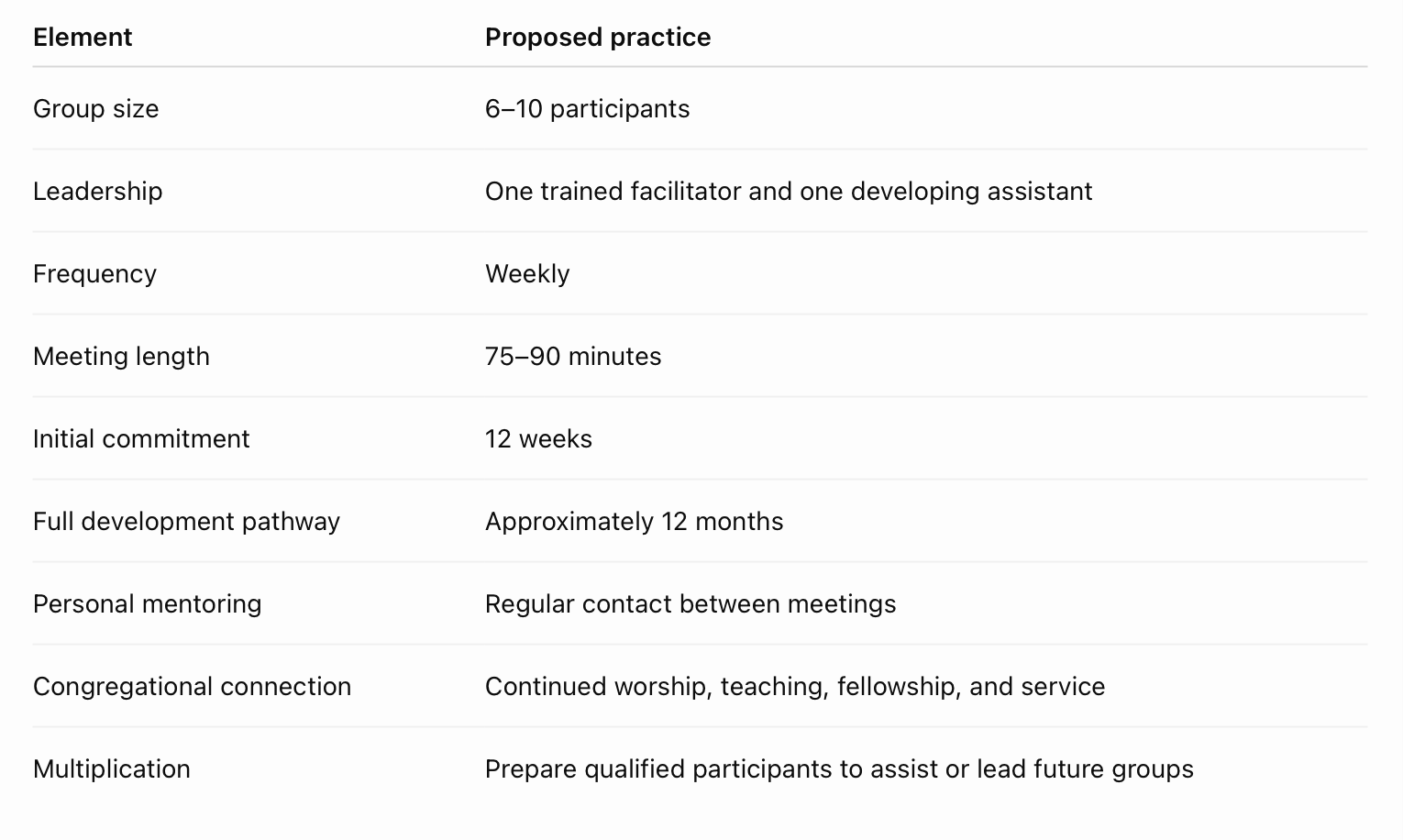
Groups may be organized according to life circumstances, geography, availability, or particular discipleship needs.
Churches should avoid creating unnecessarily rigid divisions that prevent meaningful relationships across generations.
Intergenerational relationships can be especially valuable because they allow mature believers to share their experience with younger Christians (Titus 2:1–8).
The Role of the Group Leader
The leader is not merely a moderator.
The leader is responsible for keeping Scripture central, encouraging participation, modeling humility, identifying spiritual needs, and helping participants move toward maturity.
Leaders should be trained, accountable to appropriate church leadership, and capable of recognizing situations requiring pastoral intervention.
The Role of the Assistant Leader
Each group should seek to develop an assistant who gradually assumes appropriate responsibilities.
This allows the church to prepare future leaders without requiring inexperienced believers to assume responsibility prematurely.
The assistant might initially lead prayer, then facilitate a portion of the discussion, coordinate service opportunities, and eventually lead complete meetings under supervision.
This reflects the principle of entrusting responsibility to faithful people (2 Tim. 2:2).
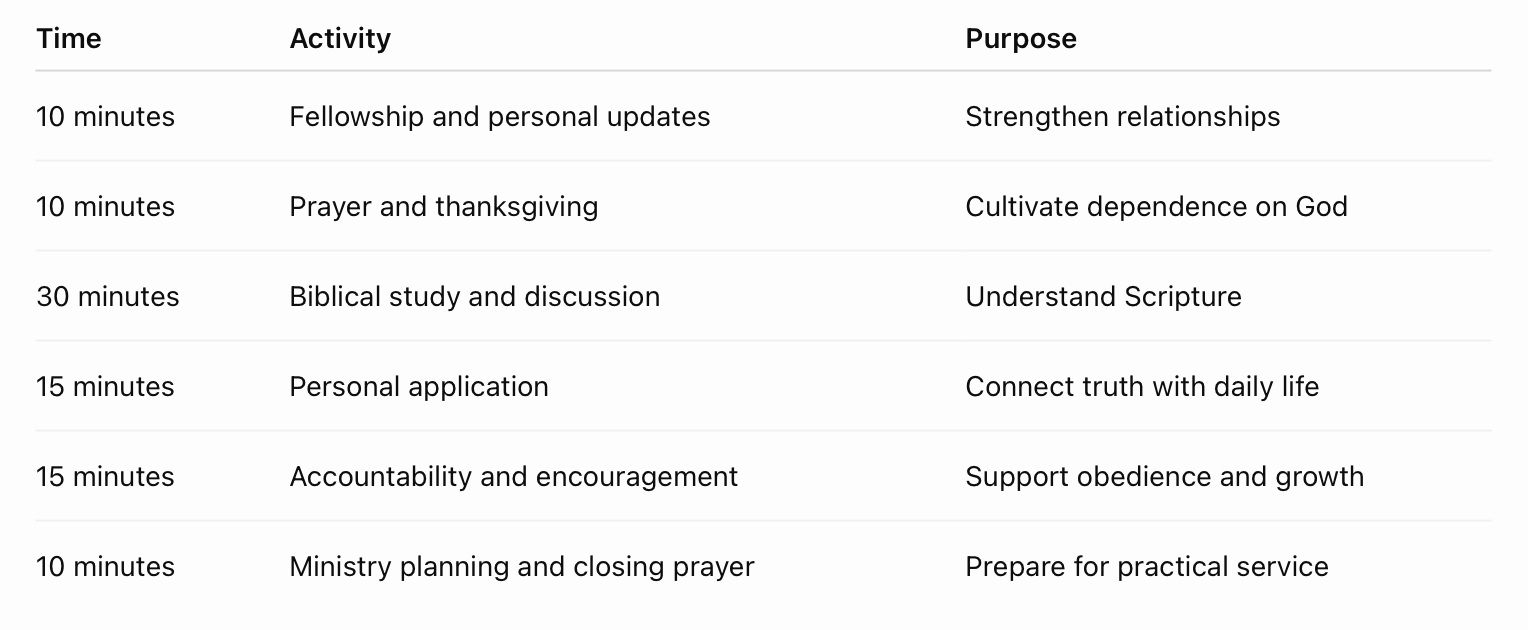
XII. A Suggested Weekly Discipleship Meeting
A consistent meeting structure can help groups remain focused while allowing flexibility for individual needs.
Questions Every Group Should Consider
The leader should regularly guide discussion through five questions.
What does this passage actually teach?
What did it mean in its original historical and literary context?
What does it reveal about God, humanity, and Christian living?
How should this truth influence our beliefs, attitudes, or conduct?
How can we help one another apply this teaching during the coming week?
These questions encourage responsible interpretation and practical application.
They also discourage the tendency to reduce Bible study to a collection of subjective impressions.
Between-Meeting Relationships
The scheduled meeting should not become the entire discipleship relationship.
Participants should be encouraged to pray for one another, communicate during the week, share meals when practical, and respond to legitimate needs.
These ordinary interactions often provide opportunities for encouragement and spiritual guidance that cannot be anticipated in a formal curriculum.
XIII. A Proposed Twelve-Month Discipleship Curriculum
A curriculum should provide a clear progression while remaining adaptable to the needs and maturity of participants.
The following model divides the first year into four twelve-week stages, with transition and review periods as needed.
Stage One: Foundations of Christian Faith
Objective: Establish a sound understanding of salvation, Christian identity, Scripture, and foundational spiritual practices.
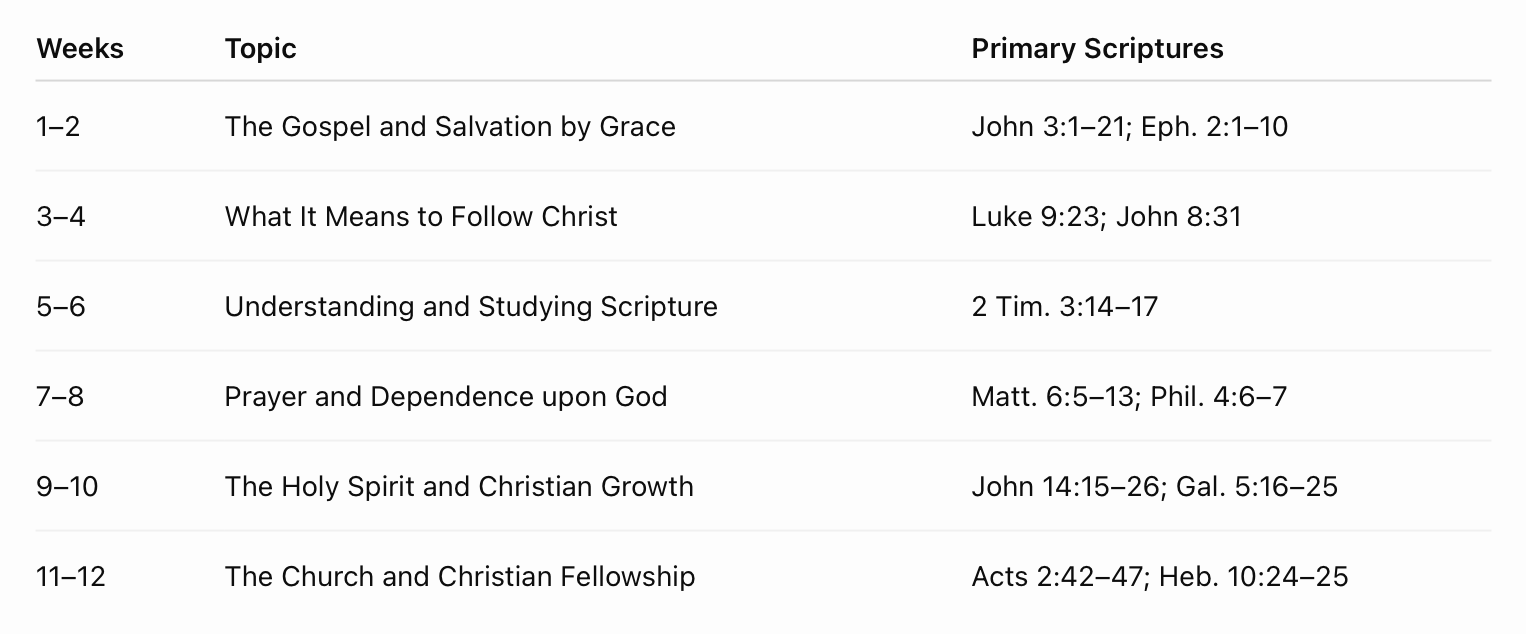
Expected development: Participants can explain the gospel, identify foundational Christian doctrines, begin studying Scripture responsibly, and develop regular habits of prayer and fellowship.
Stage Two: Growing in Christian Character
Objective: Help believers apply biblical teaching to attitudes, relationships, and personal conduct.
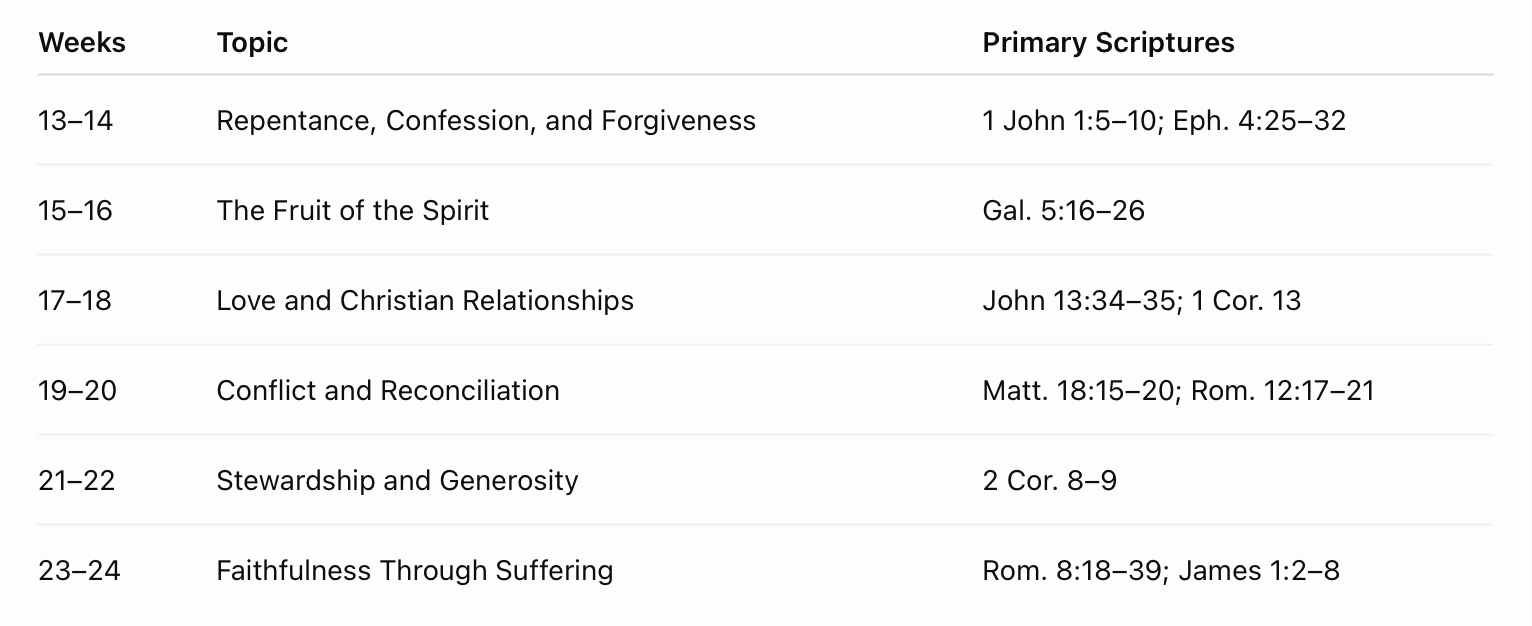
Expected development: Participants increasingly recognize the relationship between biblical truth and everyday conduct and learn to respond to difficulties with greater spiritual understanding.
Stage Three: Serving Christ and His Church
Objective: Prepare believers to participate meaningfully in Christian ministry.
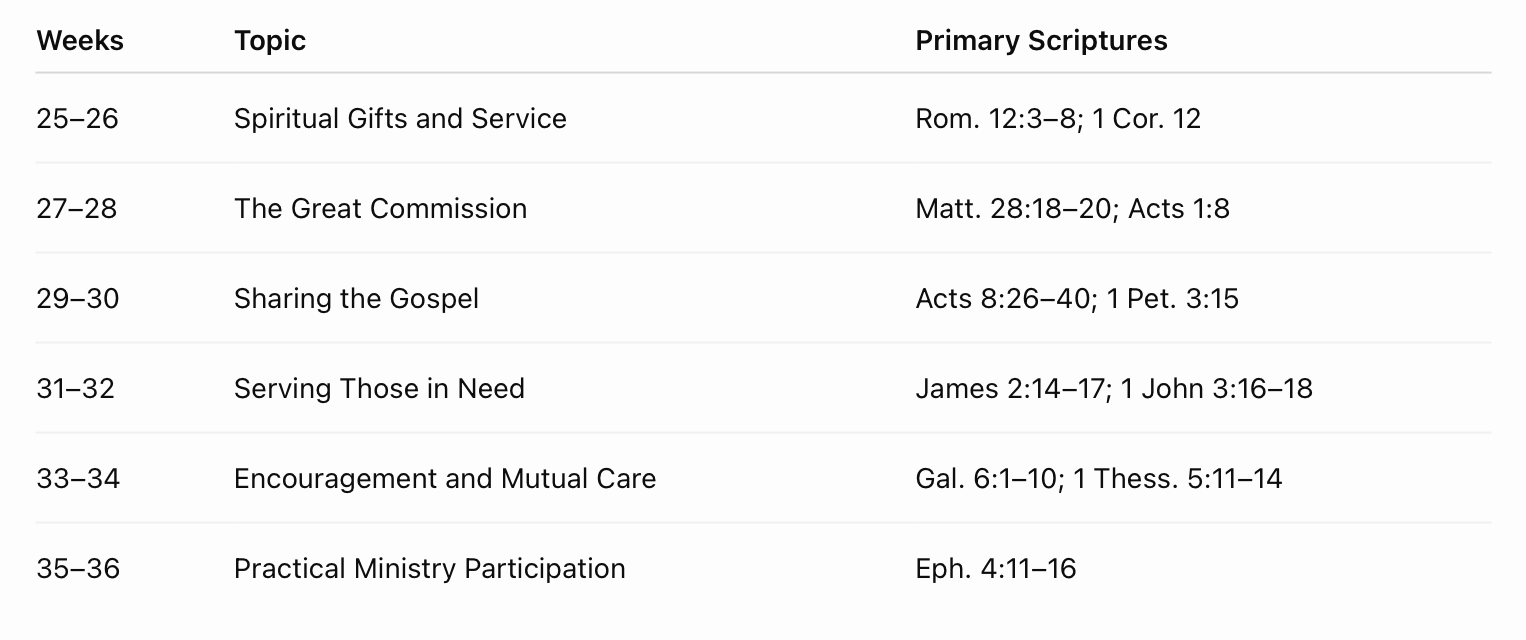
Expected development: Participants identify meaningful opportunities to serve, practice communicating biblical truth, and participate in appropriate ministry responsibilities.
Stage Four: Learning to Disciple Others
Objective: Prepare developing believers to encourage, instruct, and mentor others.
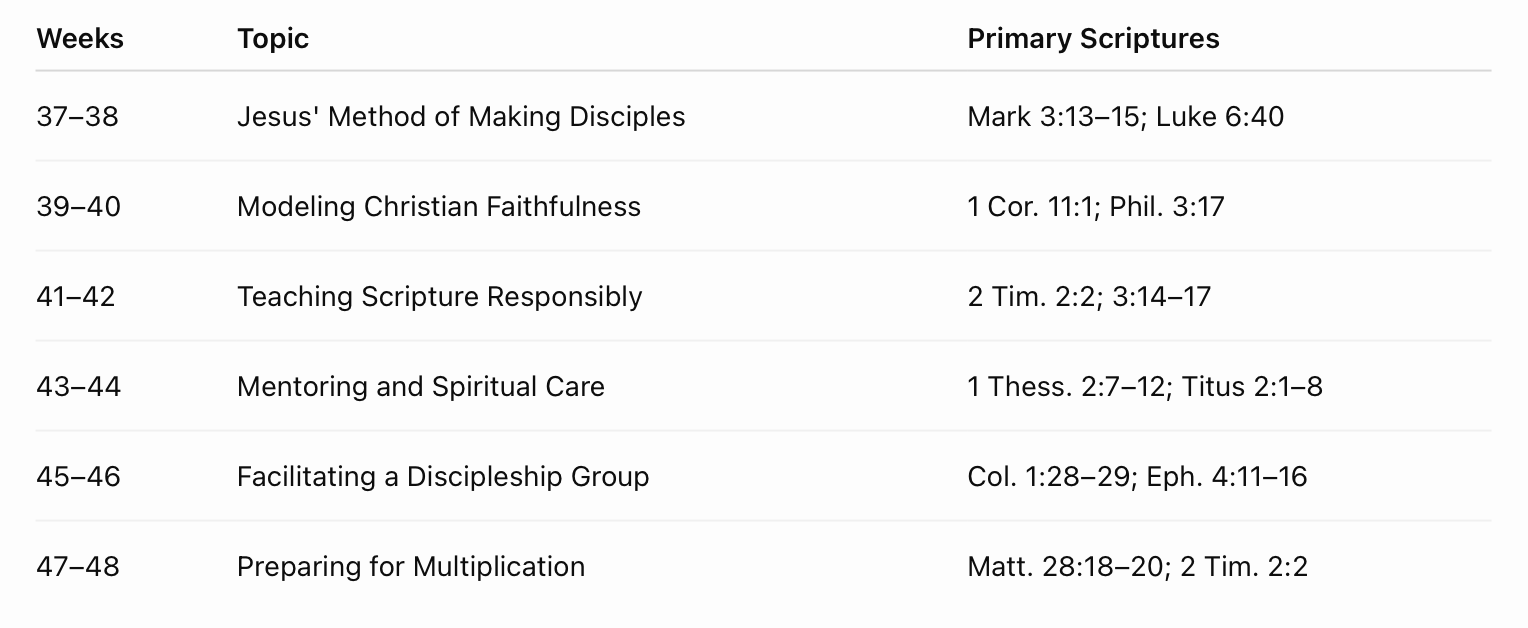
Expected development: Participants demonstrate increasing confidence in explaining Scripture, encouraging other believers, and participating in disciple-making relationships.
Completion of the curriculum should not automatically qualify a person to lead a group. Leadership requires demonstrated character, doctrinal reliability, appropriate gifting, and pastoral discernment.
XIV. A Reproducible Discipleship Pathway
The church should provide a clear pathway that helps believers understand how to enter, continue, and participate in disciple-making relationships.
The following six-stage model is proposed.
Stage 1 — Connect
A new believer or existing church member is introduced to a discipleship group.
The church identifies an appropriate group based upon availability, relational needs, and spiritual circumstances.
Primary goal: Establish meaningful Christian relationships.
Stage 2 — Establish
The participant develops foundational habits of Bible study, prayer, worship, fellowship, and obedience.
Primary goal: Strengthen the foundations of Christian living.
Stage 3 — Grow
The participant learns to apply Scripture to relationships, attitudes, decisions, and spiritual struggles.
Primary goal: Encourage increasing maturity in Christ.
Stage 4 — Serve
The participant identifies appropriate opportunities to serve others within the church and community.
Primary goal: Connect spiritual growth with practical ministry.
Stage 5 — Equip
The participant receives opportunities to encourage others, explain Scripture, and assume appropriate responsibilities within the group.
Primary goal: Develop the capacity to contribute to the spiritual growth of others.
Stage 6 — Multiply
Qualified and willing participants assist in establishing new disciple-making relationships or groups.
Primary goal: Extend the process of discipleship to additional believers.
This pathway is not a rigid ladder through which every Christian must progress at an identical rate.
Spiritual maturity is not measured simply by advancement through a program.
Some believers may require additional time and encouragement.
Others may already possess considerable maturity when they enter the process.
The pathway exists to support growth, not to classify believers according to spiritual worth.
XV. The Responsibilities of Pastors, Elders, and the Congregation
Ephesians 4:11–16 establishes that church leadership is responsible for equipping believers for ministry and the building up of the body of Christ.
This has direct implications for the organization of discipleship.
Pastors and Elders
Pastors and elders should provide doctrinal oversight, identify and train qualified leaders, establish appropriate safeguards, and regularly evaluate the spiritual development of the congregation.
They should also model the kind of relational investment they expect other believers to practice.
However, it is neither practical nor biblically necessary for a pastor to personally mentor every member of a congregation.
Small-Group Leaders
Group leaders provide regular biblical instruction, personal encouragement, and appropriate accountability.
They help participants connect the teaching of Scripture with the realities of everyday life.
They should remain accountable to church leadership and avoid creating isolated groups centered upon their own personalities.
Congregational Members
Members participate in fellowship, prayer, mutual encouragement, service, and the sharing of biblical truth.
The congregation is not merely the recipient of pastoral ministry.
It is a community in which believers minister to one another.
The Importance of Shared Responsibility
A church that depends exclusively upon its pastor for spiritual formation will inevitably encounter limitations.
The New Testament instead portrays the body of Christ growing as its members contribute according to their respective gifts and responsibilities (Eph. 4:16).
The pastor equips the saints; the saints participate in ministry; and the whole body grows toward maturity in Christ.
XVI. How Should a Church Evaluate Its Discipleship Ministry?
Churches commonly measure attendance, financial giving, volunteer participation, and program enrollment.
These measurements can provide useful administrative information.
However, they do not necessarily demonstrate spiritual maturity.
A church should also consider whether believers are developing biblical understanding, Christlike character, meaningful Christian relationships, and a growing willingness to serve others.
Suggested Areas of Evaluation
Biblical understanding: Are participants increasingly able to interpret and explain Scripture responsibly?
Spiritual habits: Are believers developing regular practices of prayer, Bible study, worship, and fellowship?
Christian character: Is there evidence of increasing humility, love, patience, honesty, and willingness to repent?
Relationships: Are believers developing meaningful connections through which they encourage and support one another?
Service: Are participants becoming involved in appropriate ministry opportunities?
Disciple-making: Are mature believers increasingly helping others grow spiritually?
Avoiding the Danger of Performance-Based Spirituality
These questions should be used pastorally rather than mechanically.
Spiritual maturity cannot be reduced to a numerical score.
Neither should participation in a small group become a condition of assurance concerning salvation.
The objective is to identify areas where believers need instruction, encouragement, or additional support.
Evaluation should serve spiritual care rather than institutional competition.
XVII. Common Mistakes in Implementing Discipleship
Mistake 1: Treating Discipleship as Another Church Program
A church may establish small groups without changing its understanding of ministry.
If the groups exist merely to fill another evening on the calendar, they may produce activity without meaningful formation.
The solution is to establish a clear biblical purpose.
Mistake 2: Emphasizing Information Without Application
Participants may complete numerous studies while making little effort to apply the teaching.
The solution is to incorporate practical application, accountability, and opportunities for service.
Mistake 3: Assuming Every Mature Christian Is a Qualified Leader
Spiritual maturity is essential, but effective leadership also requires appropriate character, doctrinal understanding, communication skills, and pastoral judgment.
The solution is intentional leadership development.
Mistake 4: Creating Dependence upon a Particular Mentor
A disciple-making relationship should direct believers toward Christ rather than cultivate dependence upon a human leader.
The solution is to maintain Christ's authority and Scripture's sufficiency as central principles.
Mistake 5: Multiplying Groups Before Leaders Are Prepared
A church may become so enthusiastic about growth that it establishes new groups without qualified leadership.
The solution is to prioritize faithful instruction and spiritual care over numerical expansion.
Mistake 6: Neglecting the Broader Congregation
Small groups must not become independent communities disconnected from the local church.
The solution is continuing pastoral oversight and meaningful participation in congregational worship and ministry.
XVIII. A Practical Implementation Plan for Church Leadership
A congregation seeking to establish an intentional discipleship ministry might begin with a modest pilot program.
First 30 Days: Preparation
Church leadership should clarify the biblical objectives of discipleship, identify potential group leaders, review available curriculum, and establish expectations for pastoral oversight.
A small number of spiritually mature members should be invited to participate in the initial leadership development process.
Days 31–60: Leadership Training
Potential leaders should receive instruction in biblical interpretation, group facilitation, prayer, accountability, safeguarding, and personal mentoring.
They should understand that their role is not merely to complete lessons but to help believers grow toward maturity.
Days 61–90: Launch
The church should begin with a manageable number of groups.
Each group should have a clear meeting schedule, defined expectations, and a trained leader.
Participants should understand the purpose of the process and the importance of continued involvement in congregational life.
After the First Twelve Weeks
Leadership should review the groups' experiences.
The evaluation should consider relational development, biblical understanding, participation, pastoral concerns, and opportunities for improvement.
Adjustments should be made before expanding the ministry.
After the First Year
The church should identify participants who demonstrate the character, maturity, and ability necessary for additional responsibilities.
Some may become assistant leaders.
Others may begin personal mentoring relationships.
Qualified individuals may eventually lead new groups.
The process should expand according to the church's capacity to provide faithful leadership and spiritual care.
XIX. Theological Conclusion: Making Disciples Is the Work of the Church
The New Testament presents disciple-making as an essential responsibility of the Christian church.
Jesus formed His disciples through relationships characterized by instruction, observation, correction, prayer, and practical ministry (Mark 3:13–15).
He taught that the fully trained disciple becomes like his teacher (Luke 6:40).
Paul demonstrated the importance of spiritual example and personal mentoring (1 Cor. 11:1; 2 Tim. 3:10–11).
He instructed Timothy to entrust biblical truth to faithful people capable of teaching others (2 Tim. 2:2).
He also identified maturity in Christ as a central objective of Christian ministry (Col. 1:28–29).
The early church practiced continuing instruction, fellowship, shared life, and prayer (Acts 2:42–47).
These passages do not establish a single mandatory organizational model for every congregation.
They do, however, establish principles that churches must take seriously.
Biblical instruction must be joined with personal relationships.
Spiritual growth must involve the practical application of God's Word.
Believers must be encouraged to serve and strengthen one another.
And the church must prepare future generations to preserve and communicate the truth entrusted to it.
Research concerning effective disciple-making churches provides additional practical support for intentional small-group ministry, particularly when groups are led by qualified believers and characterized by meaningful relationships, biblical instruction, accountability, and service.
Nevertheless, no organizational structure can replace the transforming work of God.
A church cannot manufacture spiritual maturity through curriculum alone.
It can, however, faithfully establish environments in which believers are taught Scripture, encouraged to obey Christ, supported through personal relationships, and equipped for ministry.
The ultimate measure of a discipleship ministry is not how many groups a church establishes, how many lessons participants complete, or how many programs it offers. It is whether believers are being equipped to know Christ, follow His teaching, grow in spiritual maturity, and help others do the same.
The Great Commission calls the church not merely to gather an audience, but to make disciples.
The practical responsibility of the local congregation is to organize its ministry around that calling.
Questions for Reflection and Discussion
What is the difference between teaching biblical information and making disciples?
How did Jesus combine instruction, personal relationships, and practical experience in developing His disciples?
What does Luke 6:40 teach about the responsibility of those who mentor other Christians?
How did Paul's relationships with Timothy and other believers demonstrate intentional discipleship?
What principle of spiritual multiplication is established in 2 Timothy 2:2?
Why should maturity in Christ remain the central objective of discipleship?
What does Acts 2:42–47 reveal about the relationship between biblical instruction and Christian community?
Why might small groups provide opportunities for spiritual formation that are difficult to accomplish through corporate worship alone?
What characteristics distinguish an intentional discipleship group from an ordinary social gathering?
How can churches establish accountability without encouraging legalism or inappropriate control?
What responsibilities do pastors and elders have for preparing future disciple-makers?
How could your congregation implement a reproducible discipleship pathway without creating unnecessary programs or administrative burdens?
References
Jim Putman, Bobby Harrington, and Robert E. Coleman, DiscipleShift: Five Steps That Help Your Church to Make Disciples Who Make Disciples (Grand Rapids: Zondervan, 2013), 1–4, 32–34.
Sylvia Wilkey Collinson, Making Disciples: The Significance of Jesus' Educational Methods for Today's Church(Eugene, OR: Wipf & Stock, 2004), chap. 8. Collinson examines the continuation and adaptation of Jesus' discipling method within the early Christian community.
Ken Davis, “Mentoring Church Planters,” Journal of Ministry and Theology 14, no. 2 (2010): 64–65.
George Barna, Growing True Disciples: New Strategies for Producing Genuine Followers of Christ (Colorado Springs: WaterBrook Press, 2001), 117–19.
Barna, Growing True Disciples, 119–23. The research identifies small groups and mentoring as common features among effective disciple-making churches while emphasizing the importance of trained facilitators, accountability, and intentionality.
Jeffrey Arnold and Stephanie Black, The Big Book on Small Groups (Downers Grove, IL: InterVarsity Press, 1992), chapter “Making Disciples Through Small Groups,” 10–11.
Putman, Harrington, and Coleman, DiscipleShift, 72–73, 90. These sections discuss intentional relational environments and the importance of connecting believers through ongoing relationships.
S. Lance Quinn, “Discipling,” in MacArthur Pastor's Library on Pastoral Ministry, ed. John F. MacArthur Jr. (Nashville: Thomas Nelson, 2005), 261–71. Quinn emphasizes the personal and pastoral responsibilities involved in developing mature believers.
Michael J. Wilkins, Following the Master: Discipleship in the Steps of Jesus (Grand Rapids: Zondervan, 1992), 293.
Research and citation note: The article draws upon the four newly supplied research documents and the biblical framework established in the preceding discipleship studies. The curriculum, group configuration, meeting schedule, and implementation plan are proposed applications rather than prescribed biblical requirements. Barna's findings are presented as observations from the churches he studied, not as a universal statistical demonstration that small groups are always the most effective method.