Evaluating Fellowship, Bible Study, and Spiritual Accountability
Biblical Studies & Theology | Discipleship Series
Theological Abstract
Small groups have become an established feature of American evangelical church life. Congregations organize Bible studies, fellowship gatherings, prayer meetings, support groups, and discipleship groups to provide opportunities for Christian community and spiritual development. Yet their widespread use raises an important question: Are these gatherings intentionally developing spiritually mature disciples of Jesus Christ, or are churches sometimes mistaking participation for transformation?
George Barna's research in Growing True Disciples challenged the assumption that participation in small groups necessarily produces spiritual maturity. He argued that many groups succeed in fostering fellowship while struggling to cultivate lasting spiritual transformation.¹ More recent research examining intentional discipleship relationships suggests that substantial numbers of American Christians remain disconnected from the relational processes through which believers can encourage one another toward maturity.
This study examines the biblical responsibilities of Christian community through Acts 2:42–47; Romans 12:3–16; Galatians 6:1–2; Hebrews 3:12–13; 10:24–25; and James 5:16. It distinguishes fellowship groups, Bible study groups, support groups, and intentionally structured discipleship groups, evaluating their strengths and limitations.
Particular attention is given to biblical interpretation, capable leadership, orderly participation, spiritual accountability, personal application, and clearly defined objectives for spiritual development.
Central Thesis: The effectiveness of a church small group cannot be determined merely by attendance, fellowship, or the amount of Scripture discussed. It must be evaluated according to its biblical purpose and whether its leadership, instruction, relationships, and practices contribute to spiritual maturity and equip believers to follow Jesus Christ faithfully.
I. Introduction: Are Small Groups Accomplishing Their Intended Purpose?
Small groups are among the most common ministries of contemporary evangelical churches. Congregations encourage members to join home fellowship groups, men's and women's Bible studies, prayer groups, and other gatherings intended to strengthen Christian relationships and encourage spiritual growth.
These ministries provide opportunities that are difficult to reproduce during a Sunday worship service. Participants can ask questions, develop friendships, share personal concerns, pray together, and discuss Scripture.
These are valuable activities. However, the existence of a small group does not necessarily mean that intentional discipleship is occurring.
A group may meet faithfully for years without establishing clear spiritual objectives. Members may read Scripture together without developing a sound understanding of the passage. Discussion may be dominated by personal opinions rather than careful biblical interpretation. Participants may enjoy fellowship without developing meaningful accountability.
A group may also become dependent upon the same leader indefinitely, without preparing other believers to teach, serve, or disciple others.
These concerns raise questions extending beyond organizational preferences.
What is the biblical purpose of Christian small-group ministry, and how can churches determine whether their groups are accomplishing that purpose?
The issue is not whether small groups are biblical or beneficial. The issue is whether their structure and activities support the church's larger responsibility to make disciples.
Jesus commanded His followers to make disciples and teach them to observe His commandments (Matt. 28:18–20).
Paul identified spiritual maturity as a central objective of Christian ministry (Col. 1:28–29).
Church leaders were instructed to equip believers for ministry and contribute to the growth of the body of Christ (Eph. 4:11–16).
Small groups should therefore be evaluated in relation to their intended purposes and the broader biblical responsibilities of the church—not treated as successful merely because people attend.
II. The Biblical Foundation for Christian Community
The New Testament provides substantial instruction concerning the relationships believers should maintain with one another.
Although it does not prescribe the modern small-group program as a required organizational structure, it establishes responsibilities that smaller gatherings can help fulfill.
Acts 2:42–47 — Teaching, Fellowship, Prayer, and Shared Life
Following Pentecost, the early believers devoted themselves to apostolic teaching, fellowship, breaking bread, and prayers (Acts 2:42).
The Greek word κοινωνία (koinōnia) communicates fellowship, participation, and sharing.
The passage describes more than individuals attending religious meetings. Believers participated in a community shaped by apostolic instruction, worship, prayer, generosity, and mutual concern.
Acts 2:46 also describes believers gathering in the temple and breaking bread from house to house.
Christian community therefore involved both larger gatherings and smaller relational settings.
However, the passage does not establish a required group size, curriculum, or meeting format. Its significance lies in the responsibilities and practices characterizing the community.
Romans 12:3–16 — Mutual Ministry and Christian Character
Romans 12 emphasizes the diversity of spiritual gifts within the body of Christ.
Believers are instructed to exercise their gifts faithfully, demonstrate genuine love, honor one another, contribute to the needs of the saints, and practice hospitality.
The passage portrays Christian community as an environment of mutual ministry.
Members are not merely recipients of religious instruction. They participate in the spiritual well-being of others.
A small group that consistently allows one or two individuals to dominate discussion may fail to provide meaningful opportunities for the participation and mutual care envisioned in this passage.
Galatians 6:1–2 — Restoration and Bearing Burdens
Paul instructed spiritually mature believers to restore those overtaken in trespass with gentleness. He also commanded believers to bear one another's burdens.
These responsibilities require relationships characterized by humility, compassion, and personal concern.
They cannot be reduced to attendance at a weekly meeting.
However, restoration must not become an excuse for intrusive questioning, public humiliation, or controlling behavior.
Biblical accountability requires gentleness and self-examination.
Hebrews 3:12–13 — Encouragement Against Spiritual Hardening
Hebrews warns believers against developing an unbelieving heart and departing from the living God.
The writer instructs Christians to exhort one another regularly so that they are not hardened through the deceitfulness of sin.
This passage demonstrates that mutual encouragement serves a protective spiritual purpose.
Christian relationships should help believers recognize spiritual dangers they might otherwise overlook.
Hebrews 10:24–25 — Encouraging Love and Good Works
Believers are instructed to consider one another in order to stir up love and good works.
The emphasis is not simply upon assembling together. It is upon the spiritual encouragement that should occur through Christian fellowship.
Attendance is important, but the purpose of gathering includes strengthening believers toward faithful Christian living.
James 5:16 — Confession and Prayer
James instructs believers to confess their trespasses to one another and pray for one another.
The passage emphasizes prayer, honesty, and mutual spiritual care.
However, it does not require believers to disclose every personal struggle publicly to an entire small group.
Confession and accountability must be practiced with wisdom, appropriate boundaries, and respect for confidentiality.
The Biblical Synthesis
Taken together, these passages establish several responsibilities of Christian community: learning biblical truth, encouraging obedience, developing loving relationships, supporting believers through difficulties, restoring others with gentleness, praying together, and exercising spiritual gifts for the benefit of the body.
A small group can provide an effective environment for these responsibilities.
However, gathering Christians together does not automatically ensure that these responsibilities are being fulfilled.
III. Four Types of Church Small Groups: Different Purposes, Different Outcomes
One source of confusion in contemporary small-group ministry is the tendency to treat all small groups as though they serve the same purpose.
In practice, churches organize groups with different objectives.
Recognizing these distinctions is essential to evaluating their effectiveness.
1. Fellowship Groups
Fellowship groups primarily emphasize Christian friendship, hospitality, mutual encouragement, and belonging.
Members may gather for meals, conversation, prayer, and social activities.
Their principal strength is the development of meaningful relationships.
Christian fellowship can reduce isolation, encourage mutual care, and strengthen congregational unity.
Their limitation is that fellowship alone may not provide systematic biblical instruction or intentional spiritual accountability.
A fellowship group should not be criticized merely because it does not function as a formal discipleship class.
However, churches should not assume that fellowship automatically produces comprehensive spiritual maturity.
2. Bible Study Groups
Bible study groups primarily emphasize understanding Scripture.
They may examine individual biblical books, theological subjects, or particular passages.
Their principal strength is the opportunity to develop biblical knowledge and theological understanding.
Their limitation is that discussion may remain intellectual or become dominated by personal interpretations without sufficient attention to the biblical author's intended meaning.
A group can accumulate information without consistently applying Scripture.
James warns against hearing the Word without practicing it (James 1:22–25).
3. Support Groups
Support groups provide encouragement and assistance to believers experiencing particular difficulties.
These may include grief, illness, addiction recovery, family challenges, or other significant concerns.
Their principal strength is the opportunity to demonstrate compassion, prayer, and practical care.
Such ministries can fulfill important aspects of Galatians 6:2.
Their limitation is that their immediate purpose may not include comprehensive biblical education or preparation for discipling others.
This does not make support groups spiritually inferior. It means they should be evaluated according to their intended ministry responsibilities.
4. Intentional Discipleship Groups
Intentional discipleship groups are organized specifically to help believers develop toward Christian maturity.
They integrate biblical instruction, practical obedience, prayer, personal relationships, accountability, service, and preparation for ministry.
Their strength is the deliberate connection between instruction and spiritual formation.
Their limitation is that they require capable leadership, continuing commitment, thoughtful planning, and regular evaluation.
An effective discipleship group does not simply study biblical information. It helps participants understand how Scripture should influence their character, relationships, priorities, and conduct.
Why These Distinctions Matter
A church may have numerous fellowship groups and Bible studies without maintaining an intentional discipleship pathway.
The problem is not the existence of those groups.
It is the assumption that participation in them necessarily accomplishes the broader responsibilities of disciple-making.
Church leaders should clarify the purpose of each group and determine how the congregation's various ministries contribute to spiritual maturity.
IV. George Barna's Critique: When Fellowship Replaces Transformation
George Barna's Growing True Disciples provides an important historical assessment of weaknesses associated with contemporary discipleship programs.
Barna argued that many Christians recognize the importance of spiritual growth but fail to establish the priorities, perseverance, and relationships necessary to pursue it intentionally.¹
His criticism extended to small-group ministry.
Barna observed that groups frequently succeeded in creating fellowship while producing comparatively limited spiritual transformation.
The significance of this observation is not that fellowship lacks value. Rather, it identifies the danger of mistaking a means of discipleship for its intended outcome.
Participation Is Not the Same as Progress
A person may attend a small group regularly without establishing meaningful spiritual-growth objectives.
Participants may assume that attending meetings demonstrates sufficient commitment.
Yet a group can continue indefinitely without examining whether members are developing greater biblical understanding, Christian character, or spiritual responsibility.
This creates a distinction between participation and progress.
Participation can be counted.
Spiritual maturity requires more careful evaluation.
The Problem of Undefined Objectives
Barna's examination of churches he considered effective at disciple-making identified the importance of clearly defining discipleship and developing a long-term strategy.
Among approaches he criticized were attempts to make disciples without a clear definition of discipleship, reliance upon curriculum without a coherent strategy, and emphasis upon biblical knowledge without corresponding behavioral change.²
These observations are particularly relevant to small-group ministry.
A group may begin with enthusiasm and a useful curriculum. However, without clear objectives, participants may eventually regard the weekly meeting itself as the primary purpose.
The result can be a ministry that continues operating without seriously evaluating whether spiritual growth is occurring.
The Problem of Inadequate Accountability
Barna also emphasized the limited number of believers engaged in meaningful spiritual mentoring and accountability relationships.
A group may provide opportunities for conversation without creating relationships in which members encourage one another toward spiritual maturity.
Accountability should not be confused with monitoring personal behavior or requiring public disclosure of private struggles.
Rather, it involves trusted relationships in which believers pray for one another, offer biblical encouragement, and provide correction when appropriate.
A Necessary Historical Qualification
Barna's findings in Growing True Disciples were published in 2001.
They should therefore be understood as a historical assessment rather than a direct statistical description of every American church today.
Nevertheless, the concerns he identified provide important questions for evaluating contemporary small-group ministry.
V. What Contemporary Research Reveals About Intentional Discipleship
More recent research provides additional evidence concerning the extent to which Christians participate in intentional discipleship relationships.
However, the findings must be interpreted carefully.
Research measuring whether Christians receive or provide discipleship does not necessarily establish whether their small groups are effective.
The Discipleship Relationship Gap
Barna Group's Discipleship in Community research, conducted with RightNow Media, examined intentional discipleship relationships among Christians.
Reported findings included:
28 percent receiving discipleship and discipling others.
28 percent receiving discipleship only.
5 percent discipling others only.
39 percent participating in neither direction.³
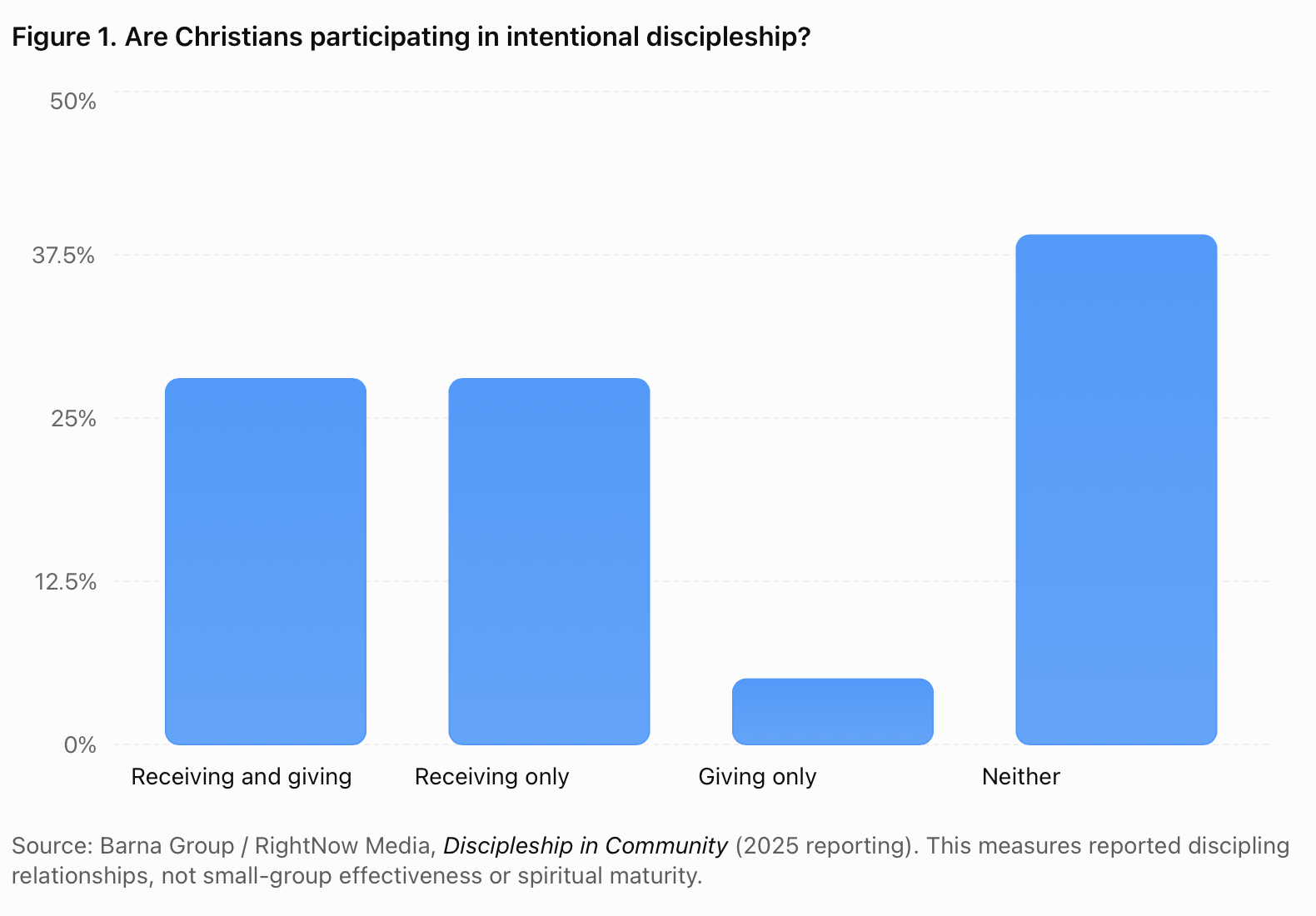
These findings indicate that a substantial proportion of Christians are not involved in the intentional relationships measured by the study.
They also raise questions about the preparation of believers to help others grow spiritually.
However, the study does not establish that all respondents participate in small groups or that particular types of groups are ineffective.
Church Attendance and Spiritual Development
The historical Willow Creek REVEAL research provides another important perspective.
As discussed by Rod Dempsey, the study challenged assumptions that increasing participation in church programs necessarily produces corresponding spiritual maturity.⁴
The findings encouraged a distinction between organizational involvement and personal spiritual development.
However, the study should not be treated as a contemporary nationally representative measurement of small-group effectiveness.
Its significance lies in the questions it raised about how churches evaluate spiritual growth.
What the Evidence Can and Cannot Establish
The available research supports several important observations.
Participation in church activities does not automatically demonstrate spiritual maturity.
Intentional discipling relationships are not universal among Christians.
Small groups can contribute to discipleship, but their effectiveness depends upon purpose, leadership, and the quality of relationships.
However, these findings do not establish a reliable contemporary percentage of American church small groups that are effective or ineffective.
The conclusion should therefore be carefully stated:
Research identifies significant weaknesses in the assumptions and practices underlying small-group discipleship, but it does not justify declaring that a particular percentage—or even a verified majority—of American small groups has failed.
VI. When Bible Study Becomes an Exchange of Personal Opinions
One of the most significant weaknesses that can arise in an unstructured Bible study is the replacement of careful biblical interpretation with an exchange of individual opinions.
Participants may read a chapter of Scripture and then discuss what they believe it means.
Personal observations can be valuable. However, the meaning of Scripture is not established by collecting the preferences or impressions of those present.
The Difference Between Interpretation and Opinion
Responsible biblical interpretation seeks to understand the meaning communicated by the biblical author within the passage's historical, grammatical, literary, and theological context.
Questions should include:
What is the historical setting?
Who is speaking or writing?
Who is the intended audience?
What does the passage communicate within its immediate context?
How does it relate to the surrounding argument or narrative?
What theological principles does it establish?
Only after understanding the passage should the group move toward personal application.
The Danger of Uncontrolled Discussion
Without responsible leadership, discussion may become dominated by participants who speak most frequently or forcefully.
Individuals may interrupt one another, introduce unrelated subjects, or repeatedly return to personal theological interests.
Eventually, the group may spend more time debating individual opinions than examining Scripture.
This can create confusion, discourage quieter participants, and undermine the purpose of biblical instruction.
James instructs believers to be swift to hear and slow to speak (James 1:19).
Paul instructed Timothy that the Lord's servant must not quarrel but should be gentle and able to teach (2 Tim. 2:24–25).
Although 1 Corinthians 14:40 directly concerns order in congregational worship, its emphasis upon orderly Christian gatherings also provides a relevant principle.
A Bible study should not become a competition to determine who can speak most loudly or longest.
The Importance of Responsible Facilitation
An effective discussion leader should help participants remain focused upon the biblical passage.
This does not require suppressing questions or preventing disagreement.
Healthy discussion may include differing interpretations.
However, the leader should guide participants toward careful examination of Scripture rather than allowing unsupported assertions to dominate.
When a question cannot be answered adequately, the leader should acknowledge the uncertainty and encourage further study.
The objective is not to win an argument.
It is to understand God's Word faithfully.
VII. Does a Small-Group Leader Need Formal Theological Education?
Formal biblical and theological education can be extremely valuable.
It can equip leaders with skills in interpretation, biblical history, theology, teaching methods, and pastoral care.
However, the New Testament does not require every person leading a small group to possess an academic degree.
The more important questions concern biblical competence, spiritual maturity, teachability, character, and the ability to guide others responsibly.
Biblical Qualifications Matter
Paul instructed Timothy to entrust sound teaching to faithful people who would be able to teach others (2 Tim. 2:2).
He also emphasized the importance of handling the Word of truth accurately (2 Tim. 2:15).
These responsibilities require preparation.
A person should not be appointed to lead biblical instruction merely because he is willing to host a meeting or possesses a forceful personality.
The Leader Is More Than a Discussion Moderator
A discipleship leader should be capable of explaining Scripture, encouraging participation, correcting significant misunderstandings, maintaining order, and helping participants apply biblical truth.
Jeffrey Arnold and Stephanie Black emphasize that effective small-group leadership requires a clear purpose, appropriate structure, relational sensitivity, and continuing evaluation.⁵
A leader must balance participation with direction.
Excessive control can suppress meaningful discussion.
Insufficient leadership can allow confusion and conflict to dominate.
Training Should Be an Ongoing Responsibility
Churches should not assume that spiritually mature believers automatically possess the skills necessary to lead group discussion.
Potential leaders may need instruction in biblical interpretation, facilitation, conflict resolution, pastoral boundaries, and discipleship practices.
Church leadership should provide resources, encouragement, and appropriate oversight.
The goal is not to professionalize every small-group ministry.
It is to ensure that those entrusted with teaching and guiding others are adequately prepared.
VIII. Why Small Groups Need Structure Without Becoming Rigid
Some Christians resist structured discipleship because they associate organization with institutional programming.
They may prefer informal gatherings in which participants can freely share their thoughts and concerns.
Informality can encourage openness.
However, the absence of structure does not necessarily produce healthy relationships or spiritual growth.
Structure Serves the Purpose of the Group
A well-organized group should understand why it meets.
It should establish reasonable expectations concerning preparation, participation, discussion, prayer, and confidentiality.
Arnold and Black recommend a group covenant that clarifies the group's purpose, meeting format, materials, communication practices, and membership expectations.⁶
Such agreements can help prevent misunderstandings and provide leaders with a basis for maintaining healthy group interaction.
Structure Should Encourage Participation
An effective leader does not need to dominate discussion.
Instead, the leader should create an environment in which members can participate meaningfully.
This includes inviting quieter participants to contribute, discouraging interruptions, and helping the group remain focused.
Structure Should Protect Biblical Instruction
A prepared lesson should identify the passage's main idea, explain important contextual issues, and provide thoughtful questions.
Discussion should remain connected to the text.
The leader should distinguish between what Scripture teaches, what participants infer, and what remains uncertain.
Structure Should Lead Toward Application
Biblical instruction should encourage participants to consider how the passage affects their conduct, relationships, priorities, and responsibilities.
Without application, Bible study can become an accumulation of information.
However, application must arise from the passage's meaning rather than being imposed upon it.
IX. Fellowship Is Necessary, but Fellowship Alone Is Not Discipleship
Christian fellowship is not a secondary or unimportant activity.
Acts 2:42 identifies fellowship as a central practice of the early church.
Romans 12 describes relationships characterized by love, hospitality, humility, and mutual care.
The church should therefore encourage meaningful Christian relationships.
However, fellowship and discipleship are not identical concepts.
A group may provide companionship without consistently encouraging spiritual maturity.
Members may enjoy one another's company while avoiding difficult conversations concerning obedience, repentance, or Christian responsibility.
The solution is not to eliminate fellowship.
It is to understand fellowship as one important element of a broader process of spiritual formation.
Relationships Must Extend Beyond the Weekly Meeting
In DiscipleShift, Jim Putman, Bobby Harrington, and Robert Coleman emphasize that effective discipleship relationships extend beyond formal group meetings.⁷
Believers learn through shared experiences, personal conversations, prayer, and opportunities to observe Christian conduct.
The weekly gathering provides structure.
The relationships developed through that gathering provide opportunities for continuing encouragement and spiritual development.
Christian Community Should Include Both Encouragement and Challenge
A healthy group should be a place where believers experience acceptance and care.
It should also be a place where Scripture can challenge attitudes and conduct.
The two responsibilities are not contradictory.
Paul instructed believers to speak the truth in love (Eph. 4:15).
Christian relationships should therefore combine genuine compassion with a commitment to biblical faithfulness.
X. Spiritual Accountability: The Missing Element in Many Groups
Accountability is frequently discussed in connection with discipleship.
However, its meaning is not always clearly understood.
Some Christians associate accountability with intrusive questioning, judgment, or attempts to control personal behavior.
Others avoid accountability entirely because they fear conflict or embarrassment.
Neither approach reflects the full biblical picture.
Accountability Begins with Mutual Responsibility
Hebrews 3:12–13 instructs believers to encourage one another against spiritual hardening.
Galatians 6:1–2 emphasizes restoration with gentleness and the bearing of burdens.
James 5:16 connects confession with prayer.
These passages establish that believers should care about one another's spiritual well-being.
Accountability Requires Trust
Meaningful accountability ordinarily develops through relationships characterized by honesty, discretion, humility, and mutual concern.
A person is unlikely to discuss significant spiritual struggles in an environment dominated by argument, ridicule, or gossip.
Leaders should therefore cultivate relationships in which participants feel respected and supported.
Confidentiality should be maintained within appropriate limits, including circumstances involving abuse, threats, or other serious safety concerns.
Accountability Should Encourage Obedience, Not Performance
A discipleship group should encourage participants to apply biblical truth.
However, spiritual maturity should not be reduced to a checklist of religious activities.
Prayer, Scripture reading, worship, service, and fellowship are important practices.
Their purpose is not to establish personal superiority or earn God's acceptance.
They are means through which believers respond to God's grace and grow in faithfulness.
XI. The Importance of Intentional Spiritual Development
One of the most important conclusions emerging from the research is that spiritual growth should not be assumed to occur automatically.
Believers may attend church and participate in small groups for many years without developing greater maturity.
Stephen McQuoid emphasizes the importance of intentional spiritual development and meaningful relationships within the Christian community.⁸
This observation corresponds with Barna's earlier critique of believers who recognize the importance of spiritual growth without establishing clear priorities or goals.
What Should Spiritual Growth Look Like?
A discipleship group should encourage development in several biblical areas.
Biblical understanding: Increasing ability to understand and apply Scripture.
Christian character: Growth in love, humility, patience, self-control, and other qualities associated with the fruit of the Spirit (Gal. 5:22–23).
Prayer and dependence upon God: Developing consistent habits of prayer and trust.
Relationships: Demonstrating forgiveness, compassion, generosity, and mutual care.
Obedience: Increasing willingness to follow Christ's commandments.
Service: Participating in the ministry and responsibilities of the church.
Disciple-making: Developing the ability to encourage and instruct others.
These are not independent measurements of salvation.
They are biblical characteristics that can help churches consider whether their ministries are supporting spiritual maturity.
The Importance of Personal Commitment
Church leadership can provide instruction, relationships, and opportunities.
However, believers must also take responsibility for their spiritual development.
Paul instructed Christians to pursue maturity while recognizing that God works within them (Phil. 2:12–13).
Spiritual growth therefore involves both personal responsibility and dependence upon divine grace.
A discipleship group should encourage commitment without promoting legalism or treating spiritual maturity as a competition.
XII. What Makes an Effective Discipleship Group?
An effective discipleship group should combine biblical instruction with meaningful relationships and intentional spiritual development.
The following principles provide a practical framework.
A Clearly Defined Purpose
The group should understand whether its primary objective is fellowship, Bible study, support, or comprehensive discipleship.
If the goal is discipleship, that purpose should influence its activities.
Biblically Competent Leadership
The leader should be capable of preparing lessons, explaining Scripture, facilitating discussion, and correcting significant misunderstandings.
A Thoughtful Curriculum
A curriculum should provide continuity and help participants develop a progressively broader understanding of Christian doctrine and practice.
However, completing the curriculum should not become the ultimate objective.
Orderly and Meaningful Participation
Members should be encouraged to contribute respectfully.
Discussion should remain connected to Scripture.
No participant should routinely dominate the meeting.
Practical Application
Each study should help participants consider how biblical truth applies to their lives.
Prayer and Mutual Care
The group should provide opportunities for prayer, encouragement, and practical assistance.
Appropriate Accountability
Trusted relationships should encourage spiritual growth through honesty, support, and biblical correction.
Opportunities for Service
Members should be encouraged to apply their gifts and abilities in service to others.
Leadership Development
Mature participants should be given opportunities to develop the skills necessary to encourage and disciple others.
Continuing Evaluation
Church leadership and group participants should periodically consider whether the group is accomplishing its stated purpose.
Evaluation should encourage improvement rather than create a legalistic performance system.
XIII. A Practical Model for a Structured Discipleship Group
The New Testament does not prescribe a particular number of participants or a fixed meeting schedule.
Nevertheless, a church can develop a practical structure consistent with biblical principles.
Suggested Group Organization
A group of approximately six to ten participants provides opportunities for meaningful discussion and personal relationships, although larger or smaller groups may also function effectively.
A prepared leader should guide the group, preferably with an assistant or developing leader.
Weekly meetings of approximately ninety minutes can provide sufficient time for biblical instruction, discussion, prayer, and mutual encouragement.
The curriculum should follow a planned sequence of biblical studies with clearly identified objectives.
The group should remain connected to the congregation's pastoral leadership and provide appropriate opportunities for encouragement between meetings.
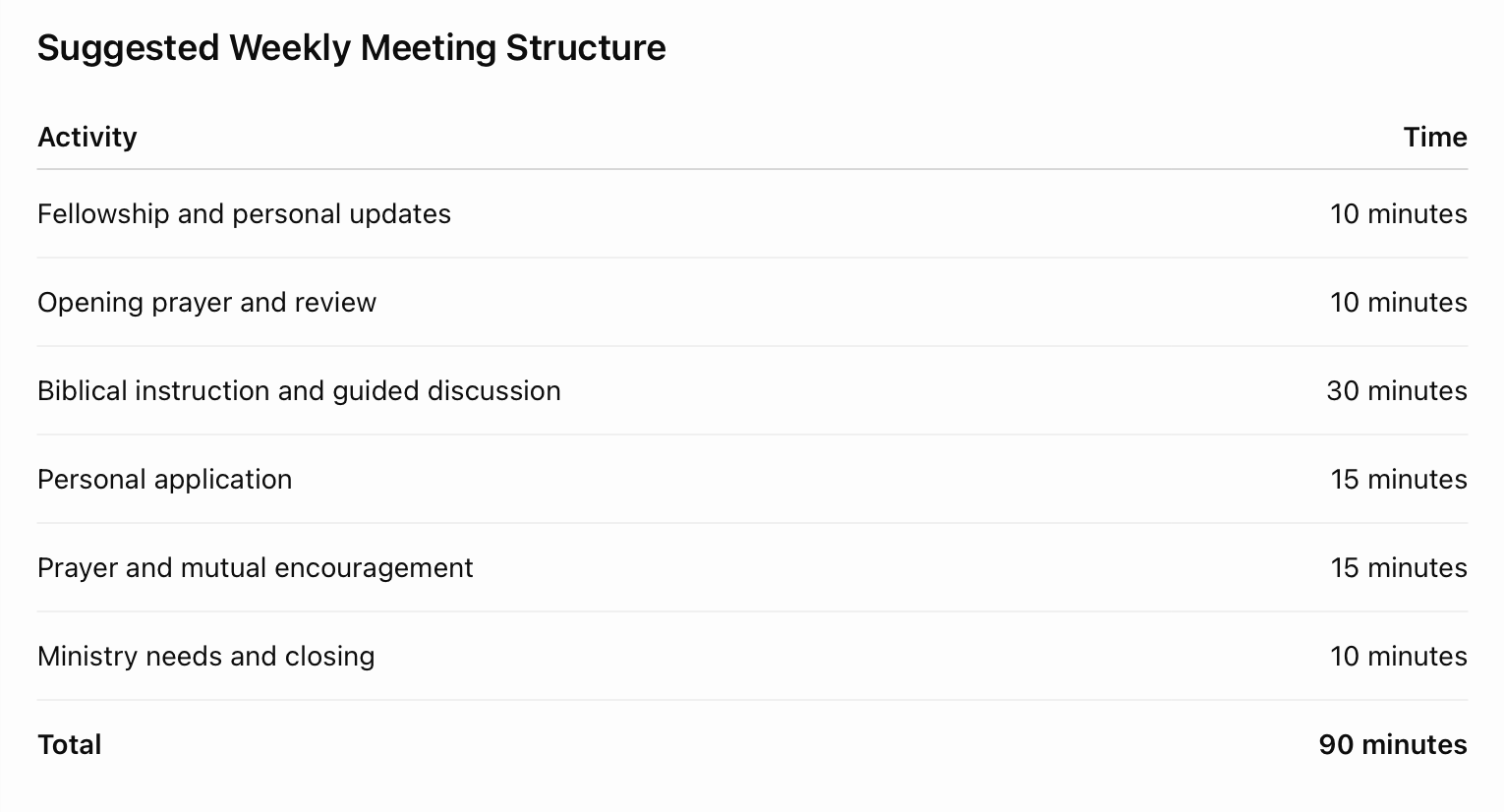
This schedule is an illustrative model rather than a biblical requirement.
Its purpose is to ensure that the meeting includes more than an unstructured discussion.
Five Questions for Biblical Study
A leader can guide discussion through five questions:
What does the passage actually say?
What did the author intend to communicate to the original audience?
What does the passage teach about God, humanity, or Christian responsibility?
How should this truth influence our beliefs, attitudes, or conduct?
How can we encourage one another to respond faithfully?
These questions move the discussion from observation to interpretation and then to application.
They also help prevent the meeting from becoming an exchange of unrelated personal opinions.
XIV. Evaluating Small-Group Effectiveness: A Practical Assessment
Churches should periodically evaluate their small-group ministries.
The objective is not to assign numerical values to spiritual maturity.
It is to determine whether the group is functioning in a manner consistent with its stated biblical purpose.
The following questions provide a useful assessment framework.
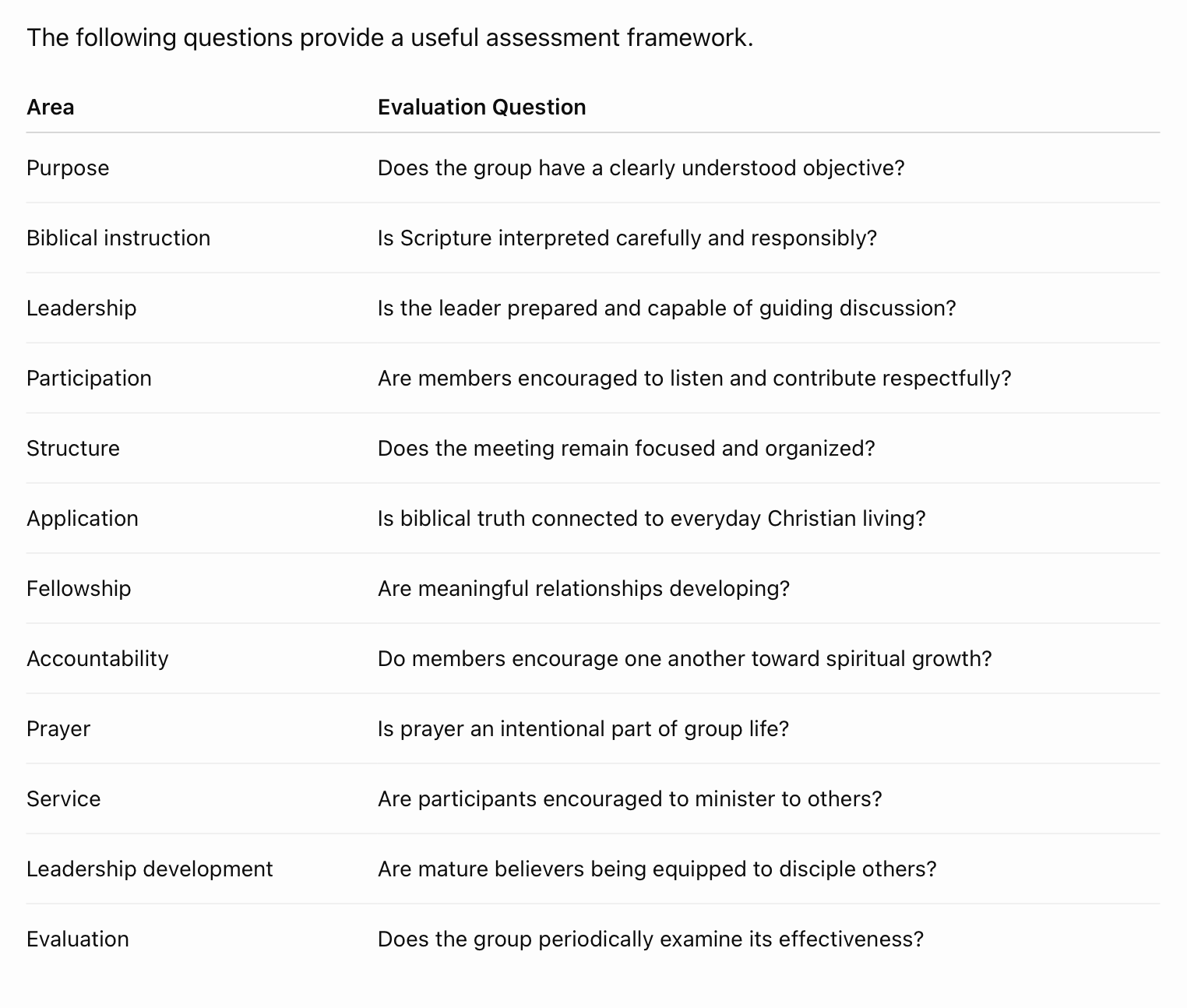
A group need not perform every function equally well.
A support group, for example, may appropriately emphasize prayer and mutual care.
However, a group specifically identified as a discipleship ministry should demonstrate a broader commitment to spiritual formation.
How Should the Assessment Be Used?
The questions should be discussed periodically by group leaders and, where appropriate, church leadership.
Participants may also provide constructive feedback concerning the group's strengths and weaknesses.
The evaluation should consider observable practices rather than attempt to measure the hidden spiritual condition of individuals.
A group demonstrating strong fellowship but limited biblical instruction may need a more thoughtful study plan.
A group with sound teaching but little mutual care may need greater attention to relationships.
A group dominated by argumentative discussion may need clearer expectations and more effective facilitation.
The purpose of evaluation is improvement, not condemnation.
XV. What Should Churches Do When a Small Group Is Not Functioning Well?
Not every struggling small group needs to be discontinued.
Many can improve through clarification, training, and responsible leadership.
Clarify the Group's Purpose
The first question should be whether participants share a common understanding of why the group meets.
A fellowship group should not be judged by the same expectations as a structured discipleship group.
Address Problems in Discussion
If participants routinely interrupt one another, dominate conversations, or introduce unrelated subjects, the leader should establish reasonable discussion expectations.
These may include allowing one person to speak at a time, returning to the biblical passage when discussion wanders, and encouraging contributions from quieter members.
Provide Leadership Training
Some leaders may simply lack experience in facilitating discussion.
Training in biblical interpretation, lesson preparation, and group dynamics may significantly improve the meeting.
Establish a Clear Study Plan
A prepared lesson with an identified biblical objective can help maintain focus.
Participants should understand what passage is being examined and what the group hopes to learn.
Seek Appropriate Pastoral Guidance
If a group remains disorderly or consistently fails to accomplish its purpose, pastoral leadership may need to provide guidance.
A participant who finds a group spiritually unhelpful should not assume that remaining indefinitely is a biblical obligation.
It may be appropriate to discuss concerns respectfully with the leader, suggest constructive changes, or seek a different group.
The objective should be restoration and improvement rather than personal conflict.
XVI. Theological Conclusion: From Gathering Christians to Making Disciples
Small groups can be among the most valuable ministries of the local church.
They provide opportunities for fellowship, prayer, biblical instruction, encouragement, accountability, and Christian service.
The early church demonstrated the importance of shared life and mutual responsibility.
The New Testament repeatedly instructs believers to teach, encourage, correct, support, and care for one another.
These responsibilities can be meaningfully practiced in smaller gatherings.
However, small groups are not automatically effective merely because they exist.
A Bible study can become an exchange of personal opinions.
A fellowship group can remain primarily social.
A support group can provide meaningful care without functioning as a comprehensive discipleship ministry.
And a group labeled a discipleship program can become another religious activity without clear objectives or meaningful spiritual accountability.
George Barna's research challenged churches to distinguish participation from transformation.
Contemporary findings concerning intentional discipling relationships suggest that many Christians remain disconnected from the relational processes through which spiritual development can be encouraged.
The solution is not to abandon small groups.
It is to recover a biblical understanding of their purpose.
Churches should develop leaders who understand Scripture and demonstrate Christian maturity.
They should establish group structures that encourage meaningful participation, responsible biblical interpretation, practical application, and mutual care.
They should help believers understand that discipleship is not simply another activity on the church calendar.
It is the continuing responsibility of following Jesus Christ.
Most importantly, churches should evaluate whether their ministries are contributing to the objective established by Christ Himself.
The Great Commission commands the church to make disciples.
Paul sought to present believers mature in Christ.
Church leaders were instructed to equip the saints for ministry.
And believers were called to encourage one another toward love and good works.
A successful small group is therefore not merely one in which Christians gather regularly, enjoy fellowship, or discuss Scripture. It is one whose activities and relationships genuinely support its biblical purpose and help believers grow toward maturity in Jesus Christ.
The central question is not simply whether churches have small groups.
It is whether those groups are helping the church make disciples.
Questions for Reflection and Discussion
What is the difference between a fellowship group and an intentional discipleship group?
How does Acts 2:42–47 describe the responsibilities of Christian community?
Why is participation in a Bible study insufficient evidence of spiritual maturity?
What problems arise when biblical discussion becomes dominated by personal opinions?
How should a leader balance open participation with responsible biblical instruction?
Does leading a small group require formal theological education? What qualifications are essential?
What does Galatians 6:1–2 teach about correction and mutual responsibility?
How can groups encourage accountability without becoming intrusive or controlling?
What does George Barna's research suggest about the limitations of small-group ministry?
How can churches distinguish between successful fellowship and effective discipleship?
What practical changes could improve the effectiveness of an existing small group?
How can small groups prepare believers to disciple others?
Scripture Index
Christian community and fellowship: Acts 2:42–47; Romans 12:3–16; Ephesians 4:11–16.
Mutual encouragement and accountability: Galatians 6:1–2; Hebrews 3:12–13; 10:24–25; James 5:16.
Biblical instruction and interpretation: 2 Timothy 2:2, 15, 24–25; 3:14–17; James 1:22–25.
Spiritual maturity: Matthew 28:18–20; Galatians 5:22–23; Philippians 2:12–13; Colossians 1:28–29.
Christian relationships and conduct: Romans 12:9–16; Ephesians 4:15; 1 Thessalonians 5:11.
References
George Barna, Growing True Disciples: New Strategies for Producing Genuine Followers of Christ (Colorado Springs: WaterBrook Press, 2001), 54–56.
Barna, Growing True Disciples, 117–23, Kindle edition pagination supplied in the research materials.
Barna Group, “Two in Five Christians Are Not Engaged in Discipleship,” Discipleship in Community research, conducted with RightNow Media, https://production.barna.com/articles/christians-discipleship-community.
Rod Dempsey, “Analyzing the Attractional Model,” in Disciple Making Is . . .: How to Live the Great Commission with Passion and Confidence (Nashville: B&H Academic, 2013), 256–59.
Jeffrey Arnold and Stephanie Black, The Big Book on Small Groups (Downers Grove, IL: InterVarsity Press, 1992), 25–27,
Arnold and Black, The Big Book on Small Groups, 25–26, pagination in the supplied Logos export.
Jim Putman, Bobby Harrington, and Robert E. Coleman, DiscipleShift: Five Steps That Help Your Church to Make Disciples Who Make Disciples (Grand Rapids: Zondervan, 2013), 72–73.
Stephen McQuoid, Discipline with Care: Applying Biblical Correction in Your Church (Leominster: Day One, 2008), 40–43.
Research Methodology
The sources include historical assessments of discipleship, practical ministry literature, and more recent survey research.
The Barna Group findings concerning intentional discipling relationships should not be interpreted as a direct measurement of the effectiveness of American church small groups.
Likewise, the historical REVEAL research should not be presented as current national data.
The article therefore evaluates small-group ministry through biblical principles, documented research concerns, and practical ministry recommendations.