An Exegetical and Theological Study
Theological Abstract
Revelation 20 presents the binding of Satan, the resurrection and reign of the saints, the thousand-year kingdom of Jesus Christ, Satan’s final rebellion, and the great white throne judgment. These events reveal the progressive fulfillment of God’s redemptive purposes and the ultimate triumph of Christ over Satan, sin, death, and every opposing power.
This study advances a pretribulational premillennial interpretation of Revelation 20. It maintains that Christ will gather His Church before the tribulation, return visibly to earth following that period, and establish a literal thousand-year kingdom before the final judgment and the creation of the new heavens and new earth.
Particular attention is given to the identity of the heavenly messenger who binds Satan in Revelation 20:1–3. Although several premillennial commentators identify this figure as an angel exercising delegated authority, this study favors identifying the descending messenger with Jesus Christ Himself. This conclusion is developed through the biblical testimony concerning Christ’s universal authority, His possession of the keys of Hades and Death, and His victorious return immediately preceding the events of Revelation 20.
The study also examines the first resurrection in relation to the rapture of the Church, the resurrection of Old Testament saints and tribulation martyrs, and the distinction between glorified believers and mortal inhabitants of the millennial kingdom. The first resurrection is understood as the bodily resurrection of the righteous, occurring in successive stages within the broader prophetic chronology.
Finally, the study distinguishes the Judgment Seat of Christ, where believers' service is evaluated for rewards, from the Great White Throne Judgment, where the unredeemed face final judgment. Salvation is grounded entirely in God's grace through Jesus Christ, while rewards recognize faithful service rendered by those already redeemed.
The central theological conclusion is that Revelation 20 describes a future historical manifestation of Christ’s sovereign reign, culminating in Satan’s permanent defeat, the final judgment of the wicked, the abolition of death, and the transition into God’s eternal kingdom.
Introduction: Understanding Revelation 20 in the Biblical Timeline
Revelation 20 is among the most significant passages in Scripture concerning the future kingdom of Jesus Christ.
In fifteen verses, the apostle John describes Satan’s imprisonment, the resurrection and reign of the saints, a thousand-year kingdom, a final rebellion, and the judgment of the dead.
Yet Revelation 20 does not provide a complete account of every event associated with Christ’s return. The rapture of the Church, the transformation of living believers, the tribulation, and the restoration of Israel receive fuller treatment elsewhere in Scripture.
Consequently, understanding Revelation 20 requires examining its relationship to the broader biblical testimony.
The interpretation presented here is pretribulational premillennialism. This position maintains that Christ will gather His Church before the tribulation, return visibly to earth after that period, and establish the millennial kingdom described in Revelation 20.
The objective is not to impose an eschatological system upon Scripture but to examine the biblical evidence and determine how the relevant passages relate to one another.
Where Scripture speaks explicitly, its testimony must govern our conclusions. Where a conclusion depends upon comparing several passages, that interpretive process should be acknowledged.
The central question is straightforward: What does Revelation 20 reveal about Christ’s future kingdom, the resurrection of the righteous, Satan’s final defeat, and the last judgment?
I. The Chronological Setting of Revelation 20
Revelation 19:11–21 describes the visible return of Jesus Christ as the conquering King.
John sees heaven opened and Christ appearing as Faithful and True. He judges and makes war in righteousness, defeats the armies gathered against Him, and consigns the beast and false prophet to the lake of fire.
Revelation 20 then describes Satan being seized, bound, and confined in the abyss for a thousand years.
The progression is significant.
The beast and false prophet are defeated in Revelation 19. Satan is imprisoned in Revelation 20. The saints reign with Christ, Satan is subsequently released and permanently judged, and the Great White Throne Judgment follows.
Revelation 21 then introduces the new heavens and new earth.
The natural reading of this sequence is that the events of Revelation 20 follow Christ’s visible return.
John F. Walvoord understands Revelation 20 as continuing the prophetic chronology established in Revelation 19, with Christ’s second coming preceding the millennial kingdom. Robert L. Thomas likewise argues that the sequence of visions favors a future millennium following Christ’s return.¹
Does Revelation Always Follow Chronological Order?
Revelation contains visions that revisit earlier events from different perspectives. Therefore, the recurring expression “And I saw” does not automatically establish chronological succession in every instance.
G. K. Beale, for example, understands Revelation 20:1–6 as recapitulating the present age rather than describing events following Revelation 19. His interpretation emphasizes the literary structure of Revelation and the relationship between Satan’s defeat through Christ’s first coming and the binding described in Revelation 20.²
Nevertheless, the premillennial interpretation finds the sequential reading more persuasive in this context.
Revelation 12 describes Satan being cast from heaven to earth, where he continues his destructive activity.
Revelation 20 describes Satan being removed from earthly activity and imprisoned in the abyss.
These are substantially different conditions.
Thomas emphasizes that Satan’s confinement in Revelation 20 cannot readily be equated with his earlier expulsion from heaven. The millennium follows Christ’s return and provides the setting for the promised messianic reign.³
The distinction is important because Scripture continues to describe Satan as active during the present age (Eph. 6:11–12; 1 Pet. 5:8).
Revelation 20 anticipates a future condition in which his deceptive activity among the nations is decisively interrupted.
II. The Thousand-Year Reign of Christ
The expression “a thousand years” appears six times in Revelation 20:2–7.
John uses this period to describe Satan’s confinement, the reign of the saints, and the interval preceding Satan’s final release.
The repetition establishes a definite period with a beginning and an end.
Premillennialism understands this as a future kingdom following Christ’s visible return.
Although Revelation employs symbolic imagery, symbolism does not require the events described to be unreal.
The dragon, chain, key, and abyss communicate supernatural realities through apocalyptic language. Similarly, the thousand years may describe an actual duration without requiring every surrounding image to be interpreted as an ordinary physical object.
Walvoord argues that the repeated references to the thousand years support understanding the period as a literal duration. Thomas likewise emphasizes the consistency of the chronological references throughout the passage.⁴
Is Christ Already Reigning?
Yes.
Scripture teaches that Jesus Christ presently reigns as the exalted Lord.
Peter declares that Christ has been raised and exalted to God’s right hand (Acts 2:29–36).
Paul describes Christ as seated above every principality, power, and authority (Eph. 1:20–23).
Premillennialism does not require denying this present reign.
Rather, it distinguishes Christ’s present heavenly authority from the future manifestation of His kingship over the nations.
Christ is already King.
The millennium represents a future historical expression of His sovereign rule.
Why Understand the Thousand Years Literally?
The strongest immediate argument is the repeated chronological function of the expression.
John identifies when Satan is bound, how long he remains confined, when he is released, and what follows his release.
The narrative presents successive events organized around a specified duration.
Some interpreters understand the number symbolically as representing a complete or divinely appointed period.
The premillennial interpretation maintains that the repeated numerical references and their chronological function favor an actual future period of one thousand years.
III. The Identity of the Descending Angel and Satan’s Binding (Revelation 20:1–3)
John writes:
“Then I saw an angel coming down from heaven, having the key to the bottomless pit and a great chain in his hand.” (Rev. 20:1, NKJV)
The figure descends from heaven, seizes Satan, binds him, casts him into the abyss, and seals it for a thousand years.
The identity of this heavenly messenger deserves careful consideration.
Is the Descending Angel Jesus Christ?
The interpretation advanced in this study is that the descending messenger is Jesus Christ Himself, personally exercising His sovereign authority over Satan.
This conclusion rests upon the cumulative testimony of Scripture concerning Christ’s authority and His victory over the devil.
At the conclusion of Matthew’s Gospel, the risen Jesus declares:
“All authority has been given to Me in heaven and on earth.” (Matt. 28:18, NKJV)
This declaration is comprehensive.
Christ possesses authority over heaven and earth, including every spiritual power opposed to God.
In Revelation 1:18, the resurrected Christ announces:
“I have the keys of Hades and of Death.” (NKJV)
Keys symbolize the authority to open, close, release, and confine.
The possession of the keys of Hades and Death demonstrates Christ’s sovereign authority over death and the realm of the dead.
Revelation 3:7 further describes Christ as the One who opens and no one shuts, and shuts and no one opens.
The language emphasizes His decisive and uncontestable authority.
The figure in Revelation 20:1 likewise possesses a key and exercises authority to imprison Satan.
Although the key to the abyss is not explicitly identified as the same key mentioned in Revelation 1:18, the correspondence in imagery is significant.
The immediate literary context strengthens this interpretation.
Revelation 19 has just presented Jesus Christ as the victorious King who defeats the beast and false prophet.
Revelation 20 then describes the imprisonment of Satan, the spiritual power behind their rebellion.
The movement from Christ’s victory over earthly opposition to Satan’s confinement naturally suggests the continuing exercise of Christ’s victorious authority.
Hebrews 2:14 teaches that Christ’s death was directed toward the defeat of the devil, while 1 John 3:8 declares that the Son of God was manifested to destroy the works of the devil.
Revelation 20 portrays the further manifestation of that victory.
The Meaning of Angelos
The Greek word translated “angel” is angelos (ἄγγελος), meaning “messenger.”
The term ordinarily refers to created angelic beings in Revelation. Nevertheless, the word itself describes a messenger and does not inherently determine the messenger’s nature.
The question is therefore whether the context requires an ordinary angel or permits identification with Christ.
The present study favors the latter conclusion because of the broader biblical testimony concerning Christ’s authority and the immediate sequence of His victorious return.
This does not mean that every appearance of an angel in Revelation should be identified with Christ.
The identification rests upon the particular function, authority, and context of Revelation 20:1–3.
Why Do Thomas and Walvoord Identify a Different Angel?
Robert L. Thomas considers several proposed identifications of the descending angel, including Christ, but concludes that the figure is best understood as a specially commissioned angel.
John F. Walvoord likewise understands the figure as an angel acting under divine authority.⁵
Their position rests partly upon the ordinary use of angelos in Revelation and the biblical precedent for angels carrying out divine judgments.
This raises an important distinction.
Christ’s possession of supreme authority does not logically exclude His commissioning another being to execute a particular judgment.
Scripture contains numerous examples of angels carrying out commands under divine authority.
Therefore, the argument that Christ possesses all authority establishes His sovereignty over Satan’s imprisonment, but does not by itself prove that Christ personally performs the binding.
Nevertheless, this study favors identifying the descending figure with Christ.
The cumulative correspondence between Christ’s declared authority, His possession of keys, His victory over Satan, and the immediate progression from Revelation 19 to Revelation 20 provides a theological basis for this interpretation.
The text does not explicitly identify the messenger as Jesus Christ. Consequently, the identification should be understood as an exegetical conclusion drawn from comparing Scripture with Scripture rather than as a direct statement of Revelation 20:1.
This distinction preserves the argument without attributing to the passage more than it explicitly says.
The Nature of Satan’s Binding
John describes Satan being seized, bound, cast into the abyss, shut in, and sealed there.
The purpose is explicitly stated: Satan is prevented from deceiving the nations until the thousand years are completed.
This confinement represents a decisive restriction of Satan’s activity, fundamentally different from his present influence in the world.
Although Christ defeated Satan through His death and resurrection (Col. 2:15; Heb. 2:14), the New Testament continues to describe Satan as active during the present age.
Thomas emphasizes that the combination of binding, imprisonment, and sealing indicates the effectiveness of Satan’s confinement. The imagery communicates a genuine restriction of his activity rather than a merely partial limitation.⁶
The passage does not explain every aspect of Satan’s condition within the abyss.
Its stated emphasis is that he can no longer deceive the nations during the thousand years.
The Abyss and the Lake of Fire
An important distinction exists between the abyss and the lake of fire.
The abyss is portrayed as a place of confinement associated with demonic powers (Rev. 9:1–11; 11:7; 17:8).
The lake of fire is the final place of judgment described in Revelation 19:20 and 20:10–15.
Satan’s imprisonment in the abyss is temporary.
His final judgment in the lake of fire is permanent.
The distinction explains why Satan can be released from the abyss after the thousand years but is never released from the lake of fire.
IV. The First Resurrection and the Rapture of the Church
Revelation 20:4–6 describes faithful believers who come to life and reign with Christ for a thousand years.
John particularly emphasizes those who suffered martyrdom because of their testimony to Jesus and their refusal to worship the beast.
He declares:
“Blessed and holy is he who has part in the first resurrection. Over such the second death has no power, but they shall be priests of God and of Christ, and shall reign with Him a thousand years.” (Rev. 20:6, NKJV)
This raises an important chronological question.
If believers are resurrected at the rapture of the Church, why does Revelation 20 describe another resurrection and call it the first resurrection?
The answer requires examining the resurrection of Christ, the resurrection of Church-age believers, and the resurrection of tribulation martyrs in their proper biblical relationship.
Christ’s Resurrection: The Firstfruits
Paul writes:
“But now Christ is risen from the dead, and has become the firstfruits of those who have fallen asleep.” (1 Cor. 15:20, NKJV)
The expression firstfruits identifies Christ as the beginning and guarantee of the resurrection harvest.
His resurrection differs from earlier biblical accounts of individuals being restored to life.
Lazarus and others returned to ordinary mortal life and eventually died again.
Christ rose in a glorified, immortal body, never again to die.
Paul continues:
“But each one in his own order: Christ the firstfruits, afterward those who are Christ’s at His coming.” (1 Cor. 15:23, NKJV)
The Greek word tagma (τάγμα), translated “order,” can refer to an appointed arrangement or sequence.
Paul establishes that resurrection occurs according to God’s appointed order.
The passage does not independently specify every proposed stage of the future resurrection, but it provides an important foundation for understanding resurrection as an ordered fulfillment of God’s purposes.
The Resurrection of Church-Age Believers at the Rapture
First Thessalonians 4:13–18 describes the resurrection and gathering of believers to Christ.
Paul teaches that the Lord will descend from heaven, the dead in Christ will rise first, and living believers will then be caught up together with them to meet the Lord in the air.
First Corinthians 15:51–53 adds that living believers will be transformed.
Those who have died are raised in incorruptible bodies, while those still living are changed without first experiencing physical death.
The resurrection of deceased believers and the transformation of living believers are related but distinguishable events.
Both groups receive the immortal condition necessary for eternal fellowship with Christ.
When Does the Rapture Occur?
The pretribulational interpretation understands the rapture as occurring before the tribulation.
This conclusion is reached by correlating passages concerning Christ’s coming for His Church, the promised deliverance of believers from divine wrath, and the events associated with Christ’s visible return.
First Thessalonians 4 describes believers meeting Christ in the air.
Revelation 19 describes Christ appearing publicly in judgment, accompanied by the armies of heaven.
Pretribulational interpreters understand these as distinct events separated by the tribulation.
They also appeal to John 14:2–3, 1 Thessalonians 1:10 and 5:9, and Revelation 3:10.
These passages are understood as consistent with Christ gathering His Church before the period of divine judgment.
Nevertheless, none independently states the complete pretribulational chronology.
The position is established through theological synthesis rather than through a single passage explicitly declaring that the rapture occurs seven years before Christ’s visible return.
The First Resurrection as an Ordered Sequence
The central interpretive difficulty concerns the meaning of “first resurrection.”
If Christ has already risen and Church-age believers have been resurrected at the rapture, how can the resurrection described in Revelation 20 be called the first resurrection?
The answer is found in the contrast John establishes between two groups of the dead.
In Revelation 20:4, faithful believers come to life and reign with Christ.
In verse 5, John explains that the rest of the dead do not come to life until the thousand years have ended.
He then identifies the resurrection of the faithful as the first resurrection.
The word first distinguishes this resurrection from the later resurrection associated with final judgment.
Thomas argues that the first resurrection encompasses the resurrection of the righteous rather than a single event restricted to the martyrs of Revelation 20. He includes the resurrection of Church-age believers at the rapture and the resurrection of Old Testament saints and tribulation martyrs associated with Christ’s return.⁷
Within pretribulational premillennialism, the first resurrection is therefore understood as a broader resurrection order occurring in successive stages.
Christ’s resurrection is the firstfruits.
Church-age believers are raised at the rapture.
Tribulation martyrs are raised in connection with Christ’s second coming.
Old Testament believers are commonly understood to be raised in connection with the establishment of the kingdom.
The precise timing of every group is not explicitly stated in Revelation 20 and remains a matter of interpretation.
The central distinction is between those raised to participate in Christ’s kingdom and those raised later for final judgment.
The Greek word translated “first” does not itself mean a category encompassing multiple stages.
That understanding is a theological conclusion reached by comparing Revelation 20 with the broader biblical teaching concerning resurrection.
Nevertheless, the explanation is consistent with the distinction John establishes between the resurrection of the righteous and the later resurrection of the remaining dead.
Does “Came to Life” Mean Bodily Resurrection?
The Greek verb translated “came to life” is ezēsan (ἔζησαν), from zaō (ζάω), meaning “to live.”
The same verb is used of the faithful in verse 4 and the rest of the dead in verse 5.
This parallel is significant.
If the rest of the dead come to life through bodily resurrection after the millennium, the most natural interpretation is that the earlier coming to life also describes bodily resurrection.
Mounce and Thomas both emphasize the importance of the parallel language in understanding the first resurrection as bodily rather than merely spiritual.⁸
John also uses the noun anastasis (ἀνάστασις), ordinarily associated with resurrection.
The combined evidence supports understanding the first resurrection as bodily resurrection.
Why Does John Emphasize the Martyrs?
Revelation 20:4 specifically identifies those who suffered death because of their testimony to Christ and their refusal to worship the beast.
Their resurrection demonstrates God’s vindication of those who remained faithful under persecution.
These believers suffered at the hands of earthly powers.
They are now raised to share in the reign of the King whom they refused to deny.
Within the pretribulational framework, these martyrs are understood as believers who came to faith during the tribulation and were subsequently killed for their testimony.
Their resurrection occurs in connection with Christ’s return and the inauguration of the millennial kingdom.
They are not the first believers ever resurrected.
Rather, their resurrection belongs to the broader resurrection order of the righteous.
What About Old Testament Believers?
Daniel 12:1–3 describes a future resurrection associated with a time of unprecedented distress and the deliverance of God’s people.
Isaiah 26:19 likewise anticipates the resurrection of the dead.
Pretribulational interpreters commonly associate the resurrection of Old Testament believers with the conclusion of the tribulation and the establishment of Christ’s kingdom.
However, Revelation 20 does not explicitly identify the precise resurrection timing of Old Testament saints.
The proposed sequence is derived from correlating Daniel 12 with Revelation 20 and other resurrection passages.
The important point is that all who belong to God ultimately participate in the resurrection life secured through Jesus Christ.
A Brief Acknowledgment of Historic Premillennialism
Not all premillennialists place the rapture before the tribulation.
Historic premillennialists commonly understand the Church as remaining on earth through the tribulation and being gathered to Christ at His visible return.
George Eldon Ladd represents this broader historic premillennial tradition.⁹
Both historic and pretribulational premillennialists affirm Christ’s future return, the bodily resurrection of believers, and their participation in His kingdom.
The present study follows the pretribulational interpretation because it understands the gathering of the Church and Christ’s later public return as distinguishable events within the broader prophetic chronology.
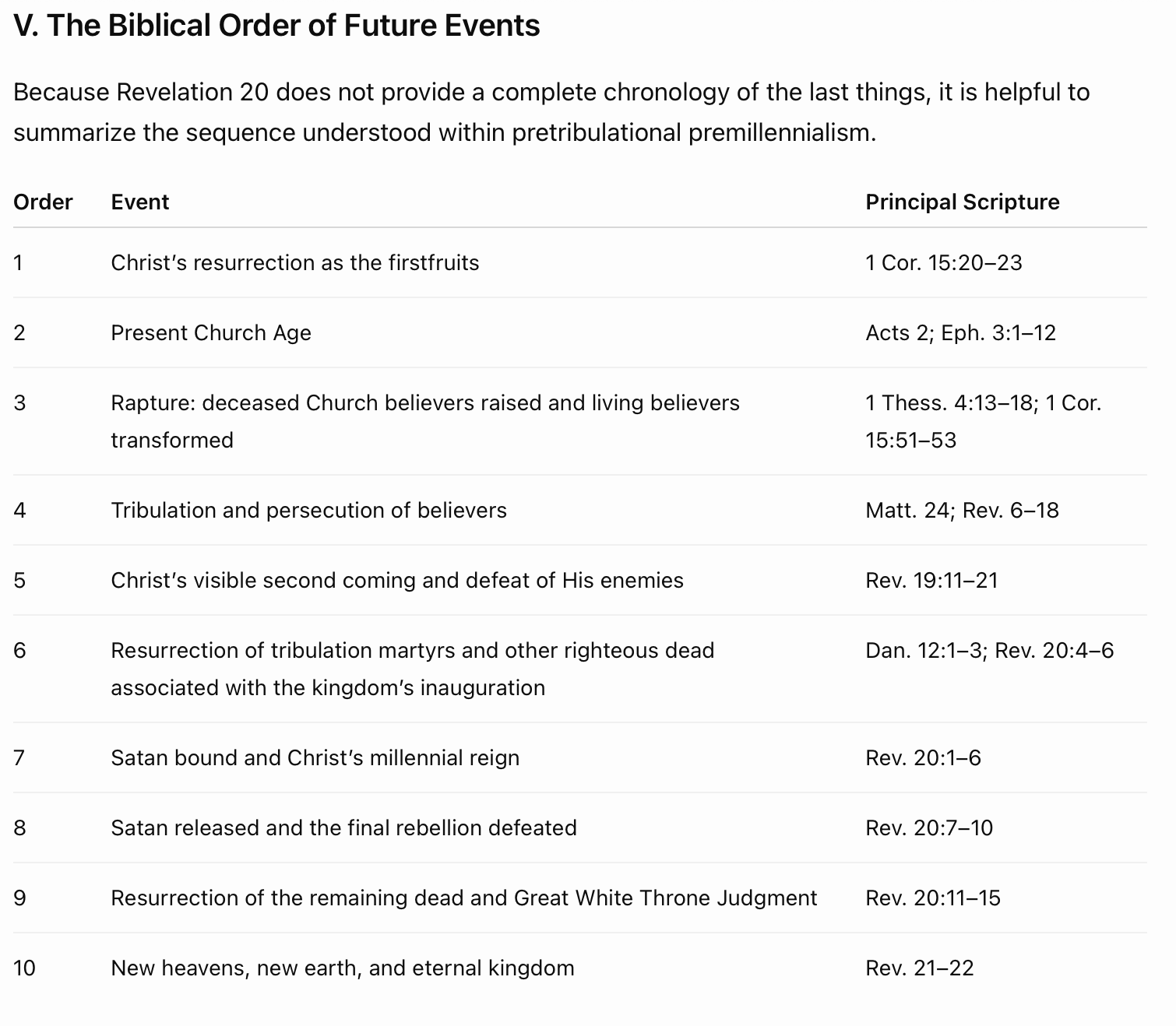
This table represents a theological synthesis of several biblical passages rather than a chronology explicitly presented in one chapter.
The sequence also distinguishes resurrection from transformation.
Deceased believers are raised from the dead.
Living believers are transformed into an immortal condition.
Both participate in the life and kingdom of Christ.
VI. The Saints Reign with Christ (Revelation 20:4–6)
John describes thrones occupied by those to whom judgment has been committed.
He also identifies faithful martyrs who come to life and reign with Christ for a thousand years.
Their participation in the kingdom fulfills the broader biblical expectation that God’s people will share in the Messiah’s reign.
Daniel 7:18 declares that the saints of the Most High will receive and possess the kingdom.
Jesus promised His apostles that they would sit on thrones judging the twelve tribes of Israel (Matt. 19:28).
Paul taught that believers will reign with Christ (2 Tim. 2:12).
Who Occupies the Thrones?
John first sees thrones occupied by individuals who have received authority to judge.
He then sees the souls of those who were martyred because of their testimony for Jesus and their refusal to worship the beast.
These descriptions need not refer to precisely the same group.
Thomas argues that the occupants of the thrones are glorified saints who accompany Christ at His return, corresponding to the heavenly armies described in Revelation 19:14.¹⁰
Having already been raised and glorified, they participate in the administration of Christ’s kingdom.
The martyrs, by contrast, are specifically described as coming to life and reigning with Christ.
Their resurrection occurs at the beginning of the Millennium.
This distinction helps explain why John describes enthroned saints before recounting the resurrection of the martyrs.
The promise of reigning with Christ is not limited to those who suffer martyrdom.
Jesus promises faithful believers a share in His future rule (Rev. 2:26–27; 3:21), and Paul teaches that the saints will judge the world (1 Cor. 6:2).
What Does It Mean That Believers Reign?
The saints do not reign independently of Christ.
Their authority is derived from Him.
John describes them as priests of God and of Christ, emphasizing both their consecrated service and participation in His royal authority.
Their priestly service includes the privilege of fellowship with God, while their royal service involves participation in Christ’s righteous government.
The passage does not provide a detailed description of their responsibilities.
Its central emphasis is that those who suffered for Christ will be vindicated and will share in His victorious reign.
VII. Why Establish a Millennial Kingdom Before the Eternal State?
The premillennial interpretation raises an important theological question.
Why would Christ establish a kingdom lasting a thousand years before the final new creation?
Revelation 20 does not explicitly provide a comprehensive explanation of God’s purposes.
Nevertheless, several themes emerge from the broader biblical narrative.
The Fulfillment of God’s Kingdom Promises
The Old Testament repeatedly anticipates a future reign of the Davidic Messiah characterized by righteousness, peace, and blessing among the nations.
Isaiah 2:2–4 describes the nations seeking instruction from the Lord and abandoning warfare.
Isaiah 11:1–10 portrays the righteous Davidic ruler and a transformed creation.
Jeremiah 23:5–6 promises a righteous Branch from David who will reign as King.
Daniel 7:13–27 describes the Son of Man receiving dominion and the saints possessing the kingdom.
Zechariah 14 portrays the Lord reigning over the earth.
Premillennialism understands these promises as anticipating historical realities that are not yet fully realized.
Revelation 20 provides a framework for their fulfillment before the eternal state.
The Vindication of Christ and His People
The Messiah who was rejected and crucified will reign in righteousness.
Those who suffered for His name will share in His victory.
The kingdom publicly demonstrates the authority of Christ and the faithfulness of God to His promises.
The Final Exposure of Rebellion
At the end of the millennium, Satan is released and gathers the nations in rebellion.
This event demonstrates that outward submission to righteous government is not equivalent to inward spiritual regeneration.
Even under the rule of Christ, those whose hearts remain unchanged are capable of rebellion.
This explanation is a theological inference rather than an explicitly stated reason for Satan’s release.
Nevertheless, it is consistent with the events John describes.
VIII. First Corinthians 15 and the Final Destruction of Death
Paul’s discussion of resurrection in 1 Corinthians 15 provides an important theological connection to Revelation 20.
After identifying Christ as the firstfruits and describing the resurrection of those who belong to Him, Paul writes:
“For He must reign till He has put all enemies under His feet. The last enemy that will be destroyed is death.” (1 Cor. 15:25–26, NKJV)
Paul presents Christ’s reign as continuing until every opposing power has been defeated.
Death is identified as the final enemy.
Does Christ’s Reign Begin at the Millennium?
No.
Christ presently reigns as the exalted Lord.
The premillennial interpretation understands His future earthly kingdom as a further manifestation of that reign.
The kingdom does not establish Christ’s authority for the first time.
It publicly demonstrates the authority He already possesses.
Why Does Death Continue During the Millennium?
Premillennial interpreters distinguish between the defeat of death for glorified believers and its final abolition throughout creation.
At the rapture, resurrected and transformed believers receive immortal bodies.
They are no longer subject to physical death.
However, the millennial kingdom is understood to include mortal inhabitants who have not yet received glorified bodies.
Death may therefore continue among mortal humanity until its final destruction.
Revelation 20:14 describes Death and Hades being cast into the lake of fire.
Revelation 21:4 then declares that death will be no more.
This sequence is consistent with Paul’s statement that death is the last enemy to be destroyed.
David K. Lowery’s discussion of 1 Corinthians 15 and Walvoord’s exposition of Revelation 20 provide complementary treatments of the relationship between Christ’s reign and the final destruction of death.¹¹
IX. Life During the Millennial Kingdom
Revelation 20 provides relatively little information concerning everyday life during the millennium.
Its emphasis is on Satan’s confinement, the reign of the saints, and the final rebellion.
Much of the traditional premillennial description of kingdom life comes from Old Testament prophecy.
Who Will Inhabit the Millennium?
Pretribulational premillennialism generally distinguishes between two groups.
The first consists of resurrected and glorified believers who participate in Christ’s reign.
The second consists of mortal believers who survive the tribulation and enter the kingdom without having received glorified bodies.
Matthew 25:31–46 is commonly understood as describing Christ’s judgment of the nations following His return.
Within this interpretation, those identified as righteous enter the kingdom, while the wicked are excluded.
Zechariah 14:16–19 describes surviving nations worshiping the Lord after His intervention in judgment.
These passages are understood as providing a biblical basis for the continued existence of mortal humanity during the millennium.
However, neither passage explicitly describes the complete demographic composition of the millennial kingdom.
The identification of these survivors as mortal kingdom inhabitants is part of the broader premillennial interpretation.
Will There Be Marriage and Children?
Jesus teaches that resurrected believers neither marry nor are given in marriage (Matt. 22:30).
Premillennial interpreters understand this as applying to glorified believers.
Mortal inhabitants of the kingdom, however, are understood to continue ordinary human life, including marriage and childbearing.
Isaiah 65:20–25 describes children, houses, vineyards, and unusually long life.
These descriptions are commonly associated with millennial conditions.
Will Sin and Death Still Exist?
Isaiah 65:20 refers to death and sinners, even while describing extraordinary longevity and blessing.
Premillennialists understand these conditions as belonging to an intermediate kingdom rather than the eternal state.
This interpretation requires careful attention because Isaiah 65:17 begins with language concerning the new heavens and new earth.
The proposed explanation is that Isaiah presents successive stages of God’s future restoration within a unified prophetic vision.
John A. Martin interprets Isaiah’s description of longevity, death, and restored conditions in relation to the future messianic kingdom.¹²
The explanation is sometimes called prophetic telescoping.
John’s Revelation distinguishes more explicitly between the millennial reign in chapter 20 and the final new creation in chapters 21–22.
Nevertheless, the prophetic telescoping explanation remains an interpretive conclusion rather than an explicit statement in Isaiah.
Why Will People Rebel After a Thousand Years of Righteous Government?
This question is closely connected with the existence of mortal inhabitants during the millennium.
The kingdom begins with redeemed survivors of the tribulation.
These individuals enter the kingdom in their natural bodies and produce descendants during the thousand years.
Their children and subsequent generations must personally respond to God.
Although they live under Christ’s righteous government and without Satan’s deceptive activity, their presence in the kingdom does not automatically guarantee personal faith.
Walvoord and Thomas understand the final rebellion as arising among unregenerate descendants of the redeemed mortal population. When Satan is released, he finds people willing to follow him in opposition to Christ.¹³
Their willingness demonstrates that favorable circumstances and righteous government do not, by themselves, transform the sinful human heart.
The Millennium therefore reveals both the righteousness of Christ’s reign and humanity’s continuing need for personal redemption.
Will Creation Itself Be Restored?
Isaiah 11:6–9 describes extraordinary peace within the animal kingdom and the earth filled with the knowledge of the Lord.
Romans 8:19–23 describes creation awaiting liberation from its bondage to corruption.
Premillennial interpreters commonly understand these passages as anticipating a substantial restoration of creation during Christ’s reign, followed by complete transformation in the new heavens and new earth.
Revelation 20 itself does not describe these ecological conditions.
Their inclusion in a millennial account depends on the interpretation of related prophetic passages.
X. Israel, Jerusalem, and the Millennial Kingdom
The future of Israel is an important consideration within premillennial theology.
Romans 11:25–29 teaches that Israel’s hardening is partial, speaks of Israel’s future salvation, and declares that God’s gifts and calling are irrevocable.
The pretribulational premillennial interpretation understands this as anticipating a future turning of Israel to Jesus Christ as Messiah.
God’s covenant promises are therefore not regarded as abandoned.
Will Jerusalem Be the Center of Christ’s Kingdom?
Isaiah 2:2–4 describes the nations coming to Jerusalem to receive instruction from the Lord.
Zechariah 14 portrays the Lord reigning over the earth and surviving nations coming to Jerusalem to worship.
Revelation 20:9 refers to “the camp of the saints and the beloved city.”
Premillennial interpreters commonly identify the beloved city with Jerusalem.
Thomas understands the expression as referring to earthly Jerusalem, consistent with Old Testament passages describing Zion as the place of God’s special affection and the center of the messianic kingdom.¹⁴
The identification is consistent with the broader prophetic context, although Revelation 20 does not explicitly name Jerusalem or identify the location of Christ’s throne.
The understanding of Jerusalem as the governmental center of the millennial kingdom is therefore a conclusion drawn from the combined prophetic testimony.
What About Ezekiel’s Temple?
Ezekiel 40–48 describes a temple, priesthood, sacrifices, and the return of God’s glory.
Some premillennial interpreters understand the vision as describing a future millennial temple.
Others emphasize its symbolic and theological significance.
The question of future sacrifices presents a particular difficulty because Hebrews 9–10 teaches that Christ offered Himself once for all.
Any interpretation proposing future sacrifices must therefore maintain that they cannot supplement, repeat, or replace Christ’s finished work.
Some interpreters understand them as memorial or ceremonial offerings.
Others regard Ezekiel’s temple imagery as portraying God’s presence among His people through the prophetic categories familiar to Ezekiel’s original audience.
The existence of differing interpretations does not require abandoning the future millennial kingdom described in Revelation 20.
XI. Satan’s Final Release and Rebellion (Revelation 20:7–10)
After the thousand years, Satan is released from his prison for a short time.
He goes out to deceive the nations from the four corners of the earth and gathers them for battle.
John identifies these nations as Gog and Magog.
The assembled forces surround the camp of the saints and the beloved city.
Fire descends from heaven and destroys them.
Satan is then cast into the lake of fire.
Why Does God Permit Satan’s Release?
Revelation states that Satan must be released, but it does not explicitly explain why.
Premillennial interpreters commonly understand the event as exposing the continuing rebellion of unregenerate humanity.
Even after a thousand years of righteous government, those whose hearts remain unchanged are capable of rejecting God’s authority.
The rebellion demonstrates that perfect external conditions cannot produce spiritual regeneration.
Nevertheless, Scripture does not directly identify this as God’s stated purpose.
The responsible conclusion is that Satan’s release occurs according to divine permission and is followed by the final destruction of rebellion.
Who Are Gog and Magog?
The names come from Ezekiel 38–39, where Gog leads hostile forces against God’s people.
Revelation 20 uses these names to describe nations gathered from the four corners of the earth.
The worldwide scope suggests that John is describing a final universal rebellion rather than identifying particular contemporary nations.
Thomas understands the names as designations for the enemies of the Messiah and distinguishes the events of Revelation 20 from a simple identification with every detail of Ezekiel’s prophecy.¹⁵
The essential point is that Satan gathers the nations in one final attempt to oppose God and His people.
Is This the Same Battle Described in Revelation 19?
Within the premillennial chronology, the two events are distinguished.
Revelation 19 describes Christ’s return and the defeat of the beast, false prophet, and their armies.
Revelation 20 places the final rebellion after the thousand years and Satan’s release.
The first conflict accompanies Christ’s return.
The second follows His millennial reign.
The chronological distinction is one of the reasons premillennial interpreters understand Revelation 19–20 as describing successive events.
XII. Satan’s Final Judgment and the Lake of Fire
Revelation 20:10 describes Satan being cast into the lake of fire, where the beast and false prophet already are.
The passage describes their torment as continuing “day and night forever and ever” (NKJV).
Traditional Christian interpretation understands this as teaching the ongoing punishment of Satan and the other enemies of God.
Walvoord and Thomas emphasize that the beast and false prophet remain in the lake of fire after the thousand years, supporting the interpretation that the punishment described is continuing rather than temporary.¹⁶
Some Christians advocate conditional immortality or annihilationism, arguing that biblical language concerning death and destruction points to the eventual extinction of the wicked.
That debate requires consideration of additional passages, including Matthew 25:46 and Revelation 14:9–11.
Revelation 20:10 itself, however, uses explicit language of continuing torment in reference to Satan, the beast, and the false prophet.
The passage emphasizes the permanence and finality of divine judgment.
Satan’s rebellion is ended.
He will never again deceive the nations or oppose God’s people.
XIII. The Great White Throne Judgment (Revelation 20:11–15)
John next sees a great white throne and the One seated upon it.
Earth and heaven flee from His presence.
The dead, small and great, stand before the throne.
Books are opened, including the Book of Life.
The dead are judged according to their works.
Anyone not found written in the Book of Life is cast into the lake of fire.
Who Is Seated Upon the Throne?
Revelation 20 does not explicitly identify the occupant of the throne.
The broader New Testament teaches that the Father has entrusted judgment to the Son (John 5:22–27) and that God will judge the world through the risen Christ (Acts 17:31).
Some commentators identify the throne’s occupant as the Father, while others emphasize Christ’s role as the appointed Judge.
The passage’s silence does not require separating the judgment of God from the authority of Christ.
Final judgment is consistently presented as God’s righteous work accomplished through His appointed Son.
Who Stands Before the Throne?
Within the premillennial chronology, the Great White Throne Judgment is understood as the judgment of the wicked dead.
Those who participated in the first resurrection have already been raised and are declared beyond the power of the second death.
Revelation 20:5 states that the rest of the dead do not come to life until the thousand years are completed.
The Great White Throne Judgment follows that period.
Walvoord understands the participants as the unrighteous dead from all ages, while Thomas similarly relates the judgment to the resurrection of those excluded from the first resurrection.¹⁷
The identification follows from the distinction between the first resurrection and the later resurrection of the remaining dead.
The text does not explicitly state in a single sentence that no redeemed person appears before the throne.
The premillennial conclusion is drawn from the sequence of resurrection and judgment.
Why Are People Judged According to Their Works? The Distinction Between Two Judgments
Revelation 20:12–13 states that the dead standing before the Great White Throne are judged according to their works.
This raises an important theological question: If salvation is by grace through faith rather than works, why does Scripture describe a judgment based upon what people have done?
The answer requires distinguishing between two judgments described in the New Testament: the Judgment Seat of Christ and the Great White Throne Judgment.
The Judgment Seat of Christ: An Evaluation for Rewards
Paul writes:
“For we must all appear before the judgment seat of Christ, that each one may receive the things done in the body, according to what he has done, whether good or bad.” (2 Cor. 5:10, NKJV)
The Greek term bēma (βῆμα), translated “judgment seat,” refers to a tribunal or elevated seat from which judgments and decisions were rendered.
In the context of believers appearing before Christ, this judgment concerns their accountability to Him for the lives they have lived and the service they have rendered.
It does not determine whether they possess eternal life.
Paul makes this distinction particularly clear in 1 Corinthians 3:11–15, where he compares Christian service to constructing a building upon the foundation of Jesus Christ.
The foundation is already established. What remains to be evaluated is the quality of each believer's work.
Paul explains:
“If anyone’s work which he has built on it endures, he will receive a reward.” (1 Cor. 3:14, NKJV)
He then adds:
“If anyone’s work is burned, he will suffer loss; but he himself will be saved, yet so as through fire.” (1 Cor. 3:15, NKJV)
This distinction is decisive.
A believer's work may be found deficient and result in the loss of reward, but the believer does not thereby lose salvation.
The Judgment Seat of Christ is therefore an evaluation of Christian faithfulness, stewardship, and service, not a trial to determine eternal destiny.
The works being evaluated are those performed during the believer's earthly life. Their value is determined not merely by outward accomplishments but by their relationship to Christ, the motives from which they arose, and their conformity to His will (1 Cor. 4:5).
Salvation is the gift of God's grace through faith in Jesus Christ (Eph. 2:8–9). Good works are the intended fruit of that salvation (Eph. 2:10), and faithful service may receive reward.
Consequently, the believer's eternal security rests upon Christ's finished work, not upon the number or quality of works performed.
This does not mean that every activity performed in the name of Christ will necessarily receive a reward.
Paul's illustration emphasizes the quality of each person's work rather than merely the quantity of religious activity.
A work that appears impressive to others may be found deficient when evaluated by Christ. Conversely, acts of humble and faithful service that receive little recognition in this life may be honored by Him.
First Corinthians 4:5 emphasizes that the Lord will disclose the hidden things of darkness and reveal the counsels of the hearts.
The evaluation therefore includes the motives underlying Christian service.
The Judgment Seat of Christ is not a competition for status among believers. It is the righteous evaluation of their stewardship by the Savior to whom they belong.
Within pretribulational premillennialism, this judgment is commonly placed after the rapture and before Christ's visible return, although the precise timing is not explicitly stated in 1 Corinthians 3 or 2 Corinthians 5.¹⁸
The Great White Throne: Judgment of the Unredeemed
The Great White Throne Judgment in Revelation 20:11–15 serves a different purpose.
Within the premillennial chronology, those participating in the first resurrection have already received eternal life and are declared beyond the power of the second death (Rev. 20:6).
The remaining dead are raised after the thousand years and stand before God in final judgment.
John describes books being opened, and the dead are judged according to the things recorded in those books.
Their works are not evaluated to determine how much reward they will receive for service to Christ.
Rather, their works are brought before the righteous Judge as evidence of their lives and their accountability before God.
Romans 2:6 declares that God will render to each person according to his deeds.
Yet Revelation 20 also identifies another book—the Book of Life.
The decisive statement concerning eternal destiny appears in verse 15:
“And anyone not found written in the Book of Life was cast into the lake of fire.” (Rev. 20:15, NKJV)
The distinction is significant.
The books containing the record of human works demonstrate the righteousness of God's judgment.
The Book of Life concerns whether a person belongs to those who receive eternal life.
The passage does not teach that an individual can earn salvation through sufficient good works. Scripture consistently teaches that redemption is possible only through Jesus Christ (John 14:6; Acts 4:12; Eph. 2:8–9).
Thus, the Great White Throne Judgment reveals the righteousness of God's final judgment upon those who remain outside Christ.
Thomas's treatment of Revelation 20:12–15 emphasizes the judgment according to works, the significance of the Book of Life, and the finality of the second death. Walvoord likewise interprets the Great White Throne as the final judgment of the wicked dead.¹⁹
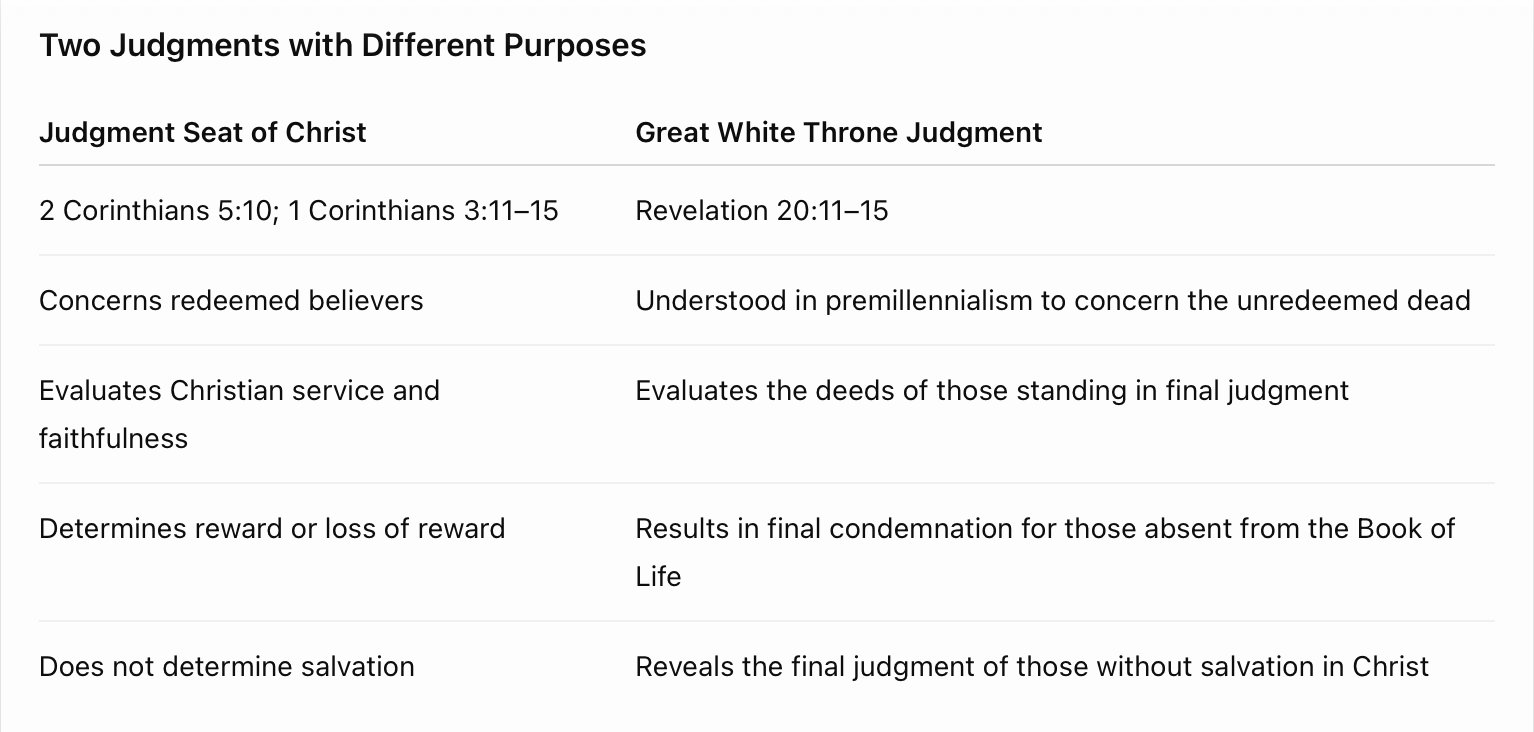
The distinction preserves two essential biblical truths.
First, salvation is entirely the result of God's grace through faith in Jesus Christ and cannot be earned through human works.
Second, believers remain accountable to Christ for their lives and service, and He will reward what has been faithfully accomplished for Him.
For the redeemed, the Judgment Seat of Christ is not a place where their salvation is placed in jeopardy. It is the occasion when their service is evaluated by the Lord who saved them.
For the unredeemed, the Great White Throne reveals the righteousness of God's final judgment and the eternal consequences of remaining outside Jesus Christ.
What Is the Second Death?
Revelation 20:14 explicitly identifies the lake of fire as the second death.
Physical death ends ordinary earthly life.
The second death represents the final judgment of those excluded from the life of God’s kingdom.
Those who participate in the first resurrection are declared beyond its power.
The second death is therefore not simply another physical death.
It is the irreversible consequence of final judgment.
Why Are Death and Hades Cast into the Lake of Fire?
John describes Death and Hades surrendering the dead and then being cast into the lake of fire.
These realities are personified as enemies that have reached the end of their appointed existence.
Paul identifies death as the last enemy to be destroyed (1 Cor. 15:26).
Their destruction signifies that death and the realm associated with the dead will no longer exercise power over God’s creation.
This prepares the way for Revelation 21, where death, sorrow, crying, and pain are permanently abolished.
XIV. The Millennium and the Eternal Kingdom (Revelation 21–22)
Revelation 20 concludes with the final judgment and the destruction of Death and Hades.
Revelation 21 introduces the new heavens and new earth.
John sees the holy city, New Jerusalem, descending from heaven, and announces that God will dwell with His people.
The distinction between the millennium and the eternal state is fundamental to premillennialism.
During the millennium, Christ reigns, Satan is restrained, and the saints participate in His government.
Yet the final rebellion and judgment remain future.
In the eternal state, rebellion has ended, Satan has been permanently judged, and death has been abolished.
Revelation 21:4 declares:
“And God will wipe away every tear from their eyes; there shall be no more death, nor sorrow, nor crying. There shall be no more pain, for the former things have passed away.” (NKJV)
The millennium is not the final destination of God’s people.
It is an intermediate stage in the fulfillment of God’s kingdom purposes before the complete renewal of creation.
The final hope of believers is not merely a thousand years of righteous government.
It is eternal fellowship with God in a creation where sin, death, and suffering no longer exist.
Conclusion: The Complete Victory of Jesus Christ
Revelation 20 presents the progressive and complete triumph of Jesus Christ.
Satan is restrained.
The faithful are raised and reign with Christ.
The nations experience His righteous authority.
Satan’s final rebellion is defeated.
The wicked are judged, and death itself is abolished.
From a pretribulational premillennial perspective, these events occur after Christ’s visible second coming and before the establishment of the eternal state.
The strongest arguments for this interpretation arise from the apparent chronological progression of Revelation 19–21, the distinction between the first resurrection and the rest of the dead, the repeated boundaries of the thousand-year reign, and the relationship between Revelation 20 and Old Testament kingdom promises.
The identification of the descending messenger in Revelation 20:1 deserves particular attention.
Although several respected commentators understand the figure as a commissioned angel, this study favors identifying him with Jesus Christ.
The conclusion rests upon Christ’s declaration of universal authority, His possession of the keys of Hades and Death, His authority to open and shut, and His victorious return immediately preceding the binding of Satan.
The argument is cumulative rather than dependent upon a single word or verse.
At the same time, the identification remains an interpretive conclusion because Revelation 20:1 does not explicitly name the messenger.
The first resurrection likewise occupies an important place in the pretribulational understanding.
Christ’s resurrection is the firstfruits of the resurrection harvest.
First Thessalonians 4 describes the resurrection of deceased Church-age believers and the transformation of living believers at the rapture.
Revelation 20 describes the resurrection of faithful martyrs associated with the inauguration of the millennial kingdom.
Within pretribulational premillennialism, these events belong to the broader resurrection order of the righteous, occurring in successive stages.
The designation “first resurrection” does not mean that no resurrection has previously occurred.
Rather, it distinguishes the resurrection of those who belong to Christ from the later resurrection of the remaining dead for final judgment.
This staged-resurrection understanding is a theological synthesis rather than an explanation explicitly provided by John.
Nevertheless, it offers a coherent way of relating Revelation 20 to the broader biblical teaching concerning resurrection.
Likewise, 1 Corinthians 15:20–28 provides an important framework for understanding Christ’s reign and the progressive destruction of His enemies.
Paul’s teaching does not independently establish a thousand-year kingdom, but it is consistent with the premillennial understanding that the resurrection of believers and the final abolition of death are distinguishable events.
The distinction between the Judgment Seat of Christ and the Great White Throne Judgment further clarifies the biblical teaching concerning accountability and salvation.
Believers do not stand before Christ to determine whether their salvation has been sufficient.
Their salvation rests upon His finished redemptive work.
Nevertheless, their service will be evaluated, and Christ will reward what has been faithfully accomplished for Him.
The Great White Throne Judgment, by contrast, reveals the righteousness of God's final judgment upon those who remain outside Christ.
The works recorded in the books demonstrate human accountability, while the Book of Life identifies those who possess eternal life.
These judgments therefore do not contradict salvation by grace through faith.
They demonstrate that God's grace and His righteous evaluation of human conduct are complementary biblical truths.
The interpretation of Old Testament kingdom promises also requires careful consideration.
Passages concerning Israel, Jerusalem, restored creation, and continued mortal life contribute to the premillennial understanding of the kingdom, but their relationship to Revelation 20 must be established through responsible interpretation rather than assumption.
These qualifications do not eliminate the case for premillennialism.
They demonstrate the importance of distinguishing what Scripture directly teaches from conclusions reached through theological synthesis.
Although Christians differ concerning the timing of the rapture and the nature of the millennium, the central message of Revelation 20 remains clear.
Jesus Christ will bring every enemy into final subjection.
Satan’s opposition will end.
Human rebellion will be judged.
Death will be destroyed.
God’s people will share in Christ’s victory, and the eternal kingdom will be established in righteousness.
The Christian’s ultimate confidence rests not in the ability to explain every detail of the prophetic chronology but in the promise that Jesus Christ will complete the work He has begun.
References
1. John F. Walvoord, “Revelation,” in The Bible Knowledge Commentary: An Exposition of the Scriptures, ed. John F. Walvoord and Roy B. Zuck (Wheaton, IL: Victor Books, 1985), 2:978–81; Robert L. Thomas, Revelation 8–22: An Exegetical Commentary (Chicago: Moody Press, 1995), 405.
2. G. K. Beale, The Book of Revelation: A Commentary on the Greek Text, New International Greek Testament Commentary (Grand Rapids, MI: Eerdmans, 1999), 972, 974–76.
3. Thomas, Revelation 8–22, 403.
4. Walvoord, “Revelation,” 2:978–79; Thomas, Revelation 8–22, 403.
5. Thomas, Revelation 8–22, 403; John F. Walvoord, The Revelation of Jesus Christ (Chicago: Moody Press, 1966), 292–93.
6. Thomas, Revelation 8–22, 405.
7. Thomas, Revelation 8–22, 405; Walvoord, “Revelation,” 2:979–80.
8. Robert H. Mounce, The Book of Revelation, rev. ed., New International Commentary on the New Testament (Grand Rapids, MI: Eerdmans, 1997), 361, 363–64; Thomas, Revelation 8–22, 403–35, commentary on Revelation 20:4–5.
9. George Eldon Ladd, A Commentary on the Revelation of John (Grand Rapids, MI: Eerdmans, 1972), 263–64.
10. Thomas, Revelation 8–22, 405.
11. David K. Lowery, “1 Corinthians,” in The Bible Knowledge Commentary: An Exposition of the Scriptures, ed. John F. Walvoord and Roy B. Zuck (Wheaton, IL: Victor Books, 1985), 2:543–44; Walvoord, “Revelation,” 2:980.
12. John A. Martin, “Isaiah,” in The Bible Knowledge Commentary: An Exposition of the Scriptures, ed. John F. Walvoord and Roy B. Zuck (Wheaton, IL: Victor Books, 1985), 1:1120.
13. Walvoord, “Revelation,” 2:980–81; Thomas, Revelation 8–22, 405.
14. Thomas, Revelation 8–22, 435.
15. Thomas, Revelation 8–22, 435; Ladd, Commentary on the Revelation of John, 269.
16. Walvoord, “Revelation,” 2:981–82; Thomas, Revelation 8–22, 435.
17. Walvoord, “Revelation,” 2:982; Thomas, Revelation 8–22, 405.
18. Lowery, “1 Corinthians,” 2:543–44. For the biblical foundation of the distinction between salvation and reward, see 1 Corinthians 3:11–15; 4:5; and 2 Corinthians 5:10.
19. Thomas, Revelation 8–22, 435; Walvoord, “Revelation,” 2:982.
Scripture References
Old Testament
Genesis 3; Isaiah 2:1–4; 11:1–12; 26:19; 65:17–25; Jeremiah 23:5–8; Ezekiel 36–39; 40–48; Daniel 2:31–45; 7:13–27; 12:1–3; Zechariah 14.
New Testament
Matthew 12:22–29; 19:28–29; 22:23–33; 24:29–31; 25:31–46; 28:18; Mark 5:35–43; Luke 7:11–17; John 5:22–29; 11:38–44; 12:31; 14:2–3; Acts 2:29–36; 4:12; 17:31; Romans 2:6; 8:19–23; 11:25–29; 1 Corinthians 3:11–15; 4:5; 6:2; 15:20–28, 50–58; 2 Corinthians 5:10; Ephesians 1:20–23; 2:8–10; 6:10–18; Colossians 2:13–15; 1 Thessalonians 1:10; 4:13–18; 5:9; 2 Timothy 2:12; Hebrews 2:14; 9–10; 1 Peter 5:8; 1 John 3:8; Revelation 1:18; 2:26–27; 3:7, 10, 21; 6–22.
Scripture quotations are from the New King James Version (NKJV).