Understanding the Great Commission and the Church's Responsibility
An Exegetical and Theological Study of Matthew 28:18–20, the Imperative to Make Disciples, and the Responsibilities of Individual Christians and the Local Church
Theological Abstract
The Great Commission of Matthew 28:18–20 is among the most frequently cited passages in evangelical Christianity, yet its central command is often inadequately understood or implemented. Churches commonly associate the Great Commission with evangelism, missionary activity, or numerical growth. Although these activities are important, the grammatical construction of Matthew 28:19 establishes a more comprehensive responsibility. The governing imperative is mathēteusate (μαθητεύσατε), meaning “make disciples.” The accompanying participles—poreuthentes (πορευθέντες, “going”), baptizontes (βαπτίζοντες, “baptizing”), and didaskontes (διδάσκοντες, “teaching”)—describe activities associated with fulfilling that command.
This study examines the historical, grammatical, literary, and theological dimensions of Jesus' commission, emphasizing that making disciples involves more than securing professions of faith. It includes proclaiming the gospel, bringing believers into public identification with Christ through baptism, and providing continuing instruction directed toward obedience to everything Jesus commanded.
Particular attention is given to the meaning of the Greek verbs, the relationship between conversion and spiritual formation, and the implementation of the commission in the early church. Acts 2:41–47 and 14:21–23 demonstrate that apostolic disciple-making included evangelism, baptism, continuing instruction, the strengthening of believers, and the establishment of local congregations with recognized leadership.
The study also examines the responsibility of individual Christians, pastors, elders, and the entire congregation. Although the original commission was delivered to the eleven disciples, its universal scope and promised duration establish its continuing significance for the church. The responsibility to make disciples is therefore not restricted to professional clergy, missionaries, or specialized ministry programs.
The central theological argument is that the contemporary church frequently emphasizes the activities associated with the Great Commission while neglecting its principal objective: making disciples who increasingly know, follow, obey, and reflect Jesus Christ.
The study concludes that disciple-making must be recovered as a defining responsibility of every congregation and a normal expression of Christian life. The church's success cannot be evaluated solely by attendance, conversions, baptisms, financial resources, or institutional expansion, but must also be considered in relation to the spiritual formation and continuing obedience of its members.
Keywords: Great Commission; Matthew 28:18–20; Make Disciples; Mathēteusate; Biblical Discipleship; Evangelism; Baptism; Teaching; Christian Obedience; Local Church; Pastoral Ministry; Church Leadership; Spiritual Formation; Acts 14:21–23; Ephesians 4:11–16.
I. Introduction: Has the Church Lost Sight of the Great Commission?
Few passages of Scripture are more familiar to evangelical Christians than Matthew 28:18–20.
Churches frequently reference the Great Commission when discussing missions, evangelism, outreach, and church growth. Mission statements often identify reaching the lost as a central responsibility, and congregations devote considerable resources to worship services, evangelistic campaigns, and attracting new members.
These activities can be valuable expressions of Christian ministry.
Nevertheless, an important question remains:
Are churches actually accomplishing what Jesus commanded them to do?
Jesus did not simply instruct His followers to gather crowds, establish religious institutions, or persuade people to make an initial profession of faith.
He commanded them to make disciples.
This distinction is fundamental.
A person may attend church without becoming meaningfully involved in the Christian community. Someone may profess faith in Christ while receiving little instruction concerning His teaching. A congregation may celebrate numerous baptisms while providing limited opportunities for believers to grow in biblical understanding, obedience, and spiritual maturity.
Similarly, individual Christians may attend worship services for decades without ever intentionally helping another person learn to follow Jesus.
These circumstances raise serious questions about the church's understanding of its mission.
Daniel F. Goepfrich argues that the Great Commission cannot be reduced to evangelism alone. The command to make disciples is clarified by the accompanying activities of baptizing and teaching believers to obey Christ.¹
Michael J. Wilkins similarly emphasizes that the early church understood discipleship as the defining life of the Christian community rather than an optional activity reserved for selected believers.²
The problem is therefore not necessarily that churches have abandoned the language of discipleship.
It is that the biblical meaning of discipleship can become obscured by programs, institutional priorities, and inadequate understandings of Christian growth.
This study begins with the text of Matthew 28:18–20 and asks what Jesus actually commanded, how the apostles understood that command, and what responsibilities follow for the contemporary church.
II. The Historical and Literary Context of Matthew 28:18–20
The commission follows the resurrection
Matthew places the Great Commission at the conclusion of his Gospel.
Jesus has been crucified and raised from the dead.
The women have encountered the risen Lord, and the eleven disciples have been instructed to meet Him in Galilee (Matt. 28:1–16).
Matthew records that the disciples worshiped Jesus, although some doubted (Matt. 28:17).
The commission therefore occurs in the context of the resurrection and the recognition of Jesus' authority.
It is not simply another instruction from a religious teacher.
It is the command of the risen Messiah.
The commission belongs within Matthew's larger Gospel
The Gospel of Matthew repeatedly emphasizes the authority of Jesus.
He teaches with authority (Matt. 7:28–29).
He exercises authority over sickness and demonic powers (Matt. 8:1–17).
He possesses authority to forgive sins (Matt. 9:6).
He calls individuals to follow Him (Matt. 4:18–22; 9:9).
He sends His disciples to proclaim the kingdom (Matt. 10:1–15).
The Great Commission brings these themes together.
The One who has demonstrated authority throughout His ministry now declares that all authority in heaven and on earth has been given to Him.
On that basis, He commands His followers to make disciples among all nations.
The commission also reflects the widening scope of Matthew's Gospel.
Earlier, Jesus instructed the Twelve to concentrate their mission upon Israel (Matt. 10:5–6).
Now the mission extends to all nations.
This expansion fulfills the broader biblical expectation that God's salvation would reach beyond Israel (Gen. 12:3; Isa. 49:6).
III. Matthew 28:18: The Authority Behind the Commission
Jesus begins:
“All authority has been given to Me in heaven and on earth.” (Matt. 28:18 NKJV)
The Greek noun exousia (ἐξουσία) refers to authority, the legitimate right or power to act.
The statement is comprehensive.
Jesus claims authority in heaven and on earth.
This declaration establishes the foundation for everything that follows.
The commission is not merely a recommendation
The command to make disciples does not originate in a church committee, denominational tradition, or contemporary ministry strategy.
It comes from Jesus Christ.
The church therefore has no authority to redefine its mission in a manner that neglects His command.
Churches may differ in organizational structure, worship practices, outreach methods, and educational programs.
But the responsibility to make disciples is not presented as an optional strategy.
It is an expression of obedience to Christ's authority.
The significance of “therefore”
Matthew 28:19 begins with the inferential conjunction oun (οὖν), translated “therefore.”
The command follows from Jesus' declaration of universal authority.
Because Jesus possesses all authority, His followers are to carry out His commission.
This relationship is important.
Disciple-making does not depend ultimately upon the influence, resources, or institutional strength of the church.
It rests upon the authority of the risen Christ.
The commission is both an obligation and a privilege.
Christ commands His followers to participate in the mission He has established.
IV. Matthew 28:19: The Central Imperative—“Make Disciples”
Jesus commands:
“Go therefore and make disciples of all the nations.” (Matt. 28:19 NKJV)
The central verb is mathēteusate (μαθητεύσατε).
This word deserves particular attention because it identifies the primary action Jesus commands.
The grammatical form of mathēteusate
Mathēteusate is the aorist active imperative, second-person plural, of the verb mathēteuō (μαθητεύω).
The verb is related to the noun mathētēs (μαθητής), meaning disciple, learner, or follower.
In this context, mathēteuō means to make someone a disciple.
The imperative mood communicates a command.
The second-person plural form addresses the disciples collectively.
The aorist presents the commanded action as a whole rather than specifying its duration or requiring that it be completed instantaneously.
It would therefore be incorrect to argue that the aorist tense means disciple-making is merely a one-time event.
The broader context makes clear that disciple-making includes continuing instruction.
The grammatical point is straightforward:
Jesus commands His followers to make disciples.
The other verbal forms in verses 19–20 are related to this governing imperative.
What does it mean to make a disciple?
The meaning of mathēteuō must be understood in relation to the broader biblical use of mathētēs.
A disciple is more than someone who has acquired information.
Within the ministry of Jesus, disciples were individuals who followed Him, received His instruction, learned from His example, and were called to order their lives according to His teaching.
The relationship involved personal allegiance.
Jesus did not merely invite people to study His ideas.
He called them to follow Him.
Wilkins emphasizes that discipleship involves a life commitment to Jesus and continuing growth in conformity to His character.³
Consequently, making disciples cannot be reduced to communicating religious information or obtaining agreement with Christian doctrines.
It involves bringing people into a relationship of faith and allegiance to Jesus Christ and helping them grow as His followers.
The distinction between conversion and discipleship
Conversion is essential to disciple-making.
A person cannot genuinely follow Jesus while rejecting the gospel.
However, the Great Commission does not end with conversion.
Jesus includes baptism and continuing instruction directed toward obedience.
This means that conversion is the beginning of the Christian life, not the completion of the church's responsibility toward the new believer.
The distinction is important because some approaches to evangelism focus almost exclusively upon obtaining a profession of faith.
A person may respond to an invitation, repeat a prayer, or express interest in Christianity.
These responses may represent genuine beginnings of faith.
Yet the church must not assume that the commission has been fulfilled simply because an initial response has occurred.
The person must be taught what it means to follow Jesus.
The commission does not create two classes of Christians
The New Testament does not consistently distinguish between ordinary believers and a separate category of spiritually advanced disciples.
Acts 6:1 and 6:7 describe the increasing number of disciples.
Acts 9:26 identifies believers in Jerusalem as disciples.
Acts 11:26 records that the disciples were first called Christians in Antioch.
These passages indicate that discipleship became a normal designation for the Christian community.
This does not mean that every believer possesses the same level of spiritual maturity.
It means that every genuine Christian belongs to the life of following Jesus.
Discipleship is not a second level of Christianity. It is the Christian life itself.
V. “Go”: The Meaning of Poreuthentes
The first participle associated with the command is poreuthentes (πορευθέντες).
It comes from the verb poreuomai (πορεύομαι), meaning to go, travel, or proceed.
The grammatical relationship to the imperative
Poreuthentes is an aorist participle preceding the aorist imperative mathēteusate.
In this construction, the participle is commonly understood as attendant circumstance, closely associated with the command.
Accordingly, the expression is appropriately translated “Go therefore and make disciples.”
The grammatical construction should not be reduced to the idea that Christians are commanded merely to make disciples incidentally “as they happen to go” about their ordinary activities.
Jonathan K. Dodson, drawing upon Roy Ciampa's grammatical discussion, argues that the participle carries a genuine sense of going in connection with the command to make disciples.⁴
The central imperative remains “make disciples,” but the going is not insignificant.
Going involves initiative
The disciples were not instructed merely to wait for interested individuals to approach them.
They were commissioned to carry the message of Christ beyond their immediate surroundings.
The phrase “all the nations” demonstrates the geographical and ethnic breadth of the mission.
The Greek expression panta ta ethnē (πάντα τὰ ἔθνη) encompasses the nations or peoples.
The gospel is not restricted to a single ethnic or national community.
The mission extends to the world.
Does every Christian have to become a missionary?
The command's universal scope does not mean that every believer must relocate to another country.
The New Testament recognizes different gifts, responsibilities, and ministries within the body of Christ (Rom. 12:4–8; 1 Cor. 12:4–27).
Some believers are called to cross-cultural missionary service.
Others bear witness within their families, workplaces, neighborhoods, and local communities.
Nevertheless, the church must not use these distinctions to excuse indifference toward the mission.
The responsibility to make disciples belongs to the church collectively, and individual Christians participate according to their gifts, opportunities, and circumstances.
Going therefore involves more than geographical movement.
It involves intentional participation in carrying the gospel to others.
VI. “Baptizing Them”: The Meaning of Baptizontes
Jesus continues:
“Baptizing them in the name of the Father and of the Son and of the Holy Spirit.” (Matt. 28:19 NKJV)
The Greek participle is baptizontes (βαπτίζοντες).
It is the present active participle, nominative masculine plural, of baptizō (βαπτίζω).
Baptism as an identifying act
The verb baptizō refers to baptizing, with its literal background involving dipping or immersion.
In the New Testament, the precise significance of baptism is determined by its context.
In Matthew 28, baptism is associated with becoming a disciple of Jesus Christ.
It identifies the believer publicly with the Father, Son, and Holy Spirit.
The expression “in the name” indicates identification with and allegiance to the triune God.
The baptism commanded here is not merely a religious ceremony detached from personal faith.
It belongs within the process of becoming a follower of Jesus.
Baptism and conversion
The book of Acts frequently connects baptism with the response to the gospel.
Acts 2:41 records that those who received Peter's message were baptized.
Acts 8:12 describes men and women being baptized after believing Philip's proclamation.
Acts 10:44–48 records the reception of the Holy Spirit among Gentile believers and their subsequent baptism.
These passages demonstrate the close relationship between faith, conversion, and baptism.
The theological relationship between baptism and regeneration is understood differently among Christian traditions.
However, the immediate point of Matthew 28 is clear: baptism is an expected component of the church's disciple-making responsibility.
Baptism is not the completion of discipleship
A congregation may celebrate baptism as the culmination of its evangelistic ministry.
Yet Matthew 28 does not permit baptism to function as the endpoint of disciple-making.
The participle “baptizing” is followed by “teaching.”
The new believer must continue to receive instruction concerning the teaching of Christ.
Michael J. Wilkins observes that Acts 2:41–42 provides a particularly clear illustration of this sequence: those who received the apostolic message were baptized and then continued in the apostles' teaching and fellowship.⁵
Baptism marks public identification with Christ and His people.
It does not eliminate the need for spiritual formation.
The responsibility of the local church
The local church should regard baptism as part of a continuing relationship with the believer.
This includes appropriate preparation, biblical instruction, incorporation into the fellowship of believers, and ongoing opportunities for growth.
A church that baptizes converts without providing meaningful pastoral care and instruction risks separating an important act of obedience from the larger purpose of the Great Commission.
VII. “Teaching Them”: The Meaning of Didaskontes
Jesus continues:
“Teaching them to observe all things that I have commanded you.” (Matt. 28:20 NKJV)
The participle didaskontes (διδάσκοντες) is the present active participle of didaskō (διδάσκω), meaning to teach or instruct.
Teaching is integral to making disciples
The grammatical relationship between didaskontes and mathēteusate is essential.
Teaching is not presented as an unrelated activity.
It contributes directly to fulfilling the command to make disciples.
The present participle naturally describes an activity associated with the continuing work of disciple-making.
However, the participle's present tense should not by itself be treated as proof of an indefinitely continuous action.
The ongoing character of Christian instruction is established by the context and by the broader teaching of the New Testament.
The difference between teaching information and teaching obedience
Jesus does not simply say, “Teach them everything I commanded.”
He says to teach them to observe everything He commanded.
The Greek verb tēreō (τηρέω) carries the sense of keeping, observing, or obeying.
This is one of the most significant features of the passage.
The purpose of biblical instruction is not merely the transmission of knowledge.
It is the formation of obedient followers of Jesus Christ.
A church may offer excellent expository preaching, extensive Bible studies, and sophisticated theological education.
These activities are valuable.
Nevertheless, biblical knowledge alone does not establish that discipleship is taking place as Jesus intended.
The question is whether believers are being taught to practice what they learn.
James 1:22 warns against hearing God's Word without doing it.
Jesus similarly connects genuine discipleship with continuing in His Word (John 8:31).
Teaching all that Jesus commanded
The expression “all things that I have commanded you” indicates the comprehensive character of Christian instruction.
The church is not authorized to select only those teachings that are popular, comfortable, or culturally acceptable.
Jesus' teaching includes repentance, faith, love, forgiveness, prayer, generosity, humility, holiness, reconciliation, service, and faithfulness under suffering.
The Sermon on the Mount provides a substantial example of His ethical instruction (Matt. 5–7).
The command to teach obedience therefore requires the church to address the whole life of the believer.
The importance of example
The New Testament demonstrates that Christian teaching involves more than verbal communication.
Paul instructs believers to imitate him as he imitates Christ (1 Cor. 11:1).
He urges Timothy to be an example in speech, conduct, love, faith, and purity (1 Tim. 4:12).
Peter instructs elders to serve as examples to the flock (1 Pet. 5:3).
These passages establish an important principle.
Biblical discipleship involves teaching people what Christ commanded and demonstrating how those commands are lived.
A teacher who communicates sound doctrine while consistently contradicting that doctrine through personal conduct undermines the purpose of discipleship.
VIII. The Grammatical Unity of Going, Baptizing, and Teaching
The structure of Matthew 28:19–20 can be summarized as follows:
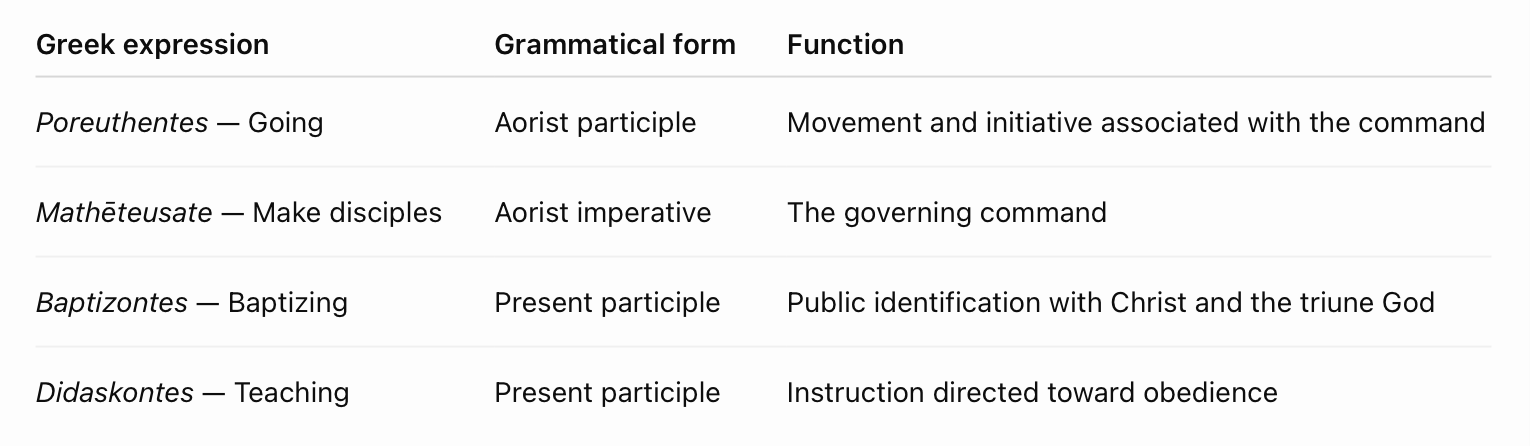
The structure establishes the priority of the command to make disciples.
The participles clarify how that command is carried out.
Evangelism brings the message of Christ to unbelievers.
Baptism identifies believers publicly with Christ.
Teaching cultivates understanding and obedience.
These activities are distinct, but they belong together.
Why separating them creates problems
When evangelism is separated from discipleship, the church may emphasize initial decisions without cultivating spiritual maturity.
When baptism is separated from continuing instruction, an important expression of Christian identification may become an isolated ceremony.
When teaching is separated from obedience, biblical education may become primarily intellectual.
When discipleship is separated from evangelism, churches may focus exclusively upon existing members while neglecting the responsibility to reach others.
The Great Commission resists all of these reductions.
It presents one comprehensive mission: making disciples of Jesus Christ.
IX. Acts 1:8: The Holy Spirit Empowers the Church's Mission
Jesus declares:
“But you shall receive power when the Holy Spirit has come upon you; and you shall be witnesses to Me.” (Acts 1:8 NKJV)
This passage complements Matthew 28:18–20.
Matthew emphasizes the authority of the risen Christ and the command to make disciples.
Acts emphasizes the empowering presence of the Holy Spirit and the expanding geographical scope of Christian witness.
The relationship between witnessing and disciple-making
Witnessing involves proclaiming the truth concerning Jesus Christ, particularly His death and resurrection.
Disciple-making includes that proclamation but extends into the continuing formation of believers.
The two responsibilities cannot be separated without diminishing the mission.
A person cannot become a disciple without encountering the message of Christ.
Likewise, the church must not assume that its responsibility ends when the gospel has been proclaimed.
The role of the Holy Spirit
The commission is not fulfilled through human persuasion alone.
The Holy Spirit empowers believers to bear witness and participate in the work of God.
This does not eliminate the need for preparation, biblical understanding, or intentional ministry.
Rather, it establishes the church's dependence upon God.
Disciple-making is a spiritual responsibility carried out through human participation under divine authority and power.
X. Acts 2:41–47: The Great Commission Practiced in the Early Church
Acts 2 provides one of the clearest examples of the Great Commission being implemented.
Peter proclaims the gospel.
Those who receive the message are baptized.
The new believers are incorporated into the community of faith.
They continue in the apostles' teaching, fellowship, the breaking of bread, and prayer.
Evangelism led to conversion
Acts 2:41 records approximately three thousand people responding to Peter's message.
The proclamation of the gospel was essential.
The early church did not attempt to make disciples apart from announcing Jesus Christ.
Baptism marked public identification
Those who received the message were baptized.
Their response involved public identification with Christ and the community of believers.
Instruction continued after baptism
Acts 2:42 states:
“And they continued steadfastly in the apostles' doctrine and fellowship, in the breaking of bread, and in prayers.” (Acts 2:42 NKJV)
The phrase “continued steadfastly” is significant.
The new believers were not simply counted and then left to develop independently.
They participated in the continuing life of the church.
Wilkins connects these practices directly with the commission to baptize and teach disciples.⁵
Discipleship involved community
The passage also describes generosity, worship, shared meals, and concern for one another.
The early church was not merely a gathering of individuals attending religious lectures.
It was a community in which believers learned to live together under the authority of Christ.
This provides an important model for contemporary congregations.
Discipleship requires both instruction and relationships in which biblical teaching can be practiced.
XI. Acts 14:21–23: A Particularly Clear Example of Making Disciples
Acts 14:21–23 is especially important because Luke uses the same Greek verb found in Matthew 28:19.
After Paul and Barnabas proclaimed the gospel in Derbe, Luke records that they made many disciples.
The Greek verb is mathēteusantes (μαθητεύσαντες), an aorist participle from mathēteuō.
This verbal connection provides substantial evidence that the apostles understood their missionary activity in terms of Jesus' commission.
First, they preached the gospel
Paul and Barnabas proclaimed the good news.
Disciple-making began with the message of Christ.
Second, they made disciples
Luke explicitly states that their ministry resulted in disciples.
This demonstrates that the command of Matthew 28 was being carried out.
Third, they strengthened the disciples
Paul and Barnabas returned to the cities where believers had been established.
They strengthened the disciples and encouraged them to continue in the faith.
This is a crucial observation.
Their ministry did not end when converts were made.
They returned to encourage perseverance and spiritual stability.
Wilkins identifies Acts 14:21–23 as an important illustration of the relationship between making disciples and continuing to strengthen believers.⁶
Fourth, they appointed elders
Acts 14:23 describes the appointment of elders in the churches.
This demonstrates the relationship between disciple-making and the establishment of organized local congregations.
The apostles recognized that believers required continuing spiritual care and leadership.
The significance for contemporary ministry
The pattern in Acts 14 is instructive:
Proclaim the gospel, make disciples, strengthen believers, and establish local churches with responsible spiritual leadership.
This does not establish an inflexible administrative procedure that every congregation must reproduce identically.
Nevertheless, it reveals the comprehensive character of apostolic ministry.
The apostles did not regard conversion as the completion of their responsibility.
They were concerned with the continuing faithfulness and spiritual maturity of the disciples.
XII. Ephesians 4:11–16: The Responsibility of Pastors and Elders
Ephesians 4 provides an essential explanation of how church leadership contributes to discipleship.
Paul identifies various ministry roles given for the equipping of the saints and the building up of the body of Christ.
Leaders are called to equip believers
Ephesians 4:12 identifies the purpose of ministry leadership as equipping the saints for the work of ministry.
The Greek noun katartismos (καταρτισμός) concerns equipping or preparation.
The emphasis is not upon leaders performing all ministry while the congregation remains passive.
Rather, leaders prepare believers to serve.
This is directly relevant to the Great Commission.
Pastors and elders are not merely responsible for delivering sermons or managing church operations.
They must help believers grow into capable followers of Christ who participate in the life and mission of the church.
The goal is spiritual maturity
Ephesians 4:13 identifies maturity in Christ as the objective.
Paul does not present numerical growth, institutional prestige, or organizational expansion as the ultimate measure.
The goal is a spiritually mature body of believers.
Verse 15 describes growth into Christ, who is the head of the church.
This places discipleship within the larger purpose of spiritual transformation.
Pastors must be examples
First Peter 5:2–3 instructs elders to shepherd God's flock willingly and serve as examples.
Pastoral ministry therefore involves both instruction and personal example.
A pastor who preaches discipleship but does not personally cultivate relationships, demonstrate obedience, or equip others for ministry risks contradicting the purpose of the office.
The responsibility cannot be delegated entirely
A pastor may appoint ministry leaders, teachers, and mentors.
Delegation is often necessary and appropriate.
However, pastors and elders remain responsible for the spiritual oversight of the congregation.
They should therefore evaluate whether the church's ministries are actually helping believers become mature followers of Jesus.
The responsibility to equip disciples cannot be satisfied merely by creating a department labeled “Discipleship.”
XIII. Second Timothy 2:2: Disciples Who Help Form Other Disciples
Paul instructs Timothy:
“And the things that you have heard from me among many witnesses, commit these to faithful men who will be able to teach others also.” (2 Tim. 2:2 NKJV)
This passage describes the continuing transmission of apostolic teaching.
Paul instructs Timothy to entrust what he has learned to reliable individuals who can teach others.
The pattern of spiritual multiplication
The passage identifies several relationships.
Paul instructed Timothy.
Timothy was to instruct faithful people.
Those individuals were to teach others.
The objective was the continuing transmission of sound doctrine and faithful ministry.
Disciple-making requires intentionality
This process does not occur automatically.
Timothy was instructed to identify trustworthy individuals and invest in their preparation.
The passage therefore supports intentional teaching and mentoring relationships.
However, its immediate context concerns the preservation and transmission of apostolic teaching, particularly through reliable teachers.
It should not be treated as proof that every Christian must reproduce an identical formal mentoring structure.
The broader New Testament establishes that believers have different gifts and responsibilities.
Nevertheless, all Christians can contribute to the growth of others through encouragement, instruction, service, and faithful example.
Spiritual multiplication is more than numerical multiplication
The objective is not merely to increase the number of teachers.
It is to preserve faithful doctrine and cultivate people capable of instructing others.
A church that produces numerous leaders without attending to their character and doctrinal faithfulness has not necessarily accomplished biblical discipleship.
The quality of spiritual formation matters.
XIV. The Responsibility of Individual Christians
A common misconception is that the Great Commission belongs primarily to pastors, missionaries, evangelists, and professional ministry leaders.
The original command was delivered to the eleven disciples.
However, the commission extends to all nations and is accompanied by Christ's promise of continuing presence until the end of the age.
These features establish its continuing relevance to the church.
The responsibility of individual Christians must therefore be understood within the mission of the whole body.
Every Christian is called to follow Jesus
A person cannot meaningfully participate in making disciples while remaining indifferent toward personal obedience to Christ.
Jesus calls His followers to deny themselves, take up their cross, and follow Him (Luke 9:23).
Discipleship begins with personal allegiance to Jesus.
Every Christian can contribute to the growth of others
Not every believer possesses the gift of teaching.
Not every Christian is called to pastoral ministry.
Nevertheless, all believers are instructed to love, encourage, serve, and build up one another.
Colossians 3:16 describes believers teaching and admonishing one another.
Hebrews 10:24–25 calls Christians to encourage one another toward love and good works.
These responsibilities provide ordinary opportunities for disciple-making.
A mature believer may help a new Christian understand Scripture.
A parent may instruct a child in the faith.
A friend may encourage another believer to persevere through suffering.
A Christian may explain the gospel to a neighbor and continue meeting with that person to study Scripture.
Such activities are not necessarily formal programs.
They are expressions of the shared responsibility to help others follow Christ.
Discipleship must be intentional
One of the contemporary church's difficulties is that many Christians have never been taught to regard the spiritual growth of others as part of their responsibility.
They may faithfully attend church, contribute financially, and participate in worship.
Yet they seldom ask how they might help another person become a more faithful follower of Jesus.
This is not necessarily evidence of deliberate disobedience.
In some cases, believers have simply never received instruction or encouragement concerning personal disciple-making.
Nevertheless, the church must address this deficiency.
The Great Commission cannot become the normal practice of the congregation if individual Christians assume that disciple-making belongs exclusively to paid ministry staff.
XV. The Responsibility of the Local Congregation
The local church has a corporate responsibility to organize its life around the mission Christ has established.
This does not require every congregation to adopt the same ministry structure.
It does require the church to evaluate its priorities.
Evangelism must lead toward discipleship
Evangelistic outreach is essential.
However, the church should consider what happens after someone responds to the gospel.
Are new believers taught the foundational doctrines of the faith?
Are they encouraged toward baptism?
Are they welcomed into meaningful fellowship?
Do they receive instruction concerning Christian obedience?
Are mature believers available to encourage and assist them?
A church that celebrates conversions but neglects these responsibilities has not fully addressed the commission.
Baptism must be connected to church life
Baptism should not function merely as an isolated religious event.
The early church connected baptism with participation in the believing community.
Local congregations should therefore help newly baptized believers understand their identity in Christ and their responsibilities within the church.
Teaching must extend beyond the pulpit
Faithful preaching is indispensable.
Yet the New Testament also describes personal instruction, mutual encouragement, correction, and practical service.
A congregation should therefore cultivate opportunities for believers to discuss Scripture, ask questions, receive guidance, and apply biblical teaching.
These opportunities may occur through small groups, mentoring relationships, classes, ministry teams, and ordinary Christian fellowship.
The method may vary.
The responsibility remains.
Church leadership must evaluate spiritual maturity
Attendance and financial stability can provide useful administrative information.
However, they cannot adequately measure whether disciples are being formed.
Pastors and elders should also consider whether believers are growing in biblical understanding, Christian character, service, fellowship, and witness.
These matters are more difficult to measure numerically.
Nevertheless, they are central to the church's mission.
XVI. Why Is the Contemporary Church Struggling to Make Disciples?
The claim that much of the contemporary church is failing in discipleship is a serious criticism.
It should not be presented as a statistically established conclusion about all churches without adequate empirical evidence.
Nevertheless, Scripture and the supplied academic literature provide a substantial basis for examining recurring weaknesses in contemporary ministry.
1. Discipleship has been reduced to a program
Some congregations treat discipleship as one ministry department among many.
The result can be that believers regard discipleship as optional participation in a particular class or group.
Yet the New Testament presents discipleship as fundamental to Christian identity.
Programs may assist discipleship.
They cannot define or replace it.
2. Evangelism has been separated from spiritual formation
Churches may devote considerable attention to reaching unbelievers while providing inadequate instruction and support after conversion.
This separation is inconsistent with the comprehensive nature of Matthew 28:18–20.
The command is not simply to produce converts.
It is to make disciples.
3. Biblical teaching has been separated from obedience
Some congregations provide substantial biblical information without intentionally helping believers apply it.
The problem is not an excess of Scripture.
The problem is the assumption that hearing biblical teaching necessarily produces spiritual maturity.
Jesus commanded His followers to teach obedience.
The church must therefore help believers connect biblical truth with practical conduct.
4. Church growth has displaced spiritual growth
Numerical growth can be encouraging.
Acts itself records increases in the number of believers.
Nevertheless, institutional expansion does not necessarily demonstrate spiritual maturity.
A church may attract large audiences while leaving many participants spiritually isolated.
The central question is whether the congregation is being formed into a mature body of Christ.
5. Ministry has become overly professionalized
Professional ministry staff can provide valuable leadership.
However, problems arise when the congregation assumes that pastors and paid employees are responsible for virtually all ministry.
Ephesians 4:11–16 presents a different model.
Leaders equip the saints for the work of ministry.
The entire body participates in its growth.
6. Relational discipleship has been neglected
Discipleship requires more than access to sermons and educational materials.
Believers need relationships in which biblical teaching can be demonstrated, discussed, and practiced.
Wilkins emphasizes the importance of personal relationships and mutuality within the community of disciples.⁷
When church participation becomes primarily anonymous attendance, opportunities for such relationships may be limited.
7. Christians have not been equipped to make disciples
Many believers sincerely desire to obey Christ but lack confidence in explaining Scripture, sharing the gospel, or encouraging another person's spiritual development.
The solution is not merely to demand greater participation.
The church must equip its members.
Pastors and mature believers should demonstrate how disciple-making occurs in ordinary Christian relationships.
XVII. Recovering the Great Commission in the Contemporary Church
Recovering biblical disciple-making requires a change in how churches understand their responsibility.
The solution is not necessarily to create more programs.
It is to ensure that the ministries already being conducted serve the purpose Christ established.
A biblical pattern for the local church
The following sequence reflects principles found in Matthew 28 and Acts.
First, proclaim the gospel faithfully.
People must hear the message of Jesus Christ, His death, resurrection, and the call to repentance and faith.
Second, identify believers publicly through baptism.
Baptism expresses identification with Christ and the believing community.
Third, incorporate believers into meaningful Christian fellowship.
New disciples should not be left to pursue spiritual growth in isolation.
Fourth, teach the whole counsel of Scripture.
Instruction should include biblical doctrine, Christian ethics, spiritual practices, and the practical responsibilities of following Christ.
Fifth, cultivate obedience and spiritual maturity.
Teaching should help believers understand how Scripture applies to their lives.
Sixth, equip believers to serve and encourage others.
Disciples should increasingly participate in the ministry of the church.
Seventh, encourage disciples to participate in making other disciples.
The process should not terminate with individual maturity.
Maturing believers should help others grow.
These principles are not a mechanical formula guaranteeing spiritual results.
Spiritual growth remains dependent upon the work of God.
Nevertheless, they provide a biblical framework for evaluating whether a church is taking the Great Commission seriously.
XVIII. How Should a Church Evaluate Its Faithfulness to the Great Commission?
A congregation should regularly examine its ministry through questions grounded in Scripture.
Are unbelievers hearing the gospel clearly?
Are those who profess faith receiving instruction concerning baptism and Christian identity?
Are new believers being welcomed into meaningful relationships?
Are Christians learning to understand and obey Scripture?
Are pastors and elders equipping believers for ministry?
Are mature Christians helping less mature believers grow?
Are members demonstrating increasing love, humility, holiness, and concern for others?
Are believers being prepared to share the gospel and encourage others in the faith?
These questions do not eliminate the value of attendance records, baptism reports, or ministry participation.
They place such information within the larger purpose of making disciples.
A church may be organizationally successful while spiritually unhealthy.
Conversely, a congregation may have limited resources yet faithfully cultivate disciples through biblical teaching, fellowship, service, and mission.
The Great Commission provides a theological standard by which ministry priorities should be evaluated.
XIX. The Promise That Accompanies the Commission
Jesus concludes His message with:
“And lo, I am with you always, even to the end of the age.” (Matt. 28:20 NKJV)
The promise is inseparable from the command.
The risen Christ does not merely assign a difficult responsibility and leave His followers to accomplish it independently.
He promises His continuing presence.
The continuing relevance of the commission
The phrase “to the end of the age” extends beyond the earthly lifetimes of the eleven disciples.
The mission would continue through succeeding generations of believers.
The church therefore remains responsible for making disciples.
Christ's presence is the foundation of confidence
Disciple-making can be difficult.
Some reject the gospel.
Others initially respond but fail to persevere.
Believers may struggle with sin, suffering, doubt, and spiritual immaturity.
Pastors may become discouraged when visible results are limited.
Yet the success of Christian ministry does not depend upon human ability alone.
Christ remains present with His people.
The church is responsible for faithful obedience.
God is responsible for the spiritual work that human effort cannot accomplish.
This distinction should produce both humility and perseverance.
XX. Theological Conclusion: The Church Must Return to the Command to Make Disciples
Matthew 28:18–20 establishes one of the clearest statements of the mission entrusted to the church.
Jesus begins by declaring His universal authority.
On that foundation, He commands His followers to make disciples of all nations.
The Greek imperative mathēteusate establishes the central objective.
The accompanying participles describe activities associated with fulfilling that command.
Going expresses the outward movement of the mission.
Baptizing identifies believers publicly with Christ and the triune God.
Teaching communicates the commands of Jesus with the explicit purpose of cultivating obedience.
These activities belong together.
The Great Commission cannot be reduced to evangelism alone.
Nor can it be fulfilled merely through baptismal ceremonies, educational programs, or church attendance.
The objective is the formation of followers of Jesus Christ.
The book of Acts demonstrates how the apostles understood this responsibility.
They proclaimed the gospel, made disciples, baptized believers, established congregations, strengthened Christians, and appointed spiritual leaders.
Their ministry was concerned not only with conversion but also with perseverance and spiritual maturity.
The Epistles further explain how this work continues within the local church.
Pastors and elders equip believers for ministry.
Mature Christians teach and encourage others.
The congregation grows as its members exercise their gifts and responsibilities under the headship of Christ.
These passages challenge the contemporary church to reconsider its priorities.
A congregation may possess excellent facilities, effective communication strategies, sophisticated technology, and substantial financial resources.
It may attract large crowds and offer numerous programs.
Yet if its members are not being taught to follow and obey Jesus Christ, an essential part of its mission is being neglected.
Likewise, individual Christians cannot regard the Great Commission as exclusively the responsibility of professional ministers.
Every believer is called to follow Christ.
Every Christian belongs to the community of disciples.
And every believer can contribute, according to personal gifts and opportunities, to the spiritual growth of others.
This does not mean that all Christians must become pastors, missionaries, or formal teachers.
It means that disciple-making should become a normal concern of Christian life.
The responsibility of pastors and elders is particularly significant.
They must not merely preach about discipleship.
They must equip the congregation to practice it.
They must cultivate a church environment in which biblical instruction, personal relationships, spiritual accountability, service, and evangelism work together toward the formation of mature followers of Christ.
The church's mission is not simply to increase the number of people who identify as Christians.
It is to make disciples.
The Great Commission is not fulfilled merely when someone hears the gospel, professes faith, or is baptized. Those events are essential beginnings, but the commission also requires the continuing work of teaching believers to obey everything Jesus commanded.
The contemporary church must therefore recover disciple-making as a defining responsibility rather than treating it as one ministry option among many.
Jesus did not command His followers simply to build larger congregations.
He commanded them to make disciples.
And He promised to remain with them as they obey.
Scripture Passages Examined
The Authority and Commission of Christ: Matthew 16:18; 28:16–20; Daniel 7:13–14.
The Calling and Identity of Disciples: Matthew 4:18–22; 9:9; 10:1–15; 16:24–26; Luke 9:23; John 8:31; 13:34–35; 15:1–8.
The Mission and Power of the Holy Spirit: Luke 24:44–49; John 20:21; Acts 1:8; 4:31; 13:1–4.
Evangelism and Baptism: Acts 2:37–41; 8:12; 10:44–48; Romans 6:3–4.
The Early Church and Disciple-Making: Acts 2:41–47; 6:1–7; 9:26–28; 11:19–26; 14:21–23; 18:24–28; 20:17–35.
The Equipping and Maturity of Believers: Romans 12:3–8; 1 Corinthians 12:4–27; Ephesians 4:11–16; Colossians 1:28–29; 3:16; Hebrews 5:12–14.
Teaching, Mentoring, and Faithful Example: 1 Corinthians 11:1; 1 Timothy 4:12–16; 2 Timothy 2:1–2; 3:14–17; Titus 1:5–9; 1 Peter 5:1–4.
Christian Obedience and Spiritual Formation: Matthew 5–7; John 14:15; Romans 12:1–2; Galatians 5:16–26; James 1:22–25.
Questions for Reflection
Why is it important to recognize that “make disciples” is the governing imperative of Matthew 28:19?
How do the participles “going,” “baptizing,” and “teaching” contribute to the fulfillment of the command?
What is the difference between making a convert and making a disciple?
Why does the Great Commission require teaching obedience rather than simply communicating biblical information?
How does Jesus' declaration of universal authority establish the church's responsibility?
What does the command to make disciples of all nations reveal about the scope of the church's mission?
Why should baptism be connected with continuing instruction and Christian fellowship?
How does Acts 2:41–47 demonstrate the relationship between evangelism, baptism, teaching, and community?
What does Acts 14:21–23 reveal about the apostles' concern for the continuing growth of new believers?
Why is the appointment of elders significant in the development of disciple-making congregations?
How does Ephesians 4:11–16 describe the responsibility of pastors and other church leaders?
Why should church leaders equip believers for ministry rather than assume responsibility for performing all ministry themselves?
What does 2 Timothy 2:2 teach about the continuing transmission of biblical instruction?
How can individual Christians participate in disciple-making without holding a formal ministry position?
What are the dangers of measuring church success primarily through attendance, financial resources, or the number of professions of faith?
How can a congregation determine whether its biblical teaching is producing practical obedience?
What obstacles prevent contemporary Christians from intentionally helping others grow spiritually?
How can small groups, mentoring relationships, and ordinary Christian fellowship contribute to disciple-making?
What changes might be necessary if a church evaluated every ministry according to its contribution to making disciples?
How should Christ's promise of His continuing presence influence the church's confidence and perseverance in fulfilling the Great Commission?
References
Daniel F. Goepfrich, “Biblical Discipleship Explained and Illustrated by the Apostles: A Practical Approach,” Journal of Dispensational Theology 24, no. 68 (2020): 74–75. Goepfrich emphasizes the relationship between the imperative “make disciples” and the participles “baptizing” and “teaching.”
Michael J. Wilkins, Following the Master: Discipleship in the Steps of Jesus (Grand Rapids, MI: Zondervan, 2010), chap. 13, “Acts: The Community of Faith.” Wilkins identifies the early church as a community of disciples and challenges the assumption that discipleship belongs only to unusually committed Christians.
Wilkins, Following the Master, discussion of the biblical identity of disciples and the continuing process of growth in Christlikeness.
Jonathan K. Dodson, discussion of the Great Commission in the supplied discipleship research compilation, citing Roy Ciampa, “As You Go, Make Disciples?” Gordon-Conwell Theological Seminary, August 18, 2008. The discussion rejects reducing the going participle to merely incidental activity.
Wilkins, Following the Master, chap. 13, discussion of Acts 2:41–42 and the relationship between baptism, apostolic teaching, and the formation of the Christian community.
Wilkins, Following the Master, chap. 13, discussion of Acts 14:21–23 and the relationship between evangelism, making disciples, and strengthening believers.
Wilkins, Following the Master, chap. 13, discussion of community, mutuality, and personal relationships in discipleship.
A. B. Bruce, “The Synoptic Gospels,” in The Expositor's Greek Testament, ed. W. Robertson Nicoll, vol. 1 (Grand Rapids, MI: Eerdmans, 1974 reprint), 340. Cites Bruce regarding the continuing character of Christian instruction following baptism.
Robert E. Coleman, The Master Plan of Evangelism (Old Tappan, NJ: Fleming H. Revell, 1963), 108. Cited concerning the relationship between disciple-making, evangelism, and teaching.
George W. Peters, A Biblical Theology of Missions (Chicago: Moody Press, 1972), 182–83. Cited in the supplied research compilation concerning the missionary and instructional dimensions of the Great Commission.
Gene Heacock, “Moving toward the Kingdom and the Seven Deadly D's,” Ashland Theological Journal 39 (2007): 83–84. The supplied research compilation uses Heacock's discussion to critique approaches to church ministry that displace intentional discipleship.
Walter Bauer, A Greek-English Lexicon of the New Testament and Other Early Christian Literature, 3rd ed., rev. and ed. Frederick W. Danker (Chicago: University of Chicago Press, 2000), 609. Cited by Goepfrich concerning the meaning of mathētēs.